Elwha River Dam Removal and Ecosystem Restoration
The restoration of the Elwha River represents one of the most ambitious ecological projects in modern history. Driven by the Elwha River Ecosystem and Fisheries Restoration Act of 1992, the project sought to reverse decades of environmental degradation by removing two major obstructions to the river's natural flow. While alternatives like fish ladders were considered, they were ultimately rejected in favor of complete dam removal to restore the river to a nearly pristine state.
The Challenge of Sediment Management
The primary obstacle to the removal process was the massive accumulation of sediment trapped behind the dams. Approximately 34 million cubic yards of sediment had built up over time, with 28 million cubic yards located behind the Glines Canyon Dam and 6 million cubic yards behind the Elwha Dam. Releasing this volume of material instantaneously would have caused devastating damage to downstream habitats and coastal beaches.
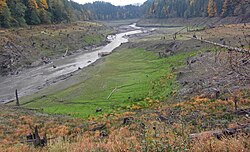
To mitigate this risk, engineers conducted a drawdown experiment on the Glines Canyon Dam. By lowering the lake level by 18 feet (5.5 m) over one week and holding it stable for another, researchers observed that the river rapidly cut a deep, narrow channel into the existing delta. This experiment led to a sediment erosion model suggesting that a gradual drawdown over two years would significantly decrease the sediment load released downstream, allowing much of the material to remain in the old lake basin.
Ecological Recovery and Habitat Reclamation
The removal process was designed to trigger a natural recovery of the river's morphology—the physical shape and structure of the stream. Once the dams were gone, sediment discharge rates were expected to increase, rejuvenating downstream habitats and helping to restore the retreating delta at the mouth of the Elwha.
Beyond the aquatic benefits, the draining of Lake Mills and Lake Aldwell reclaimed 715 acres (2.9 km2) of terrestrial vegetation. This reclamation provides critical improvements to elk habitats and restores the natural vegetation that was previously submerged.
Timeline of Restoration
The physical removal of the dams was a multi-year operation that began on September 27, 2011, and concluded on August 26, 2014. While some fish populations were anticipated to return to the upper reaches of the river within a year of completion, experts estimate it may take 15 to 20 years for salmon runs to recover to a "pre-dam" condition.
Key Facts
- Total Sediment: 34 million cubic yards (28 million at Glines Canyon; 6 million at Elwha).
- Land Reclaimed: 715 acres (2.9 km2) of terrestrial vegetation habitat.
- Removal Period: September 27, 2011, to August 26, 2014.
- Recovery Window: Initial fish return within 1 year; full recovery of salmon runs in 15–20 years.
- Scientific Significance: One of fewer than 20 dam removal projects accompanied by detailed scientific study.
| Feature | Elwha Dam | Glines Canyon Dam |
|---|---|---|
| Sediment Volume | 6 million cubic yards | 28 million cubic yards |
| Associated Water Body | Lake Aldwell | Lake Mills |
| Removal Status | Completed 2014 | Completed 2014 |
Frequently Asked Questions
Why were fish ladders not used on the Elwha River?
Although proposed as a possibility, fish ladders were ruled out in favor of complete dam removal to ensure a more comprehensive restoration of the river's natural state and fish passage.
How was the risk of downstream sediment flooding managed?
A drawdown experiment led to a model where the lakes were drained gradually over a two-year period. This approach ensured that a significant portion of the sediment remained in the old lake basins rather than being released all at once.
What are the benefits for land animals?
The removal of the dams drained Lake Mills and Lake Aldwell, creating 715 acres of new terrestrial vegetation, which specifically improves habitats for elk.
How long does it take for the ecosystem to fully recover?
While some fish may return within a single year, it is expected to take 15 to 20 years or more for salmon runs to return to pre-dam conditions.
Why is this project scientifically important?
Because fewer than 20 dam removal projects have been paired with rigorous scientific study, the Elwha project serves as a global model for the effectiveness of large-scale dam removal on river morphology and ecology.