Electoral Reform Proposals in the United States
The American electoral system is the subject of ongoing debate, with various advocates proposing changes to increase fairness, transparency, and representation. While some reforms can be implemented through standard legislation, others would require formal amendments to the U.S. Constitution. These proposals range from fundamental changes in how campaigns are funded to entirely new methods of casting and counting ballots.
Key Facts
- Campaign Finance: Proposals include "democracy vouchers" and the overturning of the Citizens United v. FEC decision.
- Presidential Elections: Efforts to abolish the Electoral College include the National Popular Vote Interstate Compact.
- Voting Methods: Alternatives to plurality voting include approval voting and ranked-choice voting (IRV).
- District Mapping: Legislation like the For the People Act aims to end gerrymandering (the manipulation of district boundaries for political gain).
- Voter Access: Early voting and mail-in ballots saw a significant increase in use, with 69% of votes cast before Election Day in 2020.
Campaign Finance Reform
A central pillar of electoral reform is the effort to reduce the influence of private money in politics. One proposed solution, suggested by scholars Lawrence Lessig and Bruce Ackerman, is the use of democracy vouchers. Under this system, eligible voters would receive a fixed amount (e.g., $100 per election year) to spend exclusively on political candidates or issues, shifting the power of funding from wealthy donors to individual citizens.
Some local governments have already implemented similar models. New York City, for example, provides a 5-to-1 match for contributions up to $250, provided candidates adhere to specific fundraising limits.
Overturning Citizens United
The 2010 Supreme Court decision in Citizens United v. FEC established that money is a form of speech protected by the First Amendment. This has led to widespread calls for a constitutional amendment to overturn the ruling. Organizations such as Move to Amend and the United for the People consortium have organized thousands of signatures and numerous local resolutions to challenge this precedent. Conversely, the Cato Institute argues that such amendments could grant Congress unchecked power over political speech.
Transparency and Disclosure
To increase accountability, the DISCLOSE Act proposes requiring the disclosure of campaign fund sources and prohibiting foreign influence and government contractor expenditures in federal elections. In California, the California Clean Money Campaign has pushed for a version of the act that would require political ads to identify their top three contributors by name.
An alternative to full disclosure is the "secret donation booth" proposed by Ackerman and Ayres. This system would use a government agency to anonymize contributions through random time delays, ensuring recipients cannot identify their donors.
Structural Changes to Governance
Beyond funding, reformers suggest changing how high-level officials are selected to reduce polarization.
Supreme Court Reform
To address the partisan nature of Senate confirmations, some propose implementing term limits or elections for Supreme Court justices. One proposal suggests a single 8 to 10-year term to reduce the justices' reliance on campaign donors, mirroring the selection process used in 33 U.S. states for their state supreme courts.
Abolishing the Electoral College
The Electoral College currently awards most states' electoral votes to the plurality winner. This often leads campaigns to focus exclusively on swing states (battleground states), leaving voters in non-swing states with less influence. While abolishing the system requires a constitutional amendment, the National Popular Vote Interstate Compact seeks to bypass this by having states agree to award their electoral votes to the winner of the national popular vote. This compact takes effect once approved by states totaling 270 electoral votes.
Alternative Voting Systems
Many advocates argue that the "winner-take-all" plurality system fails to represent the will of the majority.
Approval Voting
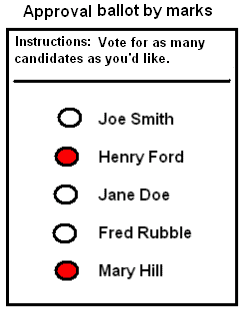
In approval voting, voters can select every candidate they find acceptable. The candidate with the most approvals wins. This method was first adopted by a U.S. city in Fargo, North Dakota, for its 2020 local elections. St. Louis also used a variant called a unified primary in 2020, which resulted in the election of Tishaura Jones as the city's first African-American woman mayor.
Ranked-Choice Voting (RCV)
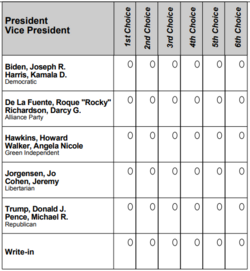
Ranked-choice voting allows voters to rank candidates by preference. A common version is instant-runoff voting (IRV), where the candidate with the fewest votes is eliminated, and their supporters' votes are redistributed to their next choice. This system is currently used in Maine and Alaska.
Proportional Representation
The Fair Representation Act proposes using Single Transferable Vote (STV) and multi-member districts for the House of Representatives to ensure seats are allocated in proportion to the vote share. However, the Uniform Congressional District Act of 1967 currently makes multi-member districts illegal for states with more than one representative.
![On top is an estimate by Fairvote of party results in US House races in California under the Fair Representation Act.[35] Below is an example of a party-list system that more directly elects candidates in proportion to their vote share. How many seats would go to new parties is a matter of debate among American political scientists.](/images/80/9f/809f04aa4dc7ea528ecd7c74a0da77d2385325261250d65677411bdad9a5e47e.png)
Voter Access and District Integrity
The physical and legal process of voting is also a target for reform.
Redistricting and Gerrymandering
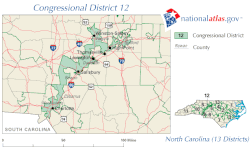
Redistricting is the periodic changing of legislative boundaries. When these boundaries are manipulated to favor a specific party, it is called gerrymandering. The For the People Act and the Open Our Democracy Act are legislative attempts to end this practice.
Turnout and Accessibility
To increase participation, some propose compulsory voting, arguing it would make the electorate more representative of racial and socioeconomic demographics. Others focus on early voting, which includes in-person and mail-in options. According to the Center for Election Innovation & Research, early voting usage rose from 40% in 2016 to 69% in 2020.
Summary of Proposed Reforms
| Category | Proposed Reform | Primary Goal | Implementation Method |
|---|---|---|---|
| Finance | Democracy Vouchers | Reduce private money influence | Legislation |
| Finance | Overturn Citizens United | Limit corporate/wealthy spending | Constitutional Amendment |
| Presidential | National Popular Vote Compact | Tie electoral votes to popular vote | Interstate Agreement |
| Voting Method | Ranked-Choice Voting | Eliminate "spoiler" candidates | Local/State Law |
| Districts | Anti-Gerrymandering Acts | Fairer district boundaries | Federal Legislation |
Frequently Asked Questions
What is the difference between approval voting and ranked-choice voting?
Approval voting allows voters to select all candidates they approve of without ranking them; the candidate with the most total approvals wins. Ranked-choice voting requires voters to list candidates in order of preference, with the least-preferred candidates being eliminated and their votes redistributed until a winner emerges.
How does the National Popular Vote Interstate Compact work?
It is an agreement among states to award all their electoral votes to the candidate who wins the national popular vote, regardless of the popular vote within that specific state. It only takes effect once enough states join to reach 270 electoral votes.
What is gerrymandering and why is it controversial?
Gerrymandering is the practice of manipulating the boundaries of electoral districts to give an unfair advantage to a particular political party or incumbent. It is controversial because it can lead to non-competitive elections and a legislature that does not accurately reflect the voters' preferences.
What are democracy vouchers?
Democracy vouchers are government-provided funds given to eligible voters that can only be spent on political candidates or issues. The goal is to empower small-dollar donors and reduce the reliance of candidates on wealthy private contributors.
Why is the Citizens United decision so significant?
The decision is significant because the Supreme Court ruled that spending money to influence elections is a form of protected speech under the First Amendment, which allowed for a massive increase in independent expenditures by corporations and unions.