El Observador: The Evolution of Venezuela's Pioneering News Program
For nearly six decades, El Observador stood as a cornerstone of Venezuelan journalism. As one of the nation's first television news programs, it mirrored the technological and political shifts of the country, evolving from a corporate-sponsored broadcast into a modern digital news operation. From its inception in the early 1950s to its final broadcast on April 24, 2012, the program defined the standards of news delivery in Venezuela.
The Era of El Observador Creole
The program began as El Observador Creole, Venezuela's first regular news broadcast. It was presented by the Creole Petroleum Corporation, a subsidiary of Standard Oil of New Jersey. The program's early identity was shaped by Francisco Amado Pernía, who anchored the news from Monday to Saturday, while Cristóbal Rodríquez Pantoja handled the Sunday broadcasts.
The talent pool for the show was drawn largely from Radio Caracas (later Radio Caracas Radio), as many of the founders of Radio Caracas Televisión (RCTV) originated there. Notable radio personalities who competed for hosting roles included Amable Espina, Carlos Quintana Negrón, Marco Antonio de Lacavalerie, and Pedro José Fajardo.
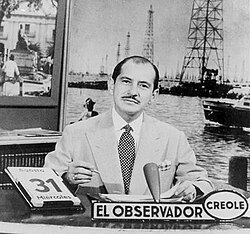
There is a slight historical discrepancy regarding its debut. While some sources cite November 16, 1953—one day after RCTV's inauguration—as the start date, José Luis Sarzalejo, then manager of the telefilm department, asserted that the first newscast actually aired on November 15 at 8:00 pm.
Early Production and Technical Challenges
The scale of production was immense for the era. The team processed 300 national and international stories daily, utilizing 35mm film. On average, the program consumed 240 feet of film per day, translating to approximately seven minutes of airtime. The foundational technical team included:
- Juan Zabala: First Technical Director
- Mario Corro: Video Control Operator
- Alejandro Wessolowski: Coordinator
- Alcides Longa: Cinematographic Editor
- Ramiro Vegas: Cinematographic Coordinator
- Antonio Di Mola: Studio Photographer
In 1971, RCTV shifted its business model to eliminate sole sponsors. Consequently, the Creole Petroleum Corporation moved its sponsorship to Cadena de Venezolana de Televisión (CVTV) on January 3, 1972, remaining there until the nationalization of the oil industry roughly two years later.
Transition to El Observador Venezolano
The departure of the Creole Petroleum Corporation led to a significant transition. The sponsor took both the name "El Observador Creole" and its host, Francisco Amado Pernía, to CVTV. This prompted RCTV to launch a variation called El Observador Venezolano. Eladio Lárez, the current president of RCTV, was selected as the new lead conductor, joined by other presenters such as Guillermo Vilchez, Antonio José Marcano, and Inés Sancho.
By 1975, a strategic shift occurred when Marcel Granier and Information Director Luis García Mora sought to give the newscast the credibility of a major daily newspaper, such as El Nacional. This led to the introduction of the news reporter role, with Marietta Santana and Darcy Alvarado serving as the first reporters in this capacity.

By the early 1980s, the program simplified its branding, becoming known simply as El Observador.
Modernization and the Digital Age
As the program grew, it featured a rotating cast of prominent hosts, including Franklin Villasmil, Tinedo Guia, Unai Amenábar, Alba Cecilia Mujica, Shia Bertoni, Eva Gutierrez, Laura Furcic, Jaime Suarez, Maricarmen Sobrino, Anna Vaccarella, María Teresa Weissacher, and Kristina Wetter.
The program embraced technology early, launching its official website in 1996 and implementing a computerized editing system in 1998 to increase production efficiency and resource management.
The Centro Nacional de Noticias
On July 18, 2005, the program inaugurated its new headquarters: the Centro Nacional de Noticias (National Center for News) in the Quinta Crespo neighborhood of Caracas. This facility served as the hub for three daily editions of El Observador, as well as La Entrevista and other opinion programs.
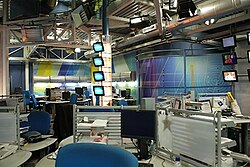
The center represented a massive leap in broadcasting technology, featuring:
- Three modern studios with heat-free lighting systems.
- A press room with 35 workstations and 10 editing booths.
- Six robotic cameras and one wireless camera.
- A server capable of holding 300 hours of video, replacing the traditional VTR (videotape system).
Political Challenges and Final Years
The program's stability was shaken on December 28, 2006, when President Hugo Chávez announced that the government would not renew RCTV's broadcast license upon its expiration in May 2007.
Following the loss of terrestrial television access, El Observador transitioned into a webcast. Newscasts were uploaded to YouTube, venezuelapress.com, and the program's own site, while also airing on Globovisión. During this period, El Observador's YouTube channel became the most subscribed channel on the platform. The program returned to traditional broadcasting on July 16, 2007, via RCTV's new cable and satellite channel, airing three times daily.
The program's history was also marked by tragedy on June 15, 2008, when reporter and part-time anchor Javier García was found murdered in his Bello Monte apartment. He remains the only current El Observador journalist to have been murdered.
Key Facts
- Launch: November 15 or 16, 1953.
- Final Broadcast: April 24, 2012.
- Original Name: El Observador Creole.
- Key Figures: Francisco Amado Pernía (original host), Eladio Lárez (later conductor and RCTV president).
- Technological Milestone: Transitioned from 35mm film to a server-based system replacing VTRs.
- Headquarters: Centro Nacional de Noticias in Quinta Crespo, Caracas.
| Era/Phase | Primary Name | Key Characteristic | Primary Platform |
|---|---|---|---|
| 1953 – 1972 | El Observador Creole | Sponsored by Creole Petroleum Corp | Terrestrial TV |
| 1972 – 1980s | El Observador Venezolano | Introduction of news reporters | Terrestrial TV |
| 1980s – 2007 | El Observador | Modernization and CNC headquarters | Terrestrial TV |
| 2007 – 2012 | El Observador | Digital transition and cable relaunch | Web/Cable/Satellite |
Frequently Asked Questions
When did El Observador first air?
There are two conflicting accounts: some sources state November 16, 1953, while former manager José Luis Sarzalejo claimed it first aired on November 15, 1953, at 8:00 pm.
Who was the first host of the program?
The first regular host was Francisco Amado Pernía, who presented the news from Monday to Saturday, while Cristóbal Rodríquez Pantoja handled Sundays.
What was the Centro Nacional de Noticias?
Inaugurated in 2005 in Quinta Crespo, Caracas, it was the high-tech headquarters for El Observador, featuring robotic cameras, a server-based video system, and multiple editing booths.
How did the program survive the loss of its broadcast license?
After the government refused to renew RCTV's license in 2007, El Observador became a webcast on YouTube and its own website, and later returned to the air via a cable and satellite channel.
What was the significance of the 1975 change in reporting?
Under the proposal of Marcel Granier, the program introduced the role of the news reporter to achieve the credibility of a daily newspaper, with Marietta Santana and Darcy Alvarado as the first reporters.