Eisteddfod: The Legacy of the Welsh Festival of Music and Poetry
In the heart of Welsh culture lies the eisteddfod, a prestigious institution and festival centered on ranked competitions in poetry and music. Derived from the Welsh morphemes eistedd (sit) and fod (be), the term literally translates to "sitting-together." Historically, these gatherings began as competitive meetings between bards and minstrels, where winners were selected by royal or noble patrons.
The first documented eisteddfod took place in 1176 at Cardigan Castle, under the patronage of Prince Rhys ap Gruffudd of the House of Dinefwr. While the tradition later fell into abeyance following the Edwardian Conquest of Wales and the subsequent Anglicisation of the nobility, it experienced a powerful 18th-century revival. This rebirth was initially driven by the London-based Gwyneddigion Society and later shaped by the Gorsedd Cymru, a society of poets and musicians founded by Iolo Morganwg.
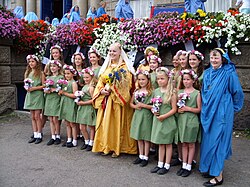
Although Morganwg's rituals and doctrines were largely fictitious blends of Christianity, Druidism, and mysticism, the movement was embraced by both Anglican and nonconformist clergy. This widespread acceptance is credited as a primary reason for the survival of the Welsh language and literature despite centuries of colonialism.
Key Facts
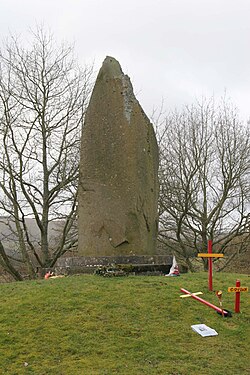
- Origin: First documented in 1176 at Cardigan Castle.
- Meaning: The word eisteddfod means "sitting-together."
- National Eisteddfod: The largest festival of competitive music and poetry in Europe.
- Gorsedd Cymru: An 18th-century invention by Iolo Morganwg that added Druidic pageantry to the festival.
- Global Reach: Traditions have spread to Argentina, Australia, South Africa, and the United States.
The Evolution of the Modern Eisteddfod
The 19th Century and the Gorsedd
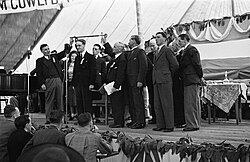
The mid-1800s saw the institutionalization of the festival. In 1858, John Williams (known by the bardic name Ab Ithel) organized a national eisteddfod in Llangollen. This event was notable for promoting themes inspired by Iolo Morganwg, such as the theory that Prince Madoc ab Owain Gwynedd discovered America in the 12th century.
Language Preservation and the 20th Century
The eisteddfod has often mirrored the political and linguistic struggles of Wales. In 1962, following a census that showed a sharp decline in Welsh speakers, Saunders Lewis delivered a radio address titled Tynged yr iaith ("The Fate of the Language"). This prompted the foundation of Cymdeithas yr Iaith Gymraeg (The Welsh Language Society) to fight for the language's survival.
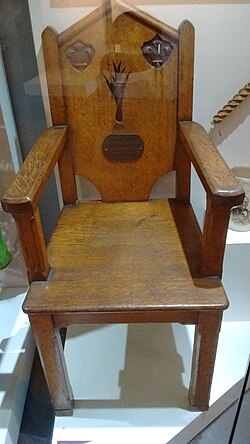
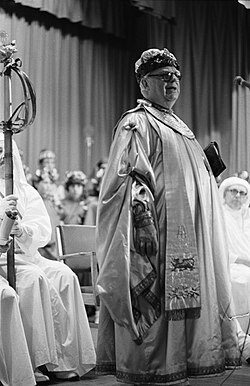
During this era, Reverend Albert Evans-Jones (Cynan) served as Archdruid twice (1950–1954 and 1963–1966). He was the first Archdruid to publicly acknowledge that the Gorsedd was an 18th-century invention rather than an ancient Druidic link, helping to reconcile the movement with academic historians.
The Poetic Renaissance
The late 20th century saw a revival of strict-meter poetry, specifically englynion and cywyddau. This movement was led by Alan Llwyd, who achieved the rare feat of winning both the chair and the crown at the National Eisteddfod in 1973 and again in 1976.
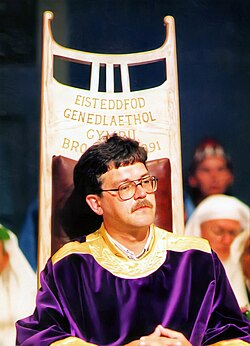
The National Eisteddfod and Global Variations
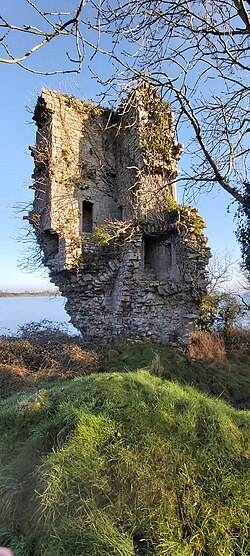
The National Eisteddfod of Wales remains the pinnacle of the tradition. Held annually in the first week of August, the event alternates between north and south Wales. It is conducted entirely in the Welsh language, attracting over 150,000 visitors and 6,000 competitors.

International Influence
The eisteddfod tradition traveled with Welsh emigrants across the globe:
- United States: The Edwardsville Cynonfardd Eisteddfod in Pennsylvania (est. 1889) is the longest-running eisteddfod outside Wales. Other significant events occurred in Ohio, Minnesota, and Illinois, including a massive 1893 event at the World Columbian Exposition in Chicago.
- Argentina: Richard Bryn Williams, a figure from Y Wladfa, won the National Eisteddfod's Bardic Chair twice and later served as Archdruid.
- Australia: The Sydney Eisteddfod, established in 1933, has grown into a massive performing arts event with 30,000 annual performers.
Similar Celtic Traditions
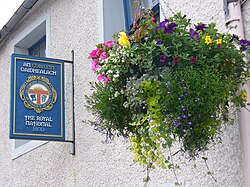
The success of the Welsh model inspired other Celtic nations. In 1891, An Comunn Gàidhealach founded the Royal National Mòd in Scotland to preserve Gaelic music and literature, deliberately modeling it after the National Eisteddfod of Wales.
Summary of Eisteddfod Traditions
| Festival | Primary Language | Key Focus | Notable Characteristic |
|---|---|---|---|
| National Eisteddfod of Wales | Welsh | Poetry & Music | Largest in Europe; entirely in Welsh |
| Royal National Mòd | Scottish Gaelic | Arts & Culture | Modeled after the Welsh Eisteddfod |
| Sydney Eisteddfod | English | Performing Arts | Massive scale (30,000 performers) |
| Edwardsville Cynonfardd | Welsh/English | Literary/Musical | Longest running outside Wales |
Frequently Asked Questions
What does the word "eisteddfod" mean?
The word is derived from the Welsh words eistedd (to sit) and fod (to be), meaning "sitting-together." It refers to a gathering of bards and musicians for competition.
Is the Gorsedd Cymru based on ancient Druids?
No. While it uses Druidic imagery and rituals, the Gorsedd Cymru was created in the 18th century by Iolo Morganwg. This was later acknowledged by Archdruid Albert Evans-Jones.
Where is the National Eisteddfod held?
It is held annually in the first week of August in Wales, with the location typically alternating between the north and south of the country.
How did the eisteddfod help the Welsh language?
By providing a prestigious platform for Welsh-language poetry and music, the revival of the eisteddfod helped preserve the language and culture against centuries of colonial influence.
Are there eisteddfodau outside of Wales?
Yes, Welsh settlers established eisteddfodau in the United States (notably Pennsylvania, Ohio, and Minnesota), Argentina, and Australia.