Economic Inequality: Drivers, Measurements, and Global Impacts
Economic inequality is a broad term used to describe the uneven distribution of financial resources across a population. Rather than a single metric, it encompasses three distinct concepts: income inequality (how money paid to individuals is distributed), wealth inequality (how total owned assets are distributed), and consumption inequality (how total spending is distributed). These disparities can be analyzed between different nations, within a single country, or across specific sub-populations, such as different age groups, genders, or generations.
Measuring these gaps is essential for policymakers and economists to understand the health of a society. The most widely used tool for this is the Gini coefficient, a statistical measure of distribution. Additionally, the Inequality-adjusted Human Development Index (IHDI) provides a more comprehensive view by accounting for inequality within a composite index of human development.
![Global map of countries by high inequality (based on Gini index), 2022, according to the Poverty and Inequality Platform (PIP)[1] <30 30–35 35–40 40–45 45–50 50+](/images/05/95/059518b6ed2793171d2909b2557e70dbc9a096f06a290ca140de94c8ca733c9c.png)
Key Facts
- Income inequality in OECD countries has reached its highest level in 50 years.
- Over the last 25 years, the income ratio between the bottom 10% and top 10% in OECD nations has widened from 1:7 to 1:9.
- Economic inequality is measured through three primary lenses: income, wealth, and consumption.
- The Gini coefficient and the Inequality-adjusted Human Development Index are primary metrics for quantifying these disparities.
- Social connectedness to higher-income individuals is a strong predictor of upward mobility, yet social segregation remains high.
Measuring Economic Disparity
To accurately assess inequality, economists look beyond simple averages. They focus on concepts such as equity, equality of outcome (where everyone receives the same result), and equality of opportunity (where everyone has the same starting point).
![Countries' income inequality according to their most recent reported Gini index values as of 2018[35]](/images/bf/be/bfbebcfc0f24a2671d9819a8313482da284cab333350baa1e5c13b2b294e88da.png)
Beyond the Gini index, the IHDI allows researchers to see how inequality affects actual living standards, such as health and education, rather than just monetary flow.
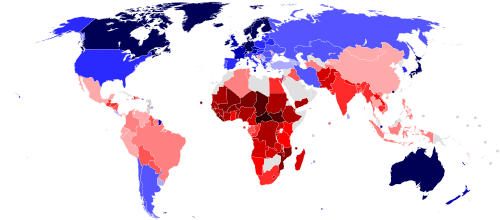
Income and Wealth Distribution
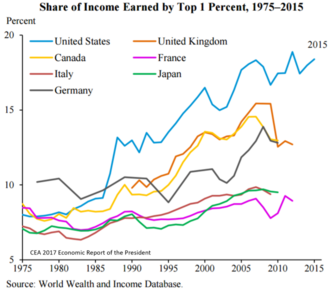
Income refers to the flow of money, while wealth refers to the stock of accumulated assets. In many developed nations, the share of income held by the top 1% has seen significant shifts over the decades.
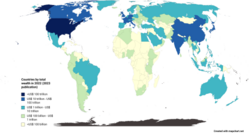
Wealth distribution is often more skewed than income distribution, as assets can be accumulated and passed down through generations, leading to high concentrations of total wealth in a small number of countries and individuals.
Factors Driving Economic Inequality
A variety of systemic and structural factors contribute to the widening gap between the rich and the poor. These range from technological shifts to political decisions.
Labor and Technology
- Automation: The rise of technology and automation can displace low-skilled workers, increasing the premium on high-skilled labor.
- Labor Markets: The decline of labor unions and the rise of deregulation have reduced the bargaining power of workers.
- Globalization: While globalization has shifted income percentiles globally, it has created uneven gains across different income brackets.
!["Elephant curve": Change in real income between 1988 and 2008 at various income percentiles of global income distribution[77]](/images/fd/7f/fd7f656f433fd558b61ba25cb7c0a9f04303fbc454f926a162c0a53bd05fedf9.png)
Systemic and Social Drivers
Demographic factors also play a critical role. The gender gap in median earnings remains a persistent issue, as does inequality based on race and age.
![The gender gap in median earnings of full-time employees according to the OECD 2015[81]](/images/3f/24/3f240bc13786975c2bbbb39fb1631b03fff1b1056297e8ecad728dcd04dd5304.webp)
Other contributing factors include rent seeking (obtaining wealth without creating new wealth), the influence of the finance industry, and the impact of climate change on vulnerable populations.
Societal Effects and Policy Responses
High levels of inequality are often linked to broader societal challenges. Research suggests correlations between economic disparity and increased crime rates, as well as "deaths of despair" linked to economic instability.
![Social connectedness to people of higher income levels is a strong predictor of upward income mobility.[129] However, data show substantial social segregation correlating with economic income groups.[129]](/images/1f/7a/1f7a8b243f91525e9f816ec5fa15f4f3b037bfc8bbd1908bc9cfc7c2b2aba04a.webp)
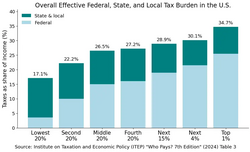
To mitigate these effects, governments often implement fiscal policies. These may include progressive taxation—where higher earners pay a larger percentage of their income—and investments in education to improve equality of opportunity.
Summary of Inequality Concepts
| Type | Definition | Primary Focus |
|---|---|---|
| Income Inequality | Distribution of money paid to people | Annual earnings, wages, and salaries |
| Wealth Inequality | Distribution of owned assets | Property, stocks, and savings |
| Consumption Inequality | Distribution of money spent | Spending patterns and purchasing power |
Frequently Asked Questions
What is the difference between income and wealth inequality?
Income inequality refers to the disparity in the amount of money people receive on a regular basis (like wages), whereas wealth inequality refers to the disparity in the total value of assets people own (like real estate or investments).
What is the Gini coefficient?
The Gini coefficient is a widely used statistical measure that represents the income or wealth distribution of a nation's residents, where 0 represents perfect equality and 1 represents perfect inequality.
How does automation affect economic inequality?
Automation can increase inequality by replacing routine, low-skill jobs with technology, which often benefits the owners of the technology and highly skilled workers while reducing opportunities for others.
What is the Inequality-adjusted Human Development Index (IHDI)?
The IHDI is a composite index that adjusts the standard Human Development Index to account for inequality in health, education, and income, providing a more accurate picture of actual human development.
Can government policy reduce economic inequality?
Yes, governments can use tools such as progressive taxation, social safety nets, and expanded access to quality education to redistribute resources and create more equal opportunities for all citizens.