Drosophila melanogaster: The Powerhouse Model Organism of Genetics
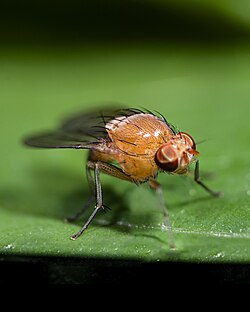
The Drosophila melanogaster, commonly known as the fruit fly, is far more than a household nuisance. For over a century, this small dipteran insect has served as one of the most vital tools in biological research. Its simple genetic makeup, rapid life cycle, and surprising similarity to human biology have made it an indispensable model organism for understanding the fundamental laws of heredity and development.
From the early days of mapping genes to modern studies on neurobiology and immunity, D. melanogaster continues to provide insights that translate directly to human health and disease.
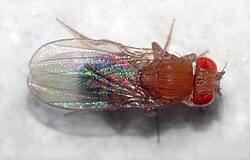
Key Facts
- Genetic Similarity: Approximately 75% of human disease-causing genes have a functional equivalent in the fruit fly genome.
- Genome Structure: The species is diploid with 8 chromosomes.
- Scientific Value: It provided the first successful gene mapping work, supporting the chromosome theory of inheritance.
- Rapid Breeding: Its short generation time allows researchers to observe multiple generations in a short period.
Biological Classification and Appearance
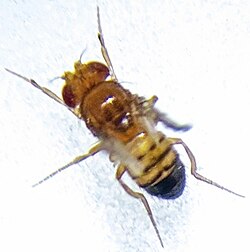
Belonging to the order Diptera and the family Drosophilidae, D. melanogaster is characterized by its small size and distinct physical traits. While often referred to as a "fruit fly," its utility in the lab stems from its predictable morphology and the ease with which mutations can be visually identified.
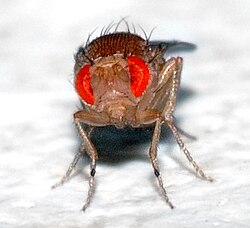
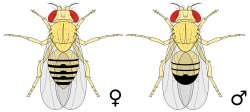
Sexual dimorphism is present in the species, allowing researchers to easily distinguish between females and males based on size and pigmentation.
Lifecycle and Reproduction
The lifecycle of the fruit fly is a rapid progression from egg to adult, making it ideal for studying developmental biology. The process begins with the egg, followed by larval stages and pupation before the adult fly emerges.
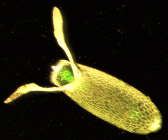
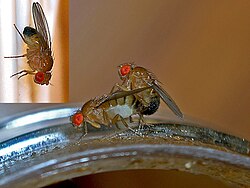
Reproduction is characterized by polygamy, and mating behaviors are complex, involving specific courtship rituals that are frequently studied in neurobiology labs.
The Gold Standard for Genetic Analysis
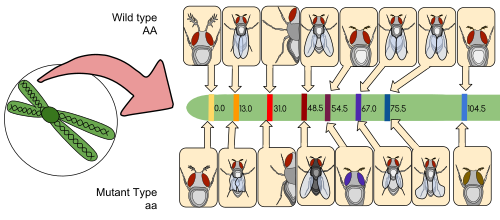
The use of D. melanogaster in genetics dates back to the early 20th century. One of the most significant milestones was Alfred Sturtevant's creation of the first genetic linkage map, which illustrated the relative positions of alleles on the second chromosome.
Why Use Fruit Flies in the Lab?
Researchers prefer D. melanogaster because it is cost-effective to maintain and produces large offspring numbers. Furthermore, the ability to identify genetic markers—visible traits that indicate the presence of a specific gene—allows for precise tracking of inheritance.
Commonly used markers include:
- Cy (Curly): Wings curve away from the body, often impairing flight.
- e (Ebony): A black body and wings.
- Sb (Stubble): Bristles that are shorter and thicker than the wild type.
- w (White): Eyes that lack pigmentation and appear white.
- y (Yellow): Yellow body and wing pigmentation, similar to albinism.
![D. melanogaster which carries the Cy allele (right), hence showing a characteristic phenotype of curly wings in adult flies[63]](/images/ae/d9/aed94df0a3af822be6a54f5fbd7c28e4ec84f5c43ce009bbf85a915d2c39a041.webp)
Classic Mutations and Phenotypes
By studying mutants, scientists can deduce the function of specific genes. These mutations can affect everything from eye color to wing shape and body pigmentation.
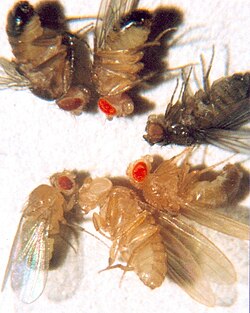
For example, the difference between a wild-type wing and a miniature wing provides clear evidence of how specific genetic changes alter physical development.
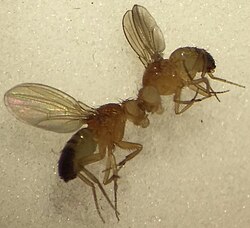
In more complex cases, triple mutants can exhibit multiple simultaneous changes, such as a black body, vestigial wings, and brown eyes.
Development and Sex Determination
Sex determination in D. melanogaster is not based solely on the presence of a Y chromosome, but rather on the ratio of X chromosomes to autosomes (X:A ratio). This mechanism leads to various phenotypic outcomes depending on the chromosomal makeup.
| X Chromosomes | Autosomes | X:A Ratio | Resulting Sex |
|---|---|---|---|
| XX | AA | 1.00 | Normal Female |
| XY | AA | 0.50 | Normal Male |
| X | AA | 0.50 | Normal Male (sterile) |
| XXX | AA | 1.50 | Metafemale |
| XX | AAA | 0.66 | Intersex |
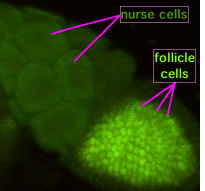
The process of oogenesis (the creation of an egg) is another critical area of study for understanding how genetic information is passed to the next generation.
Advanced Biological Research
Beyond basic genetics, the fruit fly is used to study complex systems that mirror human biology:
Neurobiology and Behavior
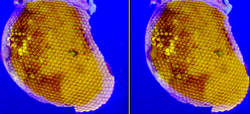
Researchers use D. melanogaster to study circadian rhythms (the internal 24-hour clock), learning, memory, and sensory systems. Their vision and olfaction (sense of smell) are highly developed, allowing for sophisticated behavioral experiments.
Modern technology, such as JARVIS-HybridNet, now allows for high-speed, multi-view recording of moving flies to track body landmarks with extreme precision.
![High-speed, multi-view recording of a freely moving fly. Colored circles represent 50 different body landmarks, tracked with JARVIS-HybridNet.[151]](/images/e8/b0/e8b00d78eb1acf288226726b4b435d91c75948b28a9e7f994472644fcc159382.gif)
Immunity and Health
The study of the JAK-STAT signaling pathway in fruit flies helps scientists understand the cellular response to infection and the process of wound closing. Because of the high percentage of shared disease-causing genes, these findings often have direct implications for human medicine.
Frequently Asked Questions
Why is the fruit fly used instead of mammals in early research?
Fruit flies are used because they have a much shorter lifecycle, are cheaper to maintain, and produce more offspring, allowing researchers to study many generations in a fraction of the time required for mammals.
How similar is a fruit fly's genome to a human's?
While they look very different, approximately 75% of human disease-causing genes have a functional equivalent in the Drosophila melanogaster genome.
What determines the sex of a fruit fly?
Sex is determined by the ratio of X chromosomes to autosomes (X:A ratio), rather than the simple presence or absence of a Y chromosome.
What are genetic markers in Drosophila?
Genetic markers are visible physical traits, such as white eyes or curly wings, that allow scientists to easily identify which genes or mutations a specific fly possesses.