Downtown Seoul: The Historic Heart and Economic Engine of South Korea
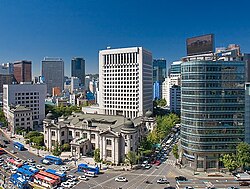
Downtown Seoul, often referred to as the Seoul Central Business District or Sadaemun-An, serves as the historic and administrative core of South Korea's capital. Spanning approximately 17.9 square kilometers, this region is not merely a collection of skyscrapers but a living timeline of the city's evolution from the Joseon Dynasty to a global megacity. While newer hubs like Gangnam and Yeouido have risen in prominence, the downtown area remains the primary seat of political power, cultural heritage, and high-value economic activity.
The area is primarily composed of the Jongno and Jung districts, which together form the most densely concentrated hub of subway stations and corporate headquarters in the city.

Key Facts

- Economic Power: Jung and Jongno districts rank 2nd and 5th respectively in regional GDP among Seoul's 25 autonomous districts.
- High Income: As of April 2023, workers in Jongno District earned the highest average monthly income in South Korea (4.26 million won).
- Political Hub: Home to the Blue House, Seoul City Hall, and the Constitutional Court of Korea.
- Financial Roots: The Bank of Korea is headquartered here in Sogong-dong, maintaining its presence since the colonial era.
- Cultural Density: Contains five major royal palaces and the historic Fortress Wall of Seoul.
Historical Evolution
The identity of Downtown Seoul has shifted through several distinct eras. During the Joseon Dynasty and the subsequent Korean Empire, it was the undisputed center of governance. Under Japanese colonial rule, the local government of Keijō (the colonial name for Seoul) formally designated the area around the current Seoul Plaza as the geographic city center in 1928.

Following liberation and the devastation of the Korean War in the 1950s, the area underwent massive reconstruction. The 1970s and 80s were marked by rapid urban redevelopment and the beginning of decentralization as the city expanded. A landmark of this era is the Daewoo Group headquarters (now Seoul Square), built in 1977, which symbolizes the rapid growth of the South Korean economy.

In the 21st century, the city focused on a "renaissance" of its old soul. A prime example is the restoration of the Cheonggyecheon in 2004, which transformed a paved-over waterway into an eco-friendly linear park that serves as a modern lungs for the dense urban environment.

Political and Social Significance
For decades, Downtown Seoul was the absolute center of executive power. Until the 2010s, when some ministries moved to Sejong City, the area housed the Government Complex Seoul, the Board of Audit and Inspection, and the Blue House. This concentration of power naturally attracted the nation's most prominent law firms and media outlets.
Because of this accessibility to power, the area has historically been the epicenter of South Korean democracy and protest. During the June Struggle of 1987, millions gathered at Seoul Plaza to memorialize Lee Han-yeol, a student whose death became a catalyst for the country's democratization.

Economic and Industrial Landscape
Finance and Law
Downtown Seoul was the nation's sole financial district in its early contemporary history. The Bank of Korea remains seated in Sogong-dong, and Myeong-dong served as the primary financial hub until the early 1990s, even after the Korean Stock Exchange moved to Yeouido in 1979.
The legal industry also saw an early agglomeration here. "Big Law" firms such as Kim & Chang (est. 1973) and Lee & Ko (est. 1977) established their roots in the downtown area to be near the Supreme Court and the Seoul Central District Court. Although many courts moved to the Seocho District in 1995, many top firms have recently returned to the Gwanghwamun area to better facilitate government relations.
Mass Media
The region is the "Mecca" of South Korean print journalism. Major newspapers like The Chosun Ilbo and The Dong-A Ilbo are located along Sejong-daero, and the Yonhap News Agency is situated near Gwanghwamun. A 2020 survey revealed that 18 of the 27 oldest mass media companies in the country are based in Jongno and Jung districts.

Regional Overview
The city's master plan groups autonomous districts into five regions to manage growth and infrastructure. Downtown Seoul remains the most historically significant of these clusters.

| Metric | Jung District | Jongno District |
|---|---|---|
| Regional GDP (2021) | 61.36 Trillion Won | 35.72 Trillion Won |
| GDP Per Capita (2021) | 480 Million Won | 230 Million Won |
| Avg. Worker Income (April 2023) | 4.04 Million Won | 4.26 Million Won |
| Seoul GDP Rank | 2nd | 5th |
Frequently Asked Questions
What is the difference between Downtown Seoul and Gangnam?
Downtown Seoul (Sadaemun-An) is the historic, traditional center focused on government, heritage, and old-money finance. Gangnam is a later development from the 1970s, known for modern residential luxury, fashion, and corporate commerce.
Why are most broadcasting companies not located in Downtown Seoul?
Due to extremely high rent prices in the historic center, newer media companies established in the 1980s settled in Yeouido. More recently, many have moved again to the Digital Media City (DMC) in Mapo District.
Which major landmarks are found in Downtown Seoul?
Key landmarks include the five grand palaces (such as Gyeongbokgung and Changdeokgung), the N Seoul Tower on Namsan, the Cheonggyecheon stream, and the Dongdaemun Design Plaza (DDP).
Is Downtown Seoul still the political center of South Korea?
While some executive ministries have relocated to Sejong City to decentralize power, it remains a critical political hub housing the Seoul City Hall, the Constitutional Court, and various national commissions.