Exploring Dong-gu: The Historic Heart of Central Busan
Located in the central part of Busan, South Korea, Dong-gu (literally meaning "East District") serves as a vital gateway to one of the country's most dynamic metropolitan areas. Established in 1957 as one of the original six districts of Busan, Dong-gu blends deep historical roots with modern significance, acting as a major transportation and cultural hub for the Yeongnam region.
Whether you are a traveler arriving via the massive Busan Station or a resident navigating its unique hilly landscapes, Dong-gu offers a distinct glimpse into the urban fabric of South Korea.
Key Facts
- Location: Central Busan, Yeongnam region, South Korea.
- Total Area: 9.86 km² (3.81 sq mi).
- Population: 86,308 (as of September 2024).
- Major Landmark: Busan Station.
- Local Dialect: Gyeongsang dialect.
- Sister Cities: Gwangsan District (Gwangju, South Korea) and Zhifu District (Yantai City, China).
Geography and Administration
Dong-gu is a compact district covering approximately 9.86 square kilometers. Despite its relatively small size, it plays a massive role in the logistics of Busan due to the presence of Busan Station, a primary railway hub that connects the city to the rest of the country.
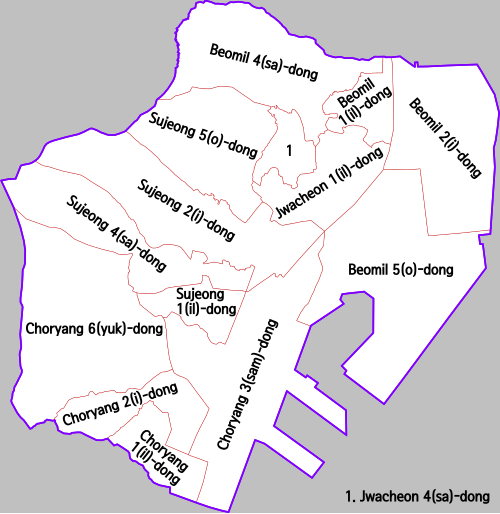
The district is governed by a Mayor, currently Kim Jin-hong, and is represented in the National Assembly by the Busan West and East District constituencies. Administratively, the district is organized into 4 legal dong (neighborhoods), which are further subdivided into 17 administrative dong to manage local services and populations.
Administrative Breakdown
The 17 administrative dong are distributed across four primary legal divisions:
- Choryang-dong: Comprising 5 administrative dong.
- Sujeong-dong: Comprising 5 administrative dong.
- Jwacheon-dong: Comprising 2 administrative dong.
- Beomil-dong: Comprising 5 administrative dong.
Culture, Education, and Tourism
Dong-gu is a melting pot of cultural influences, reflected in its international educational institutions and its global connections. The district maintains sister-city relationships with Gwangsan District in Gwangju and Zhifu District in Yantai, China.
International Education
The district hosts several specialized educational institutions that cater to diverse communities, including:
- Overseas Chinese High School, Busan
- Chinese Korea Busan School (providing kindergarten and elementary education)
Local Attractions
For those interested in local charm, Dong-gu is home to the famous 168 stairs. This iconic staircase is lined with souvenir shops and various tourist attractions, offering visitors a unique way to experience the district's hilly terrain and local atmosphere.
District Overview Summary
| Category | Details |
|---|---|
| Hanja Name | 東區 |
| Romanization | Dong-gu (RR); Tong-ku (McCune–Reischauer) |
| Total Area | 9.86 km² |
| Population | 86,308 (Sept 2024) |
| Primary Language/Dialect | Korean (Gyeongsang dialect) |
Frequently Asked Questions
What is the significance of Busan Station to Dong-gu?
Busan Station is a major transportation landmark located within Dong-gu, serving as a primary entry point for travelers arriving in the city via rail.
How is Dong-gu divided administratively?
Dong-gu is divided into 4 legal dong, which are subdivided into a total of 17 administrative dong for local governance.
What are the main tourist attractions in the district?
One of the most famous attractions is the 168 stairs, a scenic route featuring souvenir shops and various points of interest for visitors.
Does Dong-gu have international schools?
Yes, the district includes institutions such as the Overseas Chinese High School, Busan, and the Chinese Korea Busan School.
Which cities are Dong-gu's sister localities?
Dong-gu holds sister-city status with Gwangsan District in Gwangju, South Korea, and Zhifu District in Yantai City, China.