Distinguished Service Cross
The Distinguished Service Cross (DSC) is a prestigious third-level military decoration awarded by the United Kingdom. It is specifically reserved for those who demonstrate exemplary gallantry during active operations against an enemy at sea. While originally restricted to officers, the award has evolved over more than a century to recognize bravery across all ranks of the naval services.
Recipients of this honor are entitled to use the post-nominal letters "DSC" after their name, marking their place among a select group of individuals who have faced extreme danger in maritime combat.
Key Facts
- Purpose: Awarded for gallantry during active operations against the enemy at sea.
- Established: June 15, 1901 (originally as the Conspicuous Service Cross).
- Eligibility: Open to all ranks of the British Armed Forces, Royal Fleet Auxiliary, and British Merchant Navy.
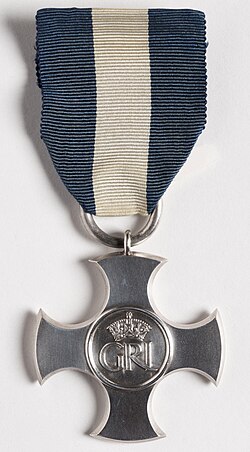
- Physical Design: A plain silver cross with rounded ends, measuring 43 mm in height and width.
- Total Awards: At least 6,658 Crosses and 603 bars issued between 1901 and 2016.
History and Evolution
Origins and Early Years
The decoration was established in 1901 as the Conspicuous Service Cross. At its inception, it was intended for warrant and subordinate officers, including midshipmen, who were ineligible for the Distinguished Service Order. In October 1914, the award was renamed the Distinguished Service Cross, and eligibility was expanded to include all naval officers below the rank of lieutenant commander.
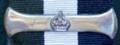
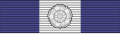
By March 1915, the UK began granting honorary awards to foreign officers of equivalent rank in allied navies. To recognize repeated acts of bravery, "bars" were introduced in August 1916. When the medal is not worn in full, a silver rosette is placed on the ribbon to denote each bar earned.
Expansion During World War II
The scale of global conflict during World War II necessitated several changes to eligibility. In December 1939, the rank ceiling was raised to include Commanders and Lieutenant-Commanders. By April 1940, Royal Air Force officers serving with the Fleet became eligible, followed by Army personnel aboard defensively equipped merchant ships in November 1942.
Modern Reforms
A significant shift occurred during the 1993 review of the honours system. In an effort to remove rank-based distinctions for bravery, the Distinguished Service Medal (previously the third-level award for ratings/non-commissioned sailors) was discontinued. Consequently, the DSC became the universal third-level award for gallantry at sea for all ranks, below the level of the Victoria Cross or the Conspicuous Gallantry Cross.
While Commonwealth nations like Canada, Australia, and New Zealand previously utilized the DSC, most established their own independent honours systems by the 1990s.
Physical Description and Design
The DSC is crafted as a plain silver cross with rounded ends. The obverse (front) features a circular center containing the Royal Cypher of the reigning monarch at the time of the award, topped with a crown. The reverse (back) is plain, featuring only the hallmark, and the ribbon is attached via a hallmarked silver ring.
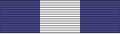
The ribbon consists of three equal stripes of dark blue, white, and dark blue. To denote further awards, a plain silver ribbon bar with convex ends and a central crown is used. Since 1940, the year of issue has been engraved on the lower limb of the cross, and since 1984, the medal has been named specifically to the recipient.
Award Statistics and Notable Recipients
The distribution of the DSC reflects the intensity of the 20th century's major conflicts, with the vast majority of awards occurring during the two World Wars.
| Period | Crosses | 1st Bar | 2nd Bar | 3rd Bar |
|---|---|---|---|---|
| Pre-1914 (1901–1913) | 8 | 0 | 0 | 0 |
| World War I (1914–1920) | 1,983 | 91 | 10 | 0 |
| Interwar (1921–1938) | 7 | 0 | 0 | 0 |
| World War II (1939–1946) | 4,524 | 434 | 44 | 1 |
| Postwar (1947–2016) | 136 | 18 | 5 | 0 |
| Total | 6,658 | 543 | 59 | 1 |
Exceptional Bravery
Norman Eyre Morley holds the unique distinction of being the only person to receive the Distinguished Service Cross four times. Serving in the Royal Naval Reserve during both World Wars, Morley earned his first DSC in 1919 and three more between 1944 and 1945, earning a place in the Guinness Book of Records as the most decorated reserve naval officer.
Other notable recipients include several three-time winners, such as William Richard Ashton and Stephen Philip Robey White, who both served aboard the Q-ship HMS Penshurst during World War I.
Collective Recognition
In a rare instance of a collective award, the DSC was granted to the City of Dunkirk in 1919 to honor the gallantry of its citizens during World War I. The cross is still featured today in the city's coat of arms.
Frequently Asked Questions
Who is currently eligible for the Distinguished Service Cross?
The DSC is currently awarded to all ranks of the British Armed Forces, the Royal Fleet Auxiliary, and the British Merchant Navy for gallantry during active operations against the enemy at sea.
What is the difference between the Cross and a Bar?
The Cross is the initial award. A "Bar" is awarded for subsequent acts of gallantry that would have merited the Cross if the recipient had not already received it.
Can the DSC be awarded posthumously?
Yes, the Distinguished Service Cross has been eligible for posthumous award since 1979.
How does the DSC rank in the order of wear?
In the official order of wear, the DSC sits below the Royal Red Cross (First Class) and above the Military Cross.
Why was the Distinguished Service Medal discontinued?
The Distinguished Service Medal was discontinued in 1993 as part of a broader reform to remove distinctions of rank in bravery awards, merging the roles of the DSM and DSC into a single award for all ranks.