Distinguished Flying Cross
The Distinguished Flying Cross (DFC) is a prestigious third-level military decoration awarded for exemplary gallantry during active operations against the enemy in the air. Established during the early days of military aviation, it recognizes acts of valour, courage, or devotion to duty performed while flying.
Originally reserved for officers, the award has evolved over a century to become an inclusive honour for all ranks of the British Armed Forces. It stands as a symbol of bravery in the skies, positioned in the order of wear below the Military Cross and above the Air Force Cross.
Key Facts
- Established: 3 June 1918.
- Purpose: Awarded for exemplary gallantry in active aerial operations against the enemy.
- Eligibility: All ranks of the British Armed Forces (since 1993); previously limited to officers.
- Total Awards (to 2017): Approximately 22,322 crosses and 1,737 bars.
- Post-nominals: Recipients are entitled to use the letters "DFC".
History and Evolution
The DFC was created shortly after the formation of the Royal Air Force (RAF), with its Royal Warrant published on 5 December 1919. Initially, the decoration was limited to RAF commissioned and warrant officers, as well as officers from Commonwealth and allied forces. Over time, eligibility expanded: Naval Officers of the Fleet Air Arm were included in March 1941, followed by Army officers in November 1942.
A significant shift occurred in 1993 during a review of the honours system aimed at removing rank-based distinctions for bravery. Consequently, the Distinguished Flying Medal—previously reserved for other ranks—was discontinued, and all ranks became eligible for the DFC. The criteria for the award were also refined from "valour, courage or devotion to duty" to "exemplary gallantry".
While Commonwealth nations like Canada, Australia, and New Zealand originally awarded the DFC, most established their own independent honours systems by the 1990s. Today, the DFC is primarily a British award, with honorary versions granted to allied forces. All official awards are announced in the London Gazette.
Design and Description
Designed by Edward Carter Preston, the DFC is a cross flory (a cross with arms ending in petals) measuring 2.125 inches (54.0 mm) wide. The decoration features aeroplane propellers on the vertical arms and wings on the horizontal arms. At the center, a laurel wreath encircles the RAF monogram, topped by a heraldic Imperial Crown.
The reverse of the medal is plain, featuring a central roundel with the reigning monarch's cypher and the date '1918'. While early medals were unnamed, the year of issue was engraved from 1939, and since 1984, medals have been personally named for the recipient.
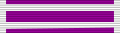
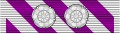
The ribbon is 1.25 inches (32 mm) wide. Between 1918 and 1919, it featured horizontal white and purple stripes; however, since 1919, it has used the current design of diagonal white and purple stripes.
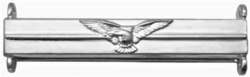
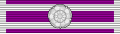
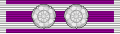
For those who earn the decoration more than once, a silver bar is added to the ribbon. When the ribbon is worn alone, a silver rosette denotes each additional bar awarded.
Award Statistics
The vast majority of DFCs were awarded during the global conflicts of the 20th century, particularly World War II. Between 1980 and 2017, approximately 80 DFCs were awarded for service in the Falklands, the Gulf War, Iraq, and Afghanistan.
| Period | Crosses | 1st Bar | 2nd Bar |
|---|---|---|---|
| World War I (1918–19) | 1,045 | 62 | 3 |
| Inter-War (1919–39) | 165 | 26 | 4 |
| World War II (1939–45) | 20,354 | 1,550 | 42 |
| Post-War (1946–79) | 678 | 42 | 5 |
| Total (1918–79) | 22,242 | 1,680 | 54 |
Notable Recipients
The DFC has been awarded to a diverse array of individuals, including foreign heads of state and pioneering aviators. Notable recipients include:
- King Albert I of Belgium: Awarded for reconnaissance flights during World War I.
- Flight Lieutenant Michelle Jayne Goodman: The first female officer to receive a British combat gallantry medal.
- Squadron Leader Stuart Mitchell: The only tanker pilot to be awarded the DFC, for actions in Bosnia.
- Robert Stanford Tuck: An RAF ace who received the DFC three times.
- Major William Chesarek: A US Marine Corps helicopter pilot awarded for rescuing a British serviceman in 2006.


Frequently Asked Questions
Who is currently eligible for the Distinguished Flying Cross?
Since 1993, all ranks of the British Armed Forces are eligible for the DFC, provided they demonstrate exemplary gallantry while flying in active operations against the enemy.
What is the difference between the DFC and the Distinguished Flying Medal?
Historically, the DFC was awarded to officers and the Distinguished Flying Medal (DFM) was awarded to other ranks. In 1993, the DFM was discontinued, and the DFC became the sole award for all ranks.
How are multiple awards of the DFC recognized?
A recipient who earns a second or third award receives a silver bar to be attached to the ribbon. If the ribbon is worn alone, a silver rosette is used to indicate each bar.
Can the DFC be awarded posthumously?
Yes, posthumous awards for the Distinguished Flying Cross have been permitted since 1979.
What are the post-nominal letters for the DFC?
Recipients of the decoration are entitled to use the post-nominal letters "DFC" after their name.