Diffusion: The Science of Particle Movement and Stochastic Processes
At its most fundamental level, diffusion is the net movement of entities—such as atoms, ions, molecules, or energy—typically from a region of higher concentration to a region of lower concentration. This process is driven by a gradient in chemical potential or Gibbs free energy (the maximum amount of non-expansion work that can be extracted from a closed system). While most diffusion occurs "downhill," certain phenomena like spinodal decomposition allow for "uphill" diffusion, where substances move toward areas of higher concentration.
Because diffusion relies on the inherent randomness of the moving entities, it is classified as a stochastic process. This randomness makes diffusion a powerful mathematical tool used not only in physics and chemistry but also in finance, marketing, information theory, and neural networks to model real-life unpredictable scenarios.
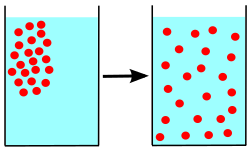
Key Facts
- Driving Force: Primarily driven by concentration gradients and chemical potential.
- Nature: A stochastic (random) process based on the random walk of particles.
- Scope: Occurs in gases, liquids, and solids, as well as in abstract systems like social networks and data science.
- Key Laws: Governed largely by Fick's laws, which relate diffusion flux to concentration gradients.
- Modern Application: Used in AI via diffusion-based generative models to create new data samples.
The Mechanics of Diffusion
Atomistic Perspective and Brownian Motion
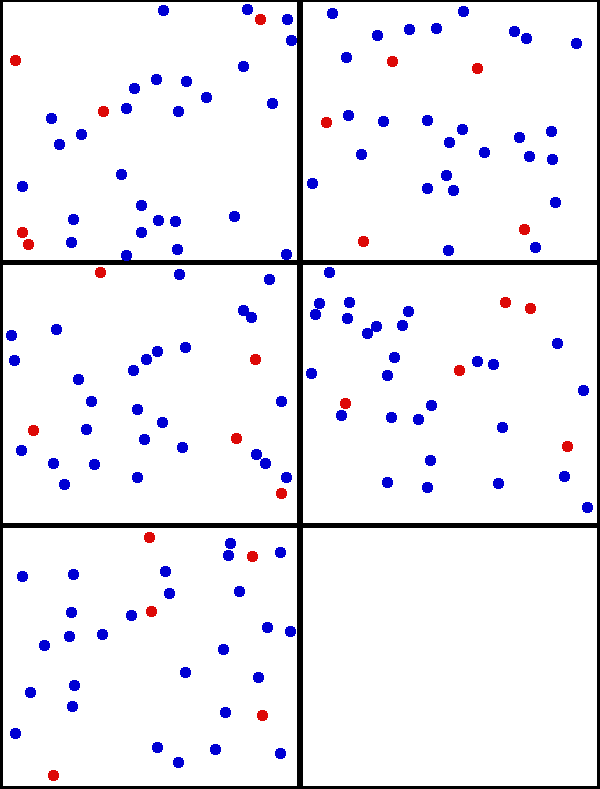
From an atomistic point of view, diffusion is the result of a random walk. In molecular diffusion, particles in a gas, liquid, or solid are self-propelled by their own kinetic energy. This was famously observed in 1827 by Robert Brown, who noticed that small particles suspended in a liquid exhibited a rapid, irregular motion now known as Brownian movement. The theoretical foundation for this motion and the atomistic nature of diffusion was later developed by Albert Einstein.
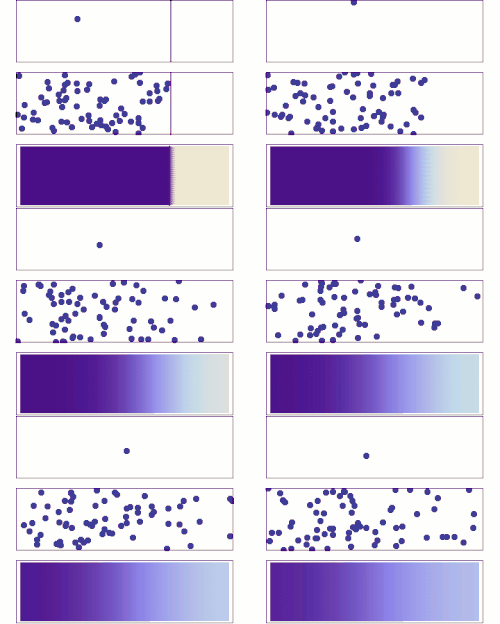
Macroscopic vs. Microscopic Views
While a single molecule moves randomly without a specific destination, the collective behavior of billions of molecules creates a statistical trend. This results in a smooth, deterministic flow from high-concentration areas to low-concentration areas. This apparent force, emerging from randomness, is referred to as an entropic force.
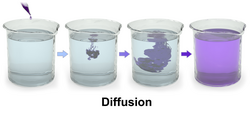
Diffusion Across Disciplines
Physics and Chemistry
In physics, diffusion is studied through various lenses, from the mean free path (the average distance a particle travels between collisions) introduced by Rudolf Clausius, to the Boltzmann equation. In solids, diffusion occurs through local defects such as vacancies or interstitial atoms, a concept elaborated by Yakov Frenkel in 1926.
Biology and Medicine
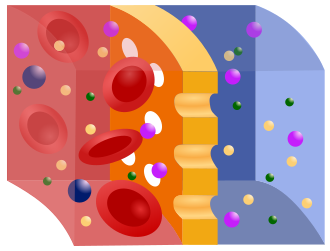
Diffusion is critical for biological survival. A primary example is dialysis, where a semipermeable membrane allows the diffusion of solutes to clean the blood.
Artificial Intelligence
In machine learning, diffusion models (or score-based generative models) use principles from non-equilibrium thermodynamics. These models learn a diffusion process for a dataset to generate new, similar elements by sampling from complex probability distributions.
Mathematical Models of Diffusion
Fick's Laws
Adolf Fick proposed the fundamental laws of diffusion in 1855, drawing analogies to heat conduction (Fourier's law) and electric current (Ohm's law). Fick's First Law states that the diffusion flux is proportional to the negative gradient of spatial concentration. Fick's Second Law predicts how diffusion causes the concentration to change over time.
Diffusion in Specialized Media
- Porous Media: Diffusion is influenced by porosity and advective molar flux, often described by the advection-dispersion equation.
- Membranes: The Teorell formula describes the diffusion of ions through membranes, accounting for both concentration gradients and electrical forces.
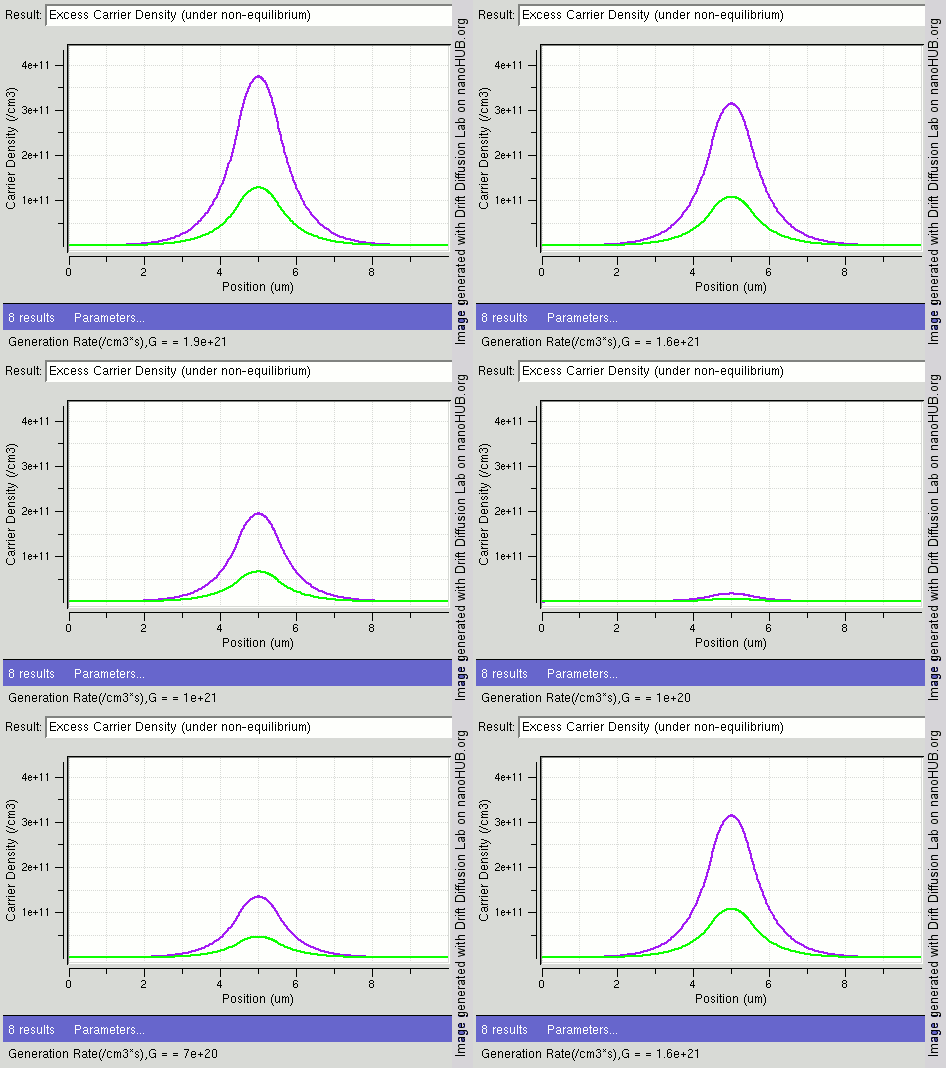
- Semiconductors: Light can generate carriers (electrons and holes) that diffuse toward opposite ends of a semiconductor; electrons typically have a higher diffusion constant than holes.
Surface and Solid State Diffusion
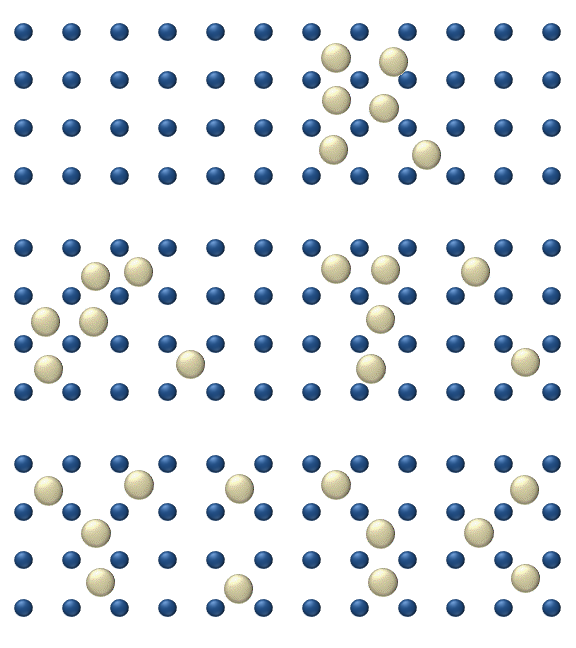
In solids, particles may oscillate near equilibrium positions before making "jumps" to the nearest free space. This jump model is essential for understanding how materials behave at the atomic level.
Summary of Diffusion Types
| Type | Description | Example/Context |
|---|---|---|
| Molecular | Movement from dense to less dense areas | Dye spreading in water |
| Atomic | Movement of atoms within a solid lattice | Zinc penetrating copper |
| Facilitated | Protein-assisted movement across membranes | Biological cell transport |
| Thermodiffusion | Diffusion caused by temperature gradients | Gas mixtures in varying heat |
| Electronic | Movement of electrons creating current | Semiconductor devices |
| Trans-cultural | Spread of cultural traits | Sociology/Geography |
Frequently Asked Questions
What is the difference between diffusion and bulk flow?
Diffusion is the random, stochastic movement of individual particles driven by a concentration gradient. Bulk flow (or advection) is the mass movement of a fluid and its dissolved solutes together, usually driven by a pressure gradient.
Can diffusion happen against a concentration gradient?
Yes. While standard diffusion moves from high to low concentration, "uphill" diffusion can occur in specific processes such as spinodal decomposition, driven by changes in chemical potential.
How does temperature affect the diffusion coefficient in gases?
According to kinetic theory, the diffusion coefficient in gases generally increases as temperature rises and decreases as pressure increases.
What is a random walk in the context of diffusion?
A random walk is a mathematical path consisting of a succession of random steps. In diffusion, it describes the trajectory of a single particle as it collides randomly with others, eventually leading to the overall spreading of the substance.
How are diffusion models used in AI?
Diffusion models in AI learn to reverse a process of adding noise to data. By learning to "denoise" an image or signal, the model can generate entirely new, high-quality data that follows the distribution of the original training set.