Deniz Baykal: A Political Journey Through Turkey's Democratic Evolution
Deniz Baykal stands as one of the most influential and polarizing figures in modern Turkish political history. His career, spanning several decades, is marked by the re-establishment of historical political institutions, the navigation of volatile coalition governments, and a long tenure as the primary voice of the opposition against the Justice and Development Party (AKP).
The SHP Era and Early Leadership Struggles
Following the political shifts of the 1980s, Baykal's trajectory was closely tied to the social democratic movement. In 1987, the Social Democracy Party (SODEP) merged with the Populist Party (SHP). Baykal was elected as a Member of Parliament (MP) for Antalya that same year. By 1988, he ascended to the role of General Secretary, serving as the party's parliamentary group leader.
Despite his high-ranking position, Baykal faced internal friction. Between 1990 and the early 1990s, he challenged party leader Erdal İnönü for leadership on three separate occasions, though he was unsuccessful each time. During this period, he expanded his influence internationally, serving as the co-president of the Turkey-European Union inter-parliamentary committee and as a member of the parliamentary foreign policy committee.
Re-establishing the Republican People's Party (CHP)
A pivotal moment in Baykal's career occurred in 1992. Following the repeal of laws that prohibited the re-foundation of parties closed by the 1980 military regime, Baykal led the movement to re-establish the Republican People's Party (CHP). He was subsequently elected as the party's leader.
The mid-1990s were characterized by a fragmented political left, split between the CHP, the SHP, and Bülent Ecevit's Democratic Left Party (DSP). In February 1995, the CHP and SHP formally merged. During this specific convention, Baykal did not seek the leadership, and Hikmet Çetin was elected to lead the enlarged party.
The Coalition Years and Parliamentary Volatility
Baykal regained the CHP leadership in September 1995. He soon entered a coalition government with the True Path Party (DYP), led by Prime Minister Tansu Çiller. In this administration, Baykal held the dual roles of Deputy Prime Minister and Minister of Foreign Affairs.
His tenure in the cabinet was short-lived. Baykal had conditioned the coalition on holding early elections, which took place in December 1995. The results were disappointing for the CHP, which secured only 10.71% of the vote and finished fifth, leading to the loss of the coalition's parliamentary majority.
The late 1990s saw further instability. Although re-elected as leader in 1998, the CHP failed to cross the 10% national election threshold in 1999, resulting in the party losing all its seats in Parliament. Baykal resigned, but returned to lead the party for a third time after winning an extraordinary convention in 2000.
Leading the Opposition (2002–2010)
The 2002 general election marked a paradigm shift in Turkish politics. The newly formed Justice and Development Party (AKP) won a landslide victory, while the CHP came second with 19.38% of the vote. This left Baykal as the sole leader of the opposition in the 550-seat Grand National Assembly, with the CHP holding 178 seats against the AKP's 363.
In a notable strategic move, Baykal assisted the AKP in changing the law to allow Recep Tayyip Erdoğan, who had been banned from public office, to enter Parliament. This support enabled Erdoğan to be elected in a 2003 by-election and eventually become Prime Minister.
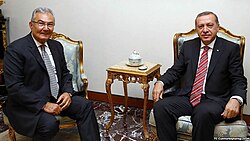
Baykal's leadership was not without internal challenge. In 2005, Mustafa Sarıgül challenged him for the leadership. While Baykal won, the convention was marred by violence, leading to Sarıgül's expulsion from the party.
The 2007 Presidential Crisis
In 2007, Baykal led fierce protests against the AKP's nomination of Abdullah Gül for the presidency, citing Gül's background in political Islam. The CHP organized Republic protests and boycotted the parliamentary vote. Because a 67% quorum was required to elect a president, the boycott forced an early general election in July 2007.
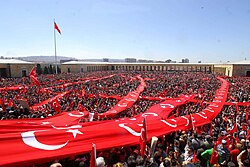
Despite an alliance with the DSP in 2007, the CHP's seat count dropped to 112 (including 13 DSP members) as the Nationalist Movement Party (MHP) also crossed the 10% threshold. Ultimately, Gül was elected President once the quorum was met.
Resignation and Later Political Activity
Despite a gradual increase in vote share in local elections—including regaining control of Antalya in 2009—Baykal resigned from the CHP leadership on May 10, 2010. His resignation followed the leak of a private video involving his former secretary and MP Nesrin Baytok. He was succeeded by Kemal Kılıçdaroğlu.
Baykal remained active as an MP in 2011 and 2015. Due to his seniority, he served as the temporary Speaker of the Parliament twice (June 2015 and November 2015). In August 2015, he declined a ministerial offer from Ahmet Davutoğlu to join an interim election government, providing a three-page letter of declination that he described as a "historical document."
Key Facts
- Party Leadership: Led the CHP through multiple terms, including the period of re-establishment in 1992.
- Government Roles: Served as Deputy Prime Minister and Minister of Foreign Affairs in a coalition with the DYP.
- Opposition Role: Was the sole opposition leader in Parliament following the 2002 AKP landslide.
- Strategic Influence: Supported the legal change that allowed Recep Tayyip Erdoğan to enter Parliament in 2003.
- Parliamentary Seniority: Served as interim Speaker of the Parliament in 2015 as the oldest member.
| Year/Period | Event/Role | Outcome/Result |
|---|---|---|
| 1987 | General Election | Elected MP for Antalya (SHP) |
| 1992 | CHP Re-establishment | Elected Leader of the CHP |
| 1995 | Coalition Government | Deputy PM and Foreign Minister |
| 1999 | General Election | CHP fell below 10% threshold; Baykal resigned |
| 2002 | General Election | CHP won 19.38%; Baykal became Opposition Leader |
| 2007 | Presidential Election | Led Republic protests against Abdullah Gül |
| 2010 | Leadership Resignation | Stepped down following private life controversy |
| 2015 | Parliamentary Speaker | Served as interim Speaker (oldest MP) |
Frequently Asked Questions
Why did Deniz Baykal re-establish the CHP in 1992?
He led the movement to re-establish the party after the laws prohibiting the re-foundation of political parties closed by the 1980 military regime were abandoned.
What was the significance of the 2002 general election for Baykal?
The CHP came second with 19.38% of the vote, but because all other parties failed to meet the 10% threshold, Baykal became the leader of the only opposition party in Parliament against the AKP.
How did Baykal influence Recep Tayyip Erdoğan's entry into Parliament?
Baykal and the CHP supported the legal changes necessary to lift the ban on Erdoğan, providing the votes needed for the AKP to allow him to run in a 2003 by-election.
What were the "Republic protests" of 2007?
These were rallies organized by the CHP to protest the nomination of Abdullah Gül for President due to his ties to political Islam, leading to a boycott of the election process.
Why did Deniz Baykal resign from the CHP leadership in 2010?
He resigned following the leak of a private video involving himself and a former secretary, Nesrin Baytok, which led to widespread criticism of his private life.
Did Baykal ever serve as the permanent Speaker of the Parliament?
No. While he served as the interim Speaker in 2015 because he was the oldest member, he lost the election for the permanent position to İsmet Yılmaz.