Deinonychus: The Terrible Claw of the Early Cretaceous
Among the most influential discoveries in the history of paleontology is Deinonychus, a predatory dinosaur whose anatomy fundamentally changed our understanding of how dinosaurs lived and evolved. Known for its lethal weaponry and bird-like agility, this theropod served as a critical link in the scientific realization that birds are the descendants of small, carnivorous dinosaurs.
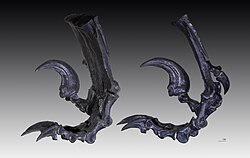
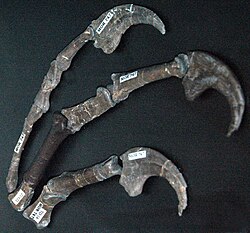
The name Deinonychus translates to "terrible claw," a direct reference to the formidable, sickle-shaped talon found on the second toe of each hind foot. This specialized tool, combined with a lightweight frame and powerful forelimbs, made it one of the most efficient hunters of its time.
Key Facts
- Temporal Range: Lived during the Early to Late Cretaceous (Aptian to Cenomanian), approximately 115–98 million years ago.
- Defining Feature: A large, curved ungual (claw) on the second toe, estimated to be over 120 millimeters long.
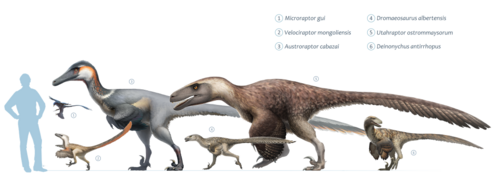
- Size: Reached lengths of 3.3–3.4 meters with a body mass estimated between 60 and 100 kg.
- Diet: Carnivorous; frequently associated with the ornithopod Tenontosaurus.
- Scientific Impact: Its discovery led paleontologist John Ostrom to revive the link between dinosaurs and birds.
Discovery and Naming
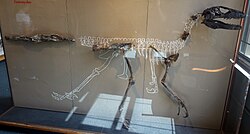
The journey of Deinonychus into the scientific record began in August 1964, when paleontologist John Ostrom led an expedition from Yale's Peabody Museum of Natural History. Near Bridger, Montana, the team uncovered more than 1,000 bones representing at least three individuals over two summers.
Due to the weak association between many of the recovered bones, the type specimen (YPM 5205) was restricted to a complete left foot and partial right foot. In 1969, Ostrom officially named the species Deinonychus antirrhopus. The specific name antirrhopus means "counter balance," referring to the dinosaur's stiffened tail, which Ostrom believed acted as a stabilizer during movement.
Physical Description and Anatomy
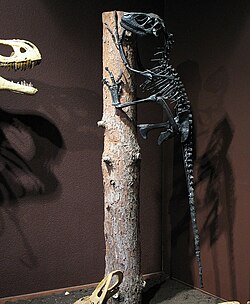
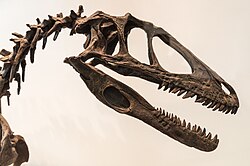
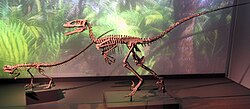
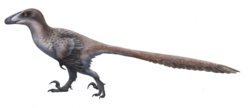
Deinonychus was a medium-sized theropod. Based on mature specimens, it typically reached a length of 3.3 to 3.4 meters (roughly 11 feet), with a hip height of 0.87 meters. While some estimates place its mass at 60–73 kg, other researchers suggest a higher mass of up to 100 kg based on the circumference of the femur and humerus.
The "Terrible Claw" and Hind Limbs
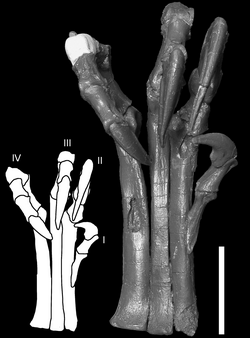
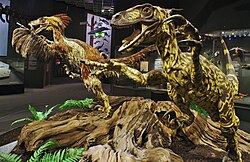
The most striking feature of Deinonychus was the second toe's sickle claw. In life, this bone was covered by a horny sheath, extending its total length. While early theories suggested this claw was used for slashing, a 2011 study proposed it was more likely used to pin down prey while the animal delivered bites.
Forelimbs and Grasping
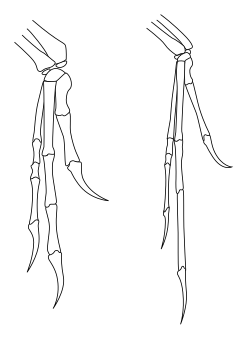
The forelimbs of Deinonychus were remarkably long, providing a greater reach than most other theropods. Biomechanical studies by Ken Carpenter in 2002 indicated that these limbs were designed for grasping. The presence of an elongated coracoid suggests powerful chest muscles supported this function. Notably, research showed that Deinonychus could not fold its arms against its body in the same manner as modern birds.
The Tail and Balance
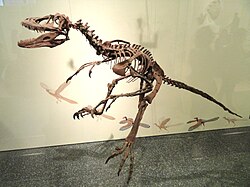
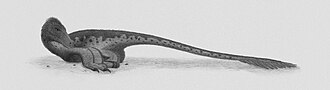
The tail of Deinonychus featured ossified tendons and elongated bone processes, which initially led scientists to believe the tail was a rigid counterbalance. However, evidence from the closely related Velociraptor mongoliensis suggests that these tails possessed a degree of lateral flexibility, allowing them to bend in an S-shape.
Paleobiology and Predatory Behavior
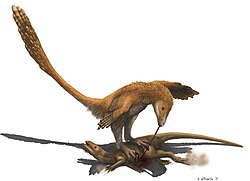
The ecological role of Deinonychus is often viewed through its relationship with the ornithopod Tenontosaurus. In both the Cloverly and Antlers formations, the remains of these two dinosaurs are frequently found together. Tooth marks on Tenontosaurus bones provide evidence that Deinonychus hunted or scavenged upon them.
Bite Force Debates
Estimating the bite force of Deinonychus has yielded conflicting results. A 2005 study suggested a weak bite, only 15% that of a modern American alligator. However, a 2010 study analyzing tooth puncture marks in Tenontosaurus bones suggested a much higher force—between 4,100 and 8,200 newtons—comparable to a similarly sized alligator. More recently, a 2022 study using a skull model calculated a significantly lower force of 706 N.
Social Structure: Solitary or Gregarious?
The discovery of multiple Deinonychus skeletons in a single quarry (such as the Yale quarry in Montana) has sparked a debate over whether they were gregarious. Because an adult Tenontosaurus weighed 1–4 metric tons—far more than a single 70–100 kg Deinonychus—some paleontologists speculate that they may have hunted in packs to bring down large prey, though recent evidence suggests they may have been gregarious without necessarily forming mammal-like packs.
Summary of Deinonychus Characteristics
| Feature | Details |
|---|---|
| Length | 3.3–3.4 meters |
| Weight | 60–100 kg |
| Primary Weapon | Sickle-shaped second toe claw |
| Key Prey | Tenontosaurus |
| Time Period | Early to Late Cretaceous (115–98 Ma) |
| Classification | Dromaeosauridae |
Frequently Asked Questions
Did Deinonychus hunt in packs?
This is a subject of ongoing debate. The presence of multiple individuals near large Tenontosaurus fossils suggests they may have been gregarious or cooperative hunters, as a single Deinonychus would struggle to kill a multi-ton herbivore. However, some researchers argue they were not "pack hunters" in the same way modern mammals are.
How did the sickle claw function?
While once thought to be a slashing weapon, more recent biomechanical evidence suggests the claw was used to pin down or grip prey, stabilizing the victim while the dinosaur used its jaws to inflict damage.
What is the connection between Deinonychus and birds?
John Ostrom noticed striking similarities between the forelimbs and skeletal structure of Deinonychus and those of birds (and Archaeopteryx). This helped revive the theory that birds evolved from small theropod dinosaurs.
How strong was the bite of a Deinonychus?
Estimates vary wildly. Some studies suggest a relatively weak bite, while others, based on bone puncture marks, suggest a force of 4,100 to 8,200 newtons, which would be equivalent to a modern alligator of similar size. A 2022 study suggests a much lower force of 706 N.
Where was Deinonychus found?
Remains have been discovered in the Cloverly Formation of Montana and Wyoming, as well as the Antlers Formation of Oklahoma.