Dastūr al-Mulūk: A Rare Glimpse into Safavid Administrative Governance
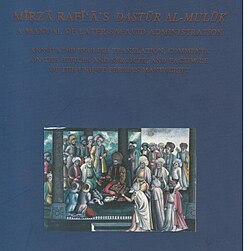
The Dastūr al-Mulūk (Persian: دستور الملوک) stands as a critical primary source for historians and scholars of Iranology. Written by Moḥammad Rafiʿ Anṣāri, better known as Mirzā Rafiʿā, this work is one of only three surviving administrative handbooks from early 18th-century Safavid Iran. These handbooks served as essential guides for statecraft and governance during a pivotal era of Persian history.
Because so few of these manuals have survived, the Dastūr al-Mulūk provides an invaluable window into the bureaucratic structures and administrative philosophies of the Safavid period.
Key Facts
- Author: Moḥammad Rafiʿ Anṣāri (Mirzā Rafiʿā).
- Origin: Early 18th-century Safavid Iran.
- Rarity: One of only three surviving administrative handbooks from this period.
- Significance: A primary research tool for the field of Iranology (the scholarly study of Iranian history, language, and culture).
Scholarly Recovery and Translation
The journey of the Dastūr al-Mulūk from a dormant manuscript to a globally recognized academic resource involved several key scholars and international efforts.
Early Persian and Russian Editions
During the 1960s, the Iranian scholar Mohammad Taqi Danesh Pajouh edited the original Persian manuscript. Later, in the 1990s, a Russian translation produced by Dr. Vil'danova was published in Tashkent, Uzbekistan, expanding the text's accessibility to Eastern European scholars.
The English Translation and Recognition
In 2002, German scholar Christoph Marcinkowski published the first annotated English translation (ISBN 983-9379-26-7). This publication was based on his doctoral dissertation and included a facsimile of what was believed at the time to be the complete manuscript. The quality of this research was recognized at the highest levels of the Iranian government; in 2000, the Iranian Ministry of Culture awarded Marcinkowski's dissertation the First Prize for Best Research on Iranian Culture Award (International Category), presented by then-President Mohammad Khatami.
The impact of Marcinkowski's work further extended back to Iran in 2006 (1385 AH solar), when a Persian translation of his study, translated by Ali Kordabadi and Mansur Sefatgol, was published in Tehran by the Markaz-e Asnad va Tarikh-e Diplomasi under the Iranian Ministry of Foreign Affairs.
The Discovery of Missing Texts
Academic understanding of the Dastūr al-Mulūk continued to evolve after the 2002 publication. The Iranian scholar Iraj Afshar discovered and edited the remaining portions of the manuscript that had previously been missing. These newly recovered sections were subsequently translated into English and analyzed by Dr. Marcinkowski in the Zeitschrift der Deutschen Morgenländischen Gesellschaft, the prestigious journal of the German Oriental Society.
| Period/Year | Scholar/Translator | Language/Contribution | Notes |
|---|---|---|---|
| 1960s | Mohammad Taqi Danesh Pajouh | Persian | Edited the original manuscript |
| 1990s | Dr. Vil'danova | Russian | Published in Tashkent, Uzbekistan |
| 2002 | Christoph Marcinkowski | English | First annotated English translation |
| 2006 (1385 AH) | Kordabadi & Sefatgol | Persian | Translation of Marcinkowski's study |
| Post-2002 | Iraj Afshar | Persian/English | Discovered and edited the remainder of the text |
Frequently Asked Questions
What is the Dastūr al-Mulūk?
It is an administrative handbook from early 18th-century Safavid Iran written by Moḥammad Rafiʿ Anṣāri (Mirzā Rafiʿā), used as a guide for governance and state administration.
Why is this text important to Iranology?
It is one of only three surviving administrative manuals from its era, making it a rare and essential tool for understanding the political and bureaucratic operations of the Safavid Empire.
Who provided the first English translation?
The first annotated English translation was published in 2002 by the German scholar Christoph Marcinkowski.
Was the 2002 English translation complete?
At the time of publication, it was thought to be complete; however, the scholar Iraj Afshar later discovered and edited the remaining parts of the manuscript.
What award did the research on this text receive?
Christoph Marcinkowski's dissertation on the work received the First Prize for Best Research on Iranian Culture Award for the Year 2000 (International Category) from the Iranian Ministry of Culture.