Darrel Richmond Frost: A Pioneer in Herpetology and Amphibian Systematics
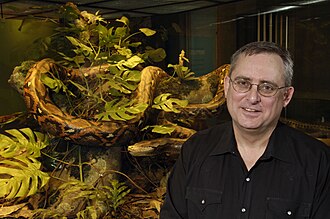
Darrel Richmond Frost is a distinguished American herpetologist (a scientist who studies amphibians and reptiles) and systematist (an expert in the classification of living things). Throughout his career, Frost has held some of the most prestigious positions in his field, including serving as the head curator of herpetology at the American Museum of Natural History. His leadership extends to professional organizations, having served as president of both the Society for the Study of Amphibians and Reptiles in 1998 and the American Society of Ichthyologists and Herpetologists in 2006.
Frost's contributions to science are so significant that four different taxa—groups of organisms sharing common characteristics—have been named in his honor: the toad genus Frostius (including Frost's Toad), the tree frog Dendropsophus frosti, Darrel's Chorus Frog Microhyla darreli, and Frost's arboreal alligator lizard Abronia frosti.
Key Facts
- Primary Achievement: Created and maintains Amphibian Species of the World, a comprehensive global catalog.
- Academic Background: Holds a Ph.D. in ecology and systematics from the University of Kansas.
- Major Awards: Recipient of the 2013 Sabin Award for Amphibian Conservation and the Henry S. Fitch Excellence in Herpetology Award (2021).
- Research Impact: Led the largest phylogenetic analysis of a vertebrate group to date, covering 522 species.
- Global Reach: Conducted fieldwork in Mexico, Guatemala, Peru, Ethiopia, Namibia, South Africa, and Vietnam.
Academic Journey and Professional Career
Frost's fascination with animals began at the age of four after witnessing his father kill a rattlesnake. This early curiosity evolved into a rigorous academic pursuit. He earned a B.S. in biology from the University of Arizona in 1973, followed by an M.S. in zoology from Louisiana State University in 1978. He completed his formal education in 1988 with a Ph.D. in ecology and systematics from the University of Kansas.
His professional trajectory is closely tied to the American Museum of Natural History (AMNH). Joining the institution in 1990 as an assistant curator of herpetology, he rose through the ranks to become associate curator, curator-in-charge, and eventually the associate dean of science for collections. Additionally, he has shared his expertise as an adjunct professor at Columbia University since 2000.
The Legacy of Amphibian Species of the World
One of Frost's most enduring contributions is the creation of Amphibian Species of the World. He began this monumental cataloging effort in 1980, noting that a century had passed since such a comprehensive work had been attempted. During that gap, the number of known amphibian species had roughly quadrupled, creating a massive backlog of data.
The project evolved from a printed first edition in 1985, which listed 4,014 species, into a dynamic digital resource. Since 1990, Frost has overhauled the catalog and hosted it on the AMNH website. By 2014, the database grew to include over 7,200 species and received more than a million visits annually, with updates occurring almost daily.
Impact on Global Biology
The catalog is widely regarded as the most significant single work in the history of amphibian biology. Because of this contribution, Frost was honored with the 2013 Sabin Award for Amphibian Conservation. His work provides the foundational data necessary for conservationists and biologists worldwide to track and protect amphibian populations.
Advancing the Amphibian Tree of Life
Beyond cataloging, Frost has pushed the boundaries of phylogenetic analysis—the study of evolutionary relationships among biological entities. In 2006, he served as the lead author of a landmark study that proposed major taxonomic changes to the amphibian tree of life. This study analyzed 522 species, marking it as the largest phylogenetic analysis of any vertebrate group at that time.
His commitment to discovery is further evidenced by his extensive international fieldwork. By exploring diverse ecosystems in Africa, Asia, and the Americas, Frost has described numerous new species, expanding our understanding of global biodiversity.
Summary of Professional Milestones
| Category | Detail |
|---|---|
| Education | B.S. (Arizona), M.S. (Louisiana State), Ph.D. (Kansas) |
| Key Institution | American Museum of Natural History |
| Major Publication | Amphibian Species of the World |
| Key Research | Phylogenetic analysis of 522 amphibian species (2006) |
| Honors | Sabin Award (2013), Henry S. Fitch Award (2021) |
Frequently Asked Questions
What is the significance of the Amphibian Species of the World catalog?
It is considered the most significant single work in amphibian biology, providing a comprehensive, daily-updated digital record of over 7,200 species, which is essential for scientific research and conservation.
Which animals are named after Darrel Frost?
Four taxa bear his name: the toad genus Frostius, the tree frog Dendropsophus frosti, Darrel's Chorus Frog Microhyla darreli, and Frost's arboreal alligator lizard Abronia frosti.
What was the scale of Frost's 2006 phylogenetic study?
The study analyzed 522 species, making it the largest phylogenetic analysis of a vertebrate group conducted up to that date.
Where has Darrel Frost conducted his fieldwork?
Frost has worked in several countries across the globe, including Guatemala, Mexico, Peru, Ethiopia, Namibia, South Africa, and Vietnam.
What professional leadership roles has he held?
He served as the president of the Society for the Study of Amphibians and Reptiles (1998) and the American Society of Ichthyologists and Herpetologists (2006).