Czechoslovakia Dissolution: The Peaceful Partition of 1993
The dissolution of Czechoslovakia, which took effect on December 31, 1992, stands as a rare historical example of a self-determined, peaceful partition of a sovereign state. This process split the Czech and Slovak Federative Republic into two independent nations: the Czech Republic and the Slovak Republic. This separation mirrored the internal structure of the previous Czechoslovak Socialist Republic, which had consisted of the Czech and Slovak Socialist Republics since 1969.
Key Facts
- Effective Date: December 31, 1992.
- Outcome: Creation of the independent Czech Republic and Slovakia.
- Nature of Split: A peaceful secession, often contrasted with the violent breakup of Yugoslavia occurring simultaneously.
- Key Figures: Václav Klaus (Czech) and Vladimír Mečiar (Slovak).
- Legal Basis: Constitution Acts 541 and 542.
The Path to Partition
The drive toward independence was fueled by economic disparities and diverging political visions. By 1991, the GDP per capita in the Czech Republic was approximately 20% higher than in Slovakia, leading the Czech government to stop transfer payments to Slovakia in January 1991.
Political tension peaked in 1992. Czech leader Václav Klaus advocated for either a "viable federation" (a tighter union) or complete independence. Conversely, Slovak leader Vladimír Mečiar sought a looser confederation. Following the Slovak parliament's declaration of independence on July 17, 1992, Klaus and Mečiar met in Bratislava six days later and agreed to the secession. President Václav Havel, who opposed the split, resigned rather than oversee the process.
Despite the political agreement, public opinion was divided. A September 1992 poll indicated that only 36% of Czechs and 37% of Slovaks favored the dissolution.
Legal and Territorial Settlement
To ensure a stable transition, the Federal Assembly passed two critical laws. Constitution Act 541, passed on November 13, 1992, settled the division of property. Constitution Act 542, passed on November 25, finalized the secession for December 31, 1992.
Territorial disputes were minimal but existed. For instance, the U Sabotů (Šance) area, historically Moravian, was awarded to Slovakia in 1997. The Kasárna recreational area also remained in Slovakia despite objections from Czech property owners.
National Symbols
The transition of national symbols varied by state. Slovakia adopted its traditional flag, adding a coat of arms on September 3, 1992, to distinguish it from the flags of Russia and Slovenia. The Czech Republic initially used the red and white flag of Bohemia before unilaterally deciding to retain the original Czechoslovak flag with a modified meaning.
Economic and Currency Division
The division of the Czechoslovak koruna (the national currency) was a complex operation. While both nations initially used the old currency, the Czech Republic introduced a separate currency on February 8, 1993, to prevent economic loss.
The Czech National Bank issued new currency by stamping existing Czechoslovak banknotes—a process prepared in secret during 1992. Between February 8 and 12, 1993, banknotes of 100, 500, and 1,000 Kčs were exchanged for stamped versions, and a new 200 Kč note was introduced. Slovakia also applied stamps to its banknotes and introduced a new 10 SK coin.
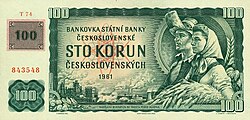
While the currencies were initially exchanged at par, the Slovak koruna eventually declined in value, becoming roughly 25–27% lower than the Czech koruna by 2004.
International and Social Aftermath
Both nations agreed to honor the international treaty obligations of the former Czechoslovakia. On May 19, 1993, Slovakia notified the United Nations of its intent to remain a party to all ratified treaties, including the 1962 Antarctic Treaty.
Citizenship and Human Rights
Citizenship laws created significant challenges. The Czech Republic initially prohibited dual citizenship for naturalized citizens, a policy that changed with the Citizenship Act of 2013. A critical issue arose regarding Roma people; many living in Czech orphanages were released as adults without legal status because the Slovak government refused citizenship to nonresidents. This left many stateless until Czech law was amended in 1999 and 2003.
Cultural and Linguistic Ties
Despite the political split, linguistic and social bonds remain strong. Czech and Slovak are mutually intelligible, and both countries allow the use of the other's language in official proceedings. For example, the Slovak Official Language Act of 2009 and the Czech Administration Procedure Act of 2004 protect these linguistic rights.
| Feature | Czech Republic | Slovak Republic |
|---|---|---|
| Political Leader (1992) | Václav Klaus | Vladimír Mečiar |
| Currency | Czech koruna (Kč) | Slovak koruna (SK) |
| Phone Code (Post-1997) | +420 | +421 |
| Flag Strategy | Retained Czechoslovak flag | Traditional flag with coat of arms |
Legacy and Modern Relations
The dissolution remains a subject of debate. While a 2023 poll showed 50% of Czechs view the decision as correct, historical figures like Marek Maďarič note that the lack of a referendum followed a long-standing Czechoslovak tradition of constitutional changes decided by political representatives.
Today, the two nations maintain close ties. It is customary for presidents and foreign ministers to make their first and last official visits to the other republic. In 2012, the two governments held a joint cabinet meeting to commemorate the 1918 declaration of independence.
Frequently Asked Questions
Was the dissolution of Czechoslovakia voted on by the people?
No, there was no public referendum. The decision was made through negotiations between political leaders, specifically Václav Klaus and Vladimír Mečiar, following the tradition of constitutional affairs in Czechoslovak history.
How was the currency split handled?
Both countries initially used the Czechoslovak koruna. The Czech Republic then secretly prepared stamps to mark banknotes, which were exchanged in February 1993 to create a distinct Czech currency. Slovakia similarly used stamps and introduced its own coins.
What happened to the international treaties signed by Czechoslovakia?
Both the Czech Republic and Slovakia agreed to honor the existing treaty obligations. Slovakia formally notified the UN that it would remain a party to all treaties signed and ratified by the former federation.
Do Czech and Slovak citizens still communicate easily?
Yes. Due to the similarity of the languages, Czech and Slovak are often used interchangeably in official and judicial proceedings in both countries, supported by specific laws like the Slovak Official Language Act of 2009.
Why did the dissolution happen despite low public support?
The split was driven by economic disparities (with the Czech Republic having a higher GDP per capita) and a fundamental disagreement between leaders over whether the state should be a tight federation or a loose confederation.