Cylinder Geometry: Types, Properties, and Mathematical Formulas
Derived from the Ancient Greek word kúlindros, meaning "roller" or "tumbler," a cylinder is one of the most fundamental curvilinear geometric shapes. In elementary geometry, it is often described as a prism with a circular base. However, in modern geometry and topology, the term can refer to either a solid three-dimensional object or an infinite curvilinear surface.
To avoid ambiguity, mathematicians distinguish between solid cylinders (the volume within) and cylindrical surfaces (the outer shell). While the term "cylinder" often defaults to the right circular cylinder in common usage, the shape encompasses a wide variety of forms depending on its base and orientation.
Key Facts
- Right Circular Cylinder: A cylinder where the elements are perpendicular to the bases.
- Volume Formula: Calculated as the product of the base area and the height (V = πrh² for circular bases).
- Surface Area: The sum of the two circular bases and the lateral side area (2πr(r + h)).
- Cylindric Sections: The curves formed when a plane intersects a cylinder's surface.
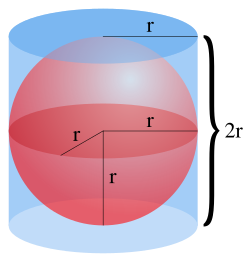
- Archimedes' Discovery: A sphere has exactly 2/3 the volume and surface area of its circumscribing cylinder.
Types of Cylinders
Cylindrical Surfaces
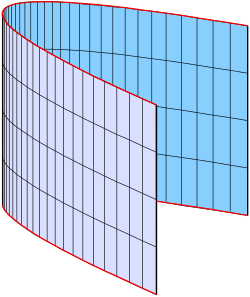
A cylindrical surface is formed by all points on lines (called elements) that are parallel to a given line and pass through a fixed plane curve known as the directrix. From a kinematic perspective, the surface is traced by a line (the generatrix) moving parallel to itself while passing through the directrix.
Solid Cylinders
A solid cylinder is the region bounded by a cylindrical surface and two parallel planes. The regions bounded by the surface in these planes are called the bases, which are always congruent figures. The perpendicular distance between these bases is the height (or altitude).
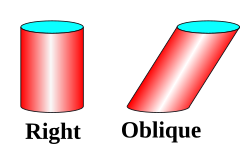
- Right Cylinder: Elements are perpendicular to the planes of the bases.
- Oblique Cylinder: Elements are not perpendicular to the bases.
- Circular Cylinder: The bases are disks (circles).
- Open Cylinder: A cylindrical surface without its bases.
Cylinders of Revolution
A cylinder of revolution is a specific type of right circular cylinder created by rotating a line segment around a fixed parallel line. This fixed line is the axis of the cylinder, passing through the centers of both bases.
Mathematical Properties and Formulas
Volume
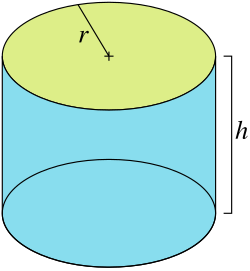
The volume of any cylinder is the product of the area of its base and its height. For a circular cylinder with radius r and height h, the formula is:
Volume (V) = πr²h
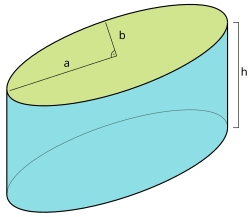
This principle, supported by Cavalieri's principle, applies to oblique cylinders as well. For an elliptic cylinder with semi-major axis a and semi-minor axis b, the volume is V = πabh.
Surface Area
For a right circular cylinder, the total surface area consists of three parts: the top base, the bottom base, and the lateral side.
- Base Area (B): πr² (per base)
- Lateral Area (L): 2πrh
- Total Surface Area: 2πr(r + h)
Interestingly, for a fixed volume, the right circular cylinder with the minimum surface area occurs when the height equals the diameter (h = 2r).
Cylindrical Shells (Hollow Cylinders)
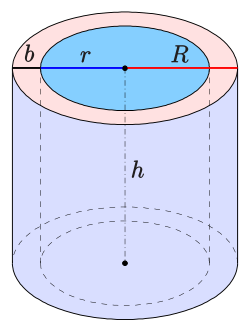
A right circular hollow cylinder is the region between two concentric right circular cylinders. If the external radius is R, the internal radius is r, and the height is h, the volume is calculated by subtracting the inner volume from the outer volume:
Volume = π(R² - r²)h
Cylindric Sections

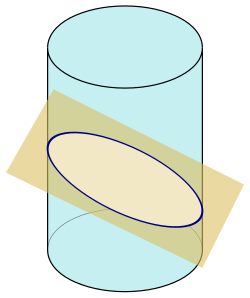
A cylindric section is the curve created by the intersection of a cylinder's surface and a plane. The nature of the resulting curve depends on the angle of the plane:
- Parallelogram/Rectangle: Formed when the plane contains two elements of the cylinder.
- Circle: Formed by a right section (perpendicular to the elements) in a circular cylinder.
- Ellipse: Formed when the plane intersects the surface at an angle.
Advanced Geometric Classifications
Generalized Cylinders
In higher geometry, cylinders are categorized by the shape of their right sections. These are considered degenerate quadric surfaces:
- Elliptic Cylinder: The right section is an ellipse.
- Parabolic Cylinder: The right section is a parabola.
- Hyperbolic Cylinder: The right section is a hyperbola.
Projective Geometry and Prisms
In projective geometry, a cylinder is viewed as a cone whose apex is located at infinity. Furthermore, a solid circular cylinder can be seen as the limiting case of an n-gonal prism as the number of sides n approaches infinity.
Summary Table: Cylinder Characteristics
| Type | Base Shape | Defining Characteristic | Key Formula (Volume) |
|---|---|---|---|
| Right Circular | Circle | Axis perpendicular to base | πr²h |
| Oblique Circular | Circle | Axis not perpendicular to base | πr²h |
| Elliptic | Ellipse | Right section is an ellipse | πabh |
| Hollow (Shell) | Annulus | Two concentric cylinders | π(R² - r²)h |
Frequently Asked Questions
What is the difference between a right cylinder and an oblique cylinder?
In a right cylinder, the elements (the lines forming the surface) are perpendicular to the planes containing the bases. In an oblique cylinder, the elements are not perpendicular to the bases, resulting in a "slanted" appearance.
How does a cylinder relate to a sphere?
As discovered by Archimedes, a sphere inscribed within a circumscribing right circular cylinder (where the cylinder's height and diameter equal the sphere's diameter) has exactly 2/3 the volume and 2/3 the surface area of that cylinder.
What is a truncated cylinder?
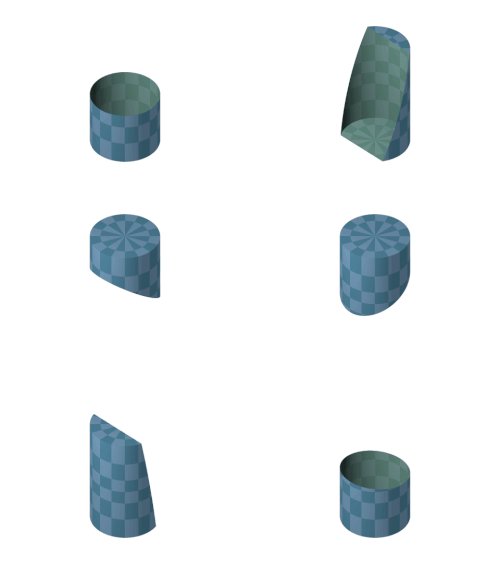
A truncated cylinder is a solid cylinder where the two bases do not lie in parallel planes, meaning the cylinder has been "cut" at an angle.
What is a cylindric section?
A cylindric section is the curve formed by the intersection of a plane and the surface of a cylinder. Depending on the angle of the plane, this can result in a circle, an ellipse, or a rectangle.
Can a cylinder be something other than circular?
Yes. While circular cylinders are most common, cylinders can have any plane curve as a base. Examples include elliptic, parabolic, and hyperbolic cylinders.