Cygnus X-1: The Dynamics of a High-Mass X-ray Binary
Cygnus X-1 is one of the most studied and significant objects in the night sky, serving as a primary example of a high-mass X-ray binary. This complex system consists of a massive blue supergiant star, HDE 226868, and a compact object that is widely accepted to be a black hole. Together, they engage in a gravitational dance that releases immense amounts of energy across the electromagnetic spectrum, from radio waves to high-energy gamma rays.
Located roughly 6,000 to 7,000 light-years away, the system resides within the Orion Spur of the Milky Way. It is associated with Cygnus OB3, a group of massive stars, suggesting that the binary system formed approximately 5 million years ago.
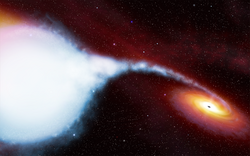
Key Facts
- Compact Object: A black hole with a mass estimated between 13.8 and 21.2 solar masses.
- Companion Star: HDE 226868, a blue supergiant (spectral class O9.7 Iab).
- Orbital Period: The two objects orbit their center of mass every 5.599829 days.
- Event Horizon: The black hole has a Schwarzschild radius (the boundary from which nothing can escape) of approximately 44 km.
- Jet Power: Relativistic jets emit power estimated at 4–14 × 1033 W, over 1,000 times the power of the Sun.
The Binary System and Orbital Mechanics
The relationship between the black hole and HDE 226868 is defined by a nearly circular orbit, with an eccentricity of only 0.018 ± 0.002. While the system does not eclipse from Earth's perspective, the orbital plane is inclined at an angle estimated between 27° and 65°, with a 2007 study suggesting 48.0 ± 6.8°. The semi-major axis—the average distance between the two bodies—is approximately 0.2 AU.
Over the vast timescales of the universe, this pairing is temporary. It is predicted that the system will merge into a single black hole in about five billion years, a cataclysmic event likely to generate detectable gravitational waves.
![A blue-band light curve for Cygnus X-1, adapted from Kemp et al. (1987)[52]](/images/fd/e8/fde8c5e9654dd2c7ce359910bfa545d5d0c4461e022481c80dd4ff2040681e2b.png)
The Compact Object: A Confirmed Black Hole
The nature of the compact object in Cygnus X-1 was determined by measuring its mass. Because its mass consistently exceeds the maximum theoretical limit for a neutron star, it is classified as a black hole. Recent measurements have placed its mass at 21.2 ± 2.2 solar masses (2021) and 17.5 solar masses (2025), though other methods suggest values as low as 13.8 solar masses.
Evidence for the event horizon—the point of no return—was observed using the Hubble Space Telescope. Researchers detected "dying pulse trains" of radiation from matter spiraling into the hole. As the matter approached the horizon, the radiation underwent gravitational redshift (an increase in wavelength), eventually vanishing without the final burst of energy that would occur if the matter had hit a solid surface.
The rotation, or spin, of the black hole remains a subject of debate. While early data from the Chandra X-ray Observatory suggested little rotation, 2011 findings indicate the object may be spinning extremely rapidly, approximately 790 times per second.
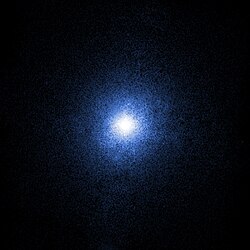
Accretion and X-ray Emission
The black hole is surrounded by an accretion disk, a thin, flat disk of ionized gas. Friction between the fast-moving inner gas and slower outer gas heats the disk to extreme temperatures. The disk consists of a hot, plasma-filled inner region and a cooler outer region extending to about 15,000 km.
Cygnus X-1 is the brightest persistent source of "hard" X-rays (high-energy photons) in the sky. These X-rays are produced via Compton scattering, where lower-energy photons gain energy from high-temperature electrons in a corona—a cloud of gas enveloping the disk—or at the base of the system's jets.
The system fluctuates between two primary states:
- Hard State: The most common state, characterized by high-energy X-rays originating in the corona.
- Soft State: A less common, more variable state where the accretion disk moves closer to the black hole (possibly within 150 km), leading to the cooling or ejection of the corona.
![A Chandra X-ray spectrum of Cygnus X-1 showing a characteristic peak near 6.4 keV due to ionized iron in the accretion disk, but the peak is gravitationally red-shifted, broadened by the Doppler effect, and skewed toward lower energies[69]](/images/7e/51/7e515efc0d41457ff8ea017424d0f1a1d9f49a1a7f165f8a7703e16528593dc6.jpg)
Relativistic Jets and Interstellar Interaction
Some of the gravitational energy from accreting matter is channeled into two jets of particles launched perpendicular to the disk. These jets travel at relativistic velocities (a significant fraction of the speed of light). Because they are inefficient radiators, they appear "dark" in many spectrums.
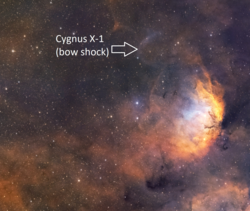
One of these jets is currently colliding with a dense interstellar cloud, creating a curved bow shock and a detectable radio-emitting ring. This interaction has formed a nebula visible in optical wavelengths. Furthermore, in 2006, Cygnus X-1 became the first stellar-mass black hole observed emitting very high-energy gamma rays (above 100 GeV), likely produced where the jet interacts with the stellar wind of the companion star.
The Companion Star: HDE 226868
HDE 226868 is a blue supergiant with a surface temperature of 31,000 K and a mass 20–40 times that of the Sun. It is roughly 15–17 times the solar radius and 300,000–400,000 times as luminous as the Sun. The star is tidally distorted into a tear-drop shape by the black hole's gravity, causing its brightness to vary slightly every 5.6 days.
The star emits a powerful stellar wind, shedding mass at a rate of one solar mass every 400,000 years. While the star does not overflow its Roche lobe (the region where its gravity dominates), the black hole's gravity captures a significant portion of this stellar wind, feeding the accretion disk.
| Property | Black Hole (Compact Object) | HDE 226868 (Companion Star) |
|---|---|---|
| Estimated Mass | ~13.8 to 21.2 M☉ | 20 to 40 M☉ |
| Physical Size | ~44 km (Schwarzschild Radius) | 15 to 17 Solar Radii |
| Primary Emission | Hard X-rays, Gamma rays, Radio | Optical, Ultraviolet |
| Role in System | Accretor / Gravitational Anchor | Mass Donor (via stellar wind) |
Frequently Asked Questions
How do scientists know Cygnus X-1 is a black hole and not a neutron star?
The primary evidence is mass. The compact object's mass is significantly higher than the maximum possible mass for a neutron star. Additionally, the absence of stable pulsations and X-ray bursts—which are characteristic of neutron stars—supports the black hole classification.
What is the "soft state" in X-ray emission?
The soft state occurs when the accretion disk moves closer to the black hole, typically within 150 km. This results in a higher proportion of lower-energy (soft) X-rays and increased variability, often accompanied by the cooling or ejection of the surrounding corona.
What is a Roche lobe?
A Roche lobe is the region of space around a star in a binary system within which orbiting material is gravitationally bound to that star. If material passes beyond this boundary, it can be captured by the companion object.
Why is HDE 226868 not visible to the naked eye?
Although it is intrinsically very bright (a fifth-magnitude star), interstellar extinction caused by gas and dust between Earth and the system reduces its apparent magnitude and reddens its hue, making it invisible without a telescope.
How did the black hole in Cygnus X-1 form?
It formed from a progenitor star with a mass likely exceeding 40 solar masses. Evidence suggests the star may have collapsed directly into a black hole without a massive supernova explosion, as the system remained intact and the black hole stayed in its current orbit.