Cueva de las Manos: The Ancient Rock Art of Argentine Patagonia
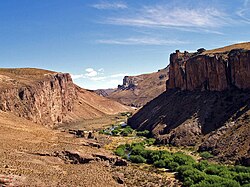
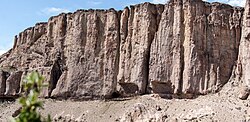
Deep in the Santa Cruz Province of Argentina, nestled within the rugged landscapes of the Pinturas River canyon, lies one of the most evocative archaeological treasures of the Americas: Cueva de las Manos (the Cave of the Hands). This extraordinary complex of rock art serves as a prehistoric gallery, capturing the essence of human existence in Patagonia thousands of years before the arrival of Europeans.
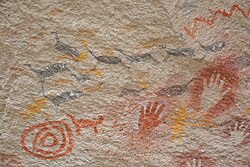
The site is most famous for its hundreds of stenciled handprints, which appear as ghostly silhouettes against the rock walls. These artworks were created in successive waves between 7,300 BC and AD 700, spanning the Archaic period—a formative era of pre-Columbian South American history.
Key Facts
- Location: Santa Cruz Province, Argentina, 163 km south of Perito Moreno.
- UNESCO Status: Inscribed as a World Heritage Site in 1999.
- Age: Art dates from approximately 7,300 BC to 700 AD.
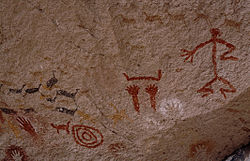
- Primary Motifs: Stenciled hands, guanacos (wild camelids), humanoid figures, and geometric patterns.
- Dating Methods: Radiocarbon dating of paint, stratigraphic dating, and analysis of bone pipes used for spraying pigment.
The History and Evolution of the Art
The artistic legacy of Cueva de las Manos was not created by a single group, but by various cultural waves over several millennia. The earliest works, dating to roughly 7,300 BC, are unique to this site in the region and are categorized as styles A1 and A2.
By 6,800 BC, similar artistic expressions began appearing at other regional sites, particularly hunting scenes categorized as styles A3, A4, and A5. The site remained a place of significance until approximately 700 AD, when it was last inhabited, possibly by the ancestors of the Tehuelche tribes.
Stylistic Groups and Themes
Archaeologists have divided the artwork into distinct stylistic groups to better understand the cultural shifts of the inhabitants:
- Stylistic Group A: Characterized by early works and dynamic hunting scenes. This includes the "Black series," which features guanacos in running motion.
- Stylistic Groups B and B1: Emerging between 5,000 BC and 1,300 BC, this period saw a shift toward more static imagery. The lively hunts were replaced by isolated groups of guanacos, often depicted with large bellies to suggest pregnancy. This era is also associated with a massive increase in handprints—approximately 2,000 superimposed stencils in various colors—as well as rare human and animal footprints.
- Stylistic Group C: Represents later additions to the cave's visual record.
Technical Mastery and Materials
The prehistoric artists utilized a sophisticated technique to create the famous hand stencils. Rather than painting the hand directly, they used bone pipes to spray pigment over a hand placed against the rock, creating a negative image. The age of these works was confirmed through the radiocarbon dating of these very pipes, alongside stratigraphic analysis of the rock layers.
The imagery extends beyond hands to include a variety of zoomorphic (animal-like) and geometric forms, such as concentric circles, red lizards, and zigzag patterns, reflecting the deep connection between the ancient inhabitants and their environment.
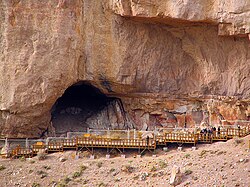
Conservation and Modern Protection
Recognized as a National Historic Monument in 1993, Cueva de las Manos gained global prominence after its 1999 UNESCO designation. The site's management has evolved significantly; in 2015, the environmental organization Rewilding Argentina purchased the land from a private ranch, eventually donating it to the state in 2020. It is now managed as a provincial park.
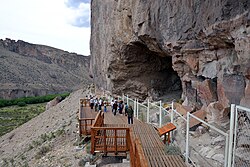
However, popularity has brought peril. Tourism has increased fourfold since 1999, with roughly 8,000 annual visitors as of 2020. This influx has led to critical conservation challenges, including graffiti, the theft of painted rock fragments, and damage caused by visitors touching the fragile pigments.
Site Summary
| Feature | Detail |
|---|---|
| Official Name | Cueva de las Manos, Río Pinturas |
| Total Area | 600 ha (1,500 acres) |
| Buffer Zone | 2,331 ha (5,760 acres) |
| UNESCO Criteria | Cultural (iii) |
| Coordinates | 47°09′21″S 70°39′26″W |
Frequently Asked Questions
How were the handprints made?
The artists used a stenciling technique where they placed their hand against the wall and sprayed pigment over it using bone pipes, leaving a negative silhouette of the hand.
What animals are most commonly depicted in the art?
The guanaco, a wild relative of the llama, is the most prominent animal depicted, appearing in both dynamic hunting scenes and static groups of pregnant animals.
Who were the last people to live in the cave?
The site was last inhabited around 700 AD, and evidence suggests the final dwellers may have been ancestors of the Tehuelche tribes.
Why is the site currently under threat?
The primary threats are human-driven, specifically graffiti, vandalism, and the physical degradation of the paintings caused by tourists touching the walls or removing pieces of rock.
How was the age of the paintings determined?
Researchers used a combination of radiocarbon dating of the bone pipes used for spraying, radiocarbon dating of the artwork itself, and stratigraphic dating of the surrounding geological layers.