Cuban Crow: The Unique Corvid of the Northern Caribbean
The Cuban crow (Corvus nasicus) is a distinctive member of the Corvidae family native to the northern Caribbean. Known for its stocky build and unusual vocalizations, this species has successfully carved out a niche across the Cuban archipelago and surrounding islands, demonstrating a remarkable ability to adapt to both wild forests and human-altered landscapes.
Key Facts
- Scientific Name: Corvus nasicus
- Conservation Status: Least Concern (IUCN 3.1)
- Primary Range: Cuba, Isla de la Juventud, and the Turks and Caicos Islands.
- Distinctive Feature: Visible nostrils, which are typically hidden in other Corvus species.
- Diet: Omnivorous, consuming fruits, insects, seeds, and human food scraps.
Taxonomy and Evolutionary History
The Cuban crow shares close morphological ties with other Caribbean species, specifically the white-necked crow (C. leucognaphalus) of Hispaniola and the Jamaican crow (C. jamaicensis). However, the evolutionary history of crows in this region is complex.
Research suggests that the Cuban crow represents one of two distinct waves of arrival on the island. While C. nasicus is an older resident, the Cuban palm crow (C. minutus) arrived later, showing closer similarities to the fish crow (C. ossifragus) of North America and certain Mexican species. Because the Cuban crow and the Cuban palm crow are sympatric—meaning they occupy the same geographic area—they have developed niche differentiation to coexist without direct competition.
Physical Description
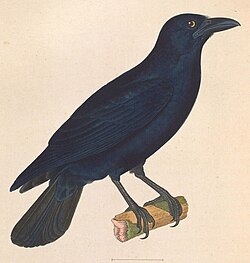
Measuring between 40 and 42 centimeters (16 to 17 inches) in length, the Cuban crow is a medium-sized forest bird with a robust frame. Its most striking feature is its large-headed profile, created by a long, deep bill that curves gently toward the tip. Unlike most members of the Corvus genus, its nasal bristles sweep forward and upward, frequently exposing the nostrils.
The bird's plumage is a deep black that exhibits a bluish-purple gloss when viewed in favorable light. Additional identifying marks include a patch of dark grey bare skin located behind the brownish-red eye and at the base of the lower mandible. Its bill, legs, and feet are entirely black.
Distribution and Habitat
The Cuban crow is commonly found throughout most of Cuba and the Isla de la Juventud, as well as the Turks and Caicos Islands. While it is naturally a forest crow, it is highly adaptable and frequently inhabits areas cleared for agriculture.
This adaptability is most evident around farms and villages, where the species lives in close proximity to human settlements. Whether in dense woodland or open agricultural fields, the Cuban crow is a resilient presence in its environment.
Diet and Behavior
The diet of the Cuban crow is opportunistic. It primarily feeds on insects and fruit, but it is also a frequent scavenger. These crows are often seen in large, noisy flocks feeding in trees or foraging on the ground, particularly where grain or seeds have been spilled in fields.
One of the most remarkable aspects of Corvus nasicus is its voice. Unlike the typical caws associated with other corvids, the Cuban crow produces strange, liquid bubbling notes and high ringing sounds. It is also known to emit a thin, rising screech described as "aaaaauh."
Breeding
Information regarding the breeding habits of the Cuban crow remains limited. It is known that they construct their nests in tall trees, though further detailed biological data on their reproductive cycles has yet to be recorded.
Species Summary
| Feature | Details |
|---|---|
| Length | 40–42 cm (16–17 in) |
| Plumage | Black with bluish-purple gloss |
| Key Habitat | Woodlands, agricultural areas, and villages |
| Dietary Habits | Omnivorous (Fruit, insects, seeds, scraps) |
| Conservation Status | Least Concern |
Frequently Asked Questions
How does the Cuban crow differ from other crows in its genus?
The Cuban crow is physically distinct due to its long, deep bill and the fact that its nostrils are often visible, whereas they are hidden in almost all other Corvus species.
Where can the Cuban crow be found?
It is native to the northern Caribbean, specifically across most of Cuba, the Isla de la Juventud, and the Turks and Caicos Islands.
What makes the call of the Cuban crow unique?
Unlike the standard calls of most corvids, the Cuban crow produces liquid bubbling notes, high ringing sounds, and a thin, rising screech.
Does the Cuban crow live near humans?
Yes, the species has adapted well to human presence and is frequently found around villages and farms, where it often scavenges for food scraps.
Is the Cuban crow an endangered species?
No, the Cuban crow is currently classified as Least Concern by the IUCN (version 3.1).