Croatian Popular Music: A Journey Through Pop, Rock, and the Dalmatian Sound
Croatian popular music is a vibrant tapestry of sounds, blending Mediterranean influences with global trends in rock, pop, and electronic music. From the sun-drenched coastlines of Dalmatia to the urban energy of Zagreb, the country has produced artists who have not only dominated local charts but have also left a mark on the international stage.
The scene is characterized by its diversity, ranging from the Dalmatian sound—a melodic style often performed at coastal festivals—to the edgy energy of the Novi val (New Wave) movement. Today, the landscape includes everything from mainstream pop icons and acclaimed singer-songwriters to influential hip hop and punk rock acts.
Key Facts
- Diverse Genres: Spans schlager, chanson, hard rock, synthpop, and modern hip hop.
- The Dalmatian Sound: A regional style influenced by the Adriatic coast, epitomized by artists like Oliver Dragojević.
- Novi val: A successful "New Wave" scene that emerged in the 1980s.
- Eurovision Success: Croatia has competed independently since 1993, achieving its best result (2nd place) in 2024.
- National Recognition: The Porin awards, established in 1994, serve as the country's premier music honors.
The Foundations: 1940s and 1950s
The roots of modern Croatian popular music can be traced back to the late 1940s with Ivo Robić. A pioneer of schlager (a style of sentimental popular song), Robić achieved international fame and collaborated with producer Bert Kaempfert. Notably, Robić authored the song that Frank Sinatra later popularized as "Strangers in the Night."
Simultaneously, rock and roll began to take hold in the 1950s. Karlo Metikoš, performing under the name Matt Collins, became one of Zagreb's first rock-n-roll stars before moving to Paris to record for Philips Records and interact with legends like Paul Anka and Jerry Lee Lewis.
Evolution Through the 1960s and 1970s
The 1960s saw the rise of influential groups such as Grupa 220, Crveni koralji, and Roboti. This era also birthed diverse solo careers; Ivica Percl transitioned from the loud sound of Roboti to become a protest singer-songwriter inspired by Bob Dylan and Joan Baez. Meanwhile, Tereza Kesovija brought chanson (a lyrical, storytelling song style) to the world stage, representing Monaco in the 1966 Eurovision Song Contest.
By the 1970s, the music shifted toward hard rock and progressive rock, led by acts like Dado Topić's Time and Atomsko sklonište. This decade also saw the formation of Parni valjak, led by Aki Rahimovski. The era closed with a punk rock explosion, spearheaded by the Rijeka-based group Paraf, who later evolved into post-punk.
The Golden Era of New Wave and the 1980s
The 1980s marked the arrival of Novi val (New Wave), a movement that produced some of Croatia's most enduring acts, including Azra, Haustor, Film, Aerodrom, and Prljavo Kazalište. This era is documented in the 2003 rockumentary Sretno dijete.
As the New Wave subsided, the decade branched into art rock, New Romanticism (with bands like Boa and Dorian Gray), and synthpop (such as the duo Denis & Denis). In Dalmatia, Tomislav Ivčić became a generational icon with his hit "Večeras je naša fešta," profoundly influencing the region's musical and political landscape.
The late 80s also saw the rise of pop groups like Magazin and Novi fosili, as well as Boris Novković and his band Noćna straža. In Split, the heavy metal group Osmi putnik emerged, featuring a young Gibonni, who would later become a major solo pop star.
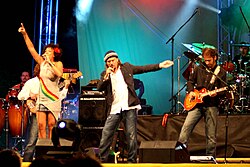
During the Yugoslav era, Croatian artists were dominant in the national preselection for Eurovision (Jugovizija). From 1986 to 1990, Yugoslavia was represented exclusively by Croatian acts, including Doris Dragović, Novi fosili, Srebrna krila, Riva (the 1989 winners), and Tajči.
Independence and the 1990s
The 1990 Eurovision Song Contest was hosted in Zagreb's Vatroslav Lisinski Concert Hall, featuring Tajči. Much of the success of this era was driven by the composer and producer Zrinko Tutić.
The Croatian War of Independence led to the creation of humanitarian projects like Hrvatski Band Aid and Rock za Hrvatsku, the latter featuring Jura Stublić's "E, moj druže Beogradski." Following independence, the music scene diversified further with the emergence of dance-pop (such as the group ET), pop acts like Baruni, and performers like Thompson and Daleka Obala.
Festivals and the Dalmatian Sound
Croatia is renowned for its coastal festivals, such as the Split Festival and the former Opatija Festival. These events showcase the Dalmatian sound, which blends folk elements with popular music, drawing comparisons to the Italian Canzone. Key figures in this tradition include Oliver Dragojević and Mišo Kovač.
Other notable festival performers include Vice Vukov—who represented Yugoslavia in 1963 and 1965—as well as Tereza Kesovija, Doris Dragović, Jasna Zlokić, and Meri Cetinić. The group Dubrovački trubaduri also contributed by incorporating Dubrovnik's renaissance music traditions.
| Era/Style | Key Artists/Groups | Defining Characteristics |
|---|---|---|
| 1940s-50s (Schlager/Early Rock) | Ivo Robić, Karlo Metikoš | International crossover, early rock-n-roll |
| 1960s-70s (Prog/Hard Rock/Punk) | Tereza Kesovija, Paraf, Time | Protest songs, hard rock, punk explosion |
| 1980s (Novi val/Synthpop) | Azra, Prljavo Kazalište, Denis & Denis | New Wave movement, electronic pop |
| 1990s-Present (Pop/Dance/Modern) | Severina, Jelena Rozga, Gibonni | Dance-pop, mainstream pop, Porin awards |
| Dalmatian Sound | Oliver Dragojević, Mišo Kovač | Mediterranean influence, coastal festivals |
Frequently Asked Questions
Who are the most prominent mainstream pop artists in Croatia?
Prominent mainstream artists include Oliver Dragojević, Gibonni, Dino Dvornik, Toni Cetinski, Thompson, Severina, and Jelena Rozga.
What is the "Novi val" scene?
Novi val, meaning "New Wave," was a successful musical movement in Croatia during the 1980s that included influential bands such as Prljavo Kazalište, Azra, Haustor, Film, and Aerodrom.
How has Croatia performed in the Eurovision Song Contest?
Croatia has participated as an independent nation since 1993. Its highest achievement to date was securing 2nd place in the 2024 contest.
What is the significance of the Porin awards?
Established in 1994, the Porins are Croatia's national music awards, recognizing excellence across various genres of popular music.
Which artists are associated with the Dalmatian sound?
The Dalmatian sound is most closely associated with artists like Oliver Dragojević and Mišo Kovač, and is frequently showcased at the Split Festival.