cosplay historycostume playfan conventionscrossplaycosplay craftsmanship

Cosplay: The Art and Evolution of Character Performance

The Art and Evolution of Cosplay: From Fan Costuming to Global Phenomenon Cosplay, a portmanteau of "costume play," is a vibrant performance art where participants, known as cosplayers, w...

The Art and Evolution of Cosplay: From Fan Costuming to Global Phenomenon

Cosplay, a portmanteau of "costume play," is a vibrant performance art where participants, known as cosplayers, wear intricate costumes and accessories to represent specific characters. While it often involves wearing a costume, true cosplay extends into performance, as participants frequently interact with others to build a shared subculture. This practice can involve any entity capable of dramatic interpretation, ranging from anime and manga to video games, comic books, television series, and even memes or original characters.
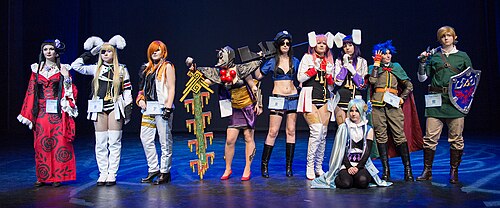
Cosplayers at Yukicon 2014, a fan convention in Finland
: Cosplayers at Yukicon 2014, a fan convention in Finland

The History and Origins of Cosplay

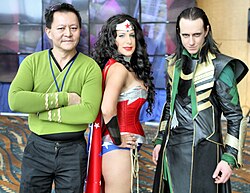
Three cosplayers at the Comic Con in Long Beach 2014, representing James T. Kirk (Star Trek), the superheroine Wonder Woman (DC Universe), and supervillain Loki (Marvel Universe)

The roots of cosplay can be traced back to the practice of fan costuming at science fiction conventions. One of the earliest recorded instances occurred at the 1st World Science Fiction Convention in New York City in 1939, where Morojo created "futuristicostumes" for herself and Forrest J Ackerman.
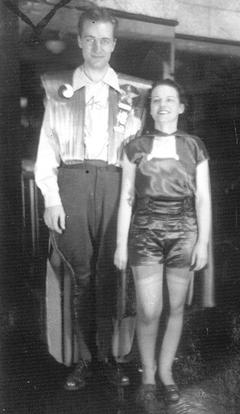
Forrest J Ackerman and Morojo at the 1st World Science Fiction Convention in "futuricostumes" designed and sewn by Morojo
: Forrest J Ackerman and Morojo at the 1st World Science Fiction Convention in "futuricostumes" designed and sewn by Morojo

While costuming has older historical precedents, such as the "Mr. Skygack" outfit from 1912, the modern term "cosplay" was officially coined in 1983 as a Japanese term (コスプレ, kosupure). Since the 1990s, the hobby has seen rapid growth, evolving into a significant pillar of popular culture in Japan, East Asia, and the Western world.

A Mr. Skygack – an early modern costuming or cosplay outfit, Washington state, 1912[10][11][12]
: A Mr. Skygack – an early modern costuming or cosplay outfit, Washington state, 1912[10][11][12]

The Practice: From Craftsmanship to Performance
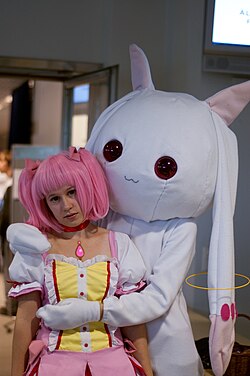
Madoka Kaname and Kyubey from Puella Magi Madoka Magica during Tracon 2013 event at the Tampere Hall in Tampere, Finland

Cosplay is a multi-faceted hobby that combines technical skill with theatrical ability. Participants often engage in crossplay (also known as gender-bending), which involves dressing as a character of a different gender. Today, the community is supported by a massive ecosystem of dedicated conventions, competitions, social networks, and specialized media.

Judging and Competition Criteria

In professional cosplay competitions, participants are often evaluated based on several key pillars of excellence. These criteria ensure that the tribute to the character is both visually stunning and performatively accurate.

Common Cosplay Judging Criteria
Category Description Examples
Accuracy How closely the look matches the source material. Hair styling, makeup, costume design, and props.
Craftsmanship The technical skill used to create the outfit. Material quality, level of detail, and percentage of handmade components.
Presentation The performance aspect of the cosplay. Acting, posture, movement, and use of iconic character phrases.
Audience Impact The ability to engage the crowd. Eye contact and effective use of stage space.
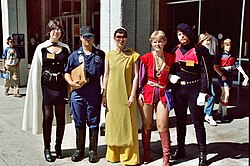
Photograph of five people standing together in costume
Costuming at the 1982 San Diego Comic-Con
: Costuming at the 1982 San Diego Comic-Con

Photography and Professionalism

As the hobby has matured, photography has become a central component. Many cosplayers work with professional photographers to capture high-quality images, sometimes using advanced techniques like chroma key (a green-screen method used to composite characters into digital backgrounds) to enhance the final result.

Professional photographers working with Mileena cosplayer for a chroma key studio photoshoot at Space City Con 2014 in the United States
: Professional photographers working with Mileena cosplayer for a chroma key studio photoshoot at Space City Con 2014 in the United States

Cosplay in the Modern World

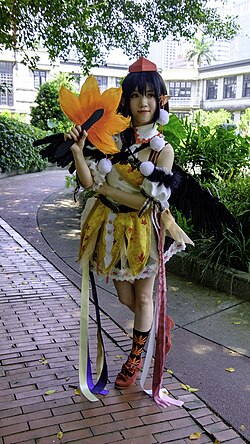
Cosplay of Aya Shameimaru from Touhou Project at the Hakurei Shrine Reitaisai in Taiwan 3, 2019

Cosplay has become a global language, with distinct styles and massive gatherings appearing in every corner of the world. From the massive crowds at Comiket in Japan to the bustling halls of San Diego Comic-Con, the community is diverse and expansive.

  • Japan: A major cultural driver, with famous gathering spots like the Jingūbashi in Tokyo.
  • Western Countries: Large-scale fan conventions serve as primary hubs for community interaction.
  • Global Events: Dedicated competitions and international festivals allow cosplayers to showcase their skills on a world stage.
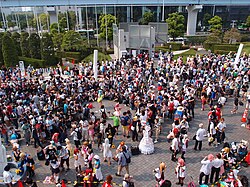
A crowd including many cosplayers at Comiket 84 in 2013
: A crowd including many cosplayers at Comiket 84 in 2013
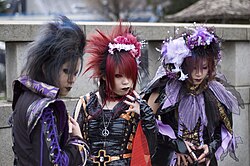
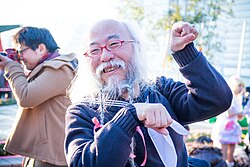
The Jingūbashi, which passes over the Yamanote Line south of Harajuku Station in Tokyo, near the gate of Meiji Shrine, is a well-known gathering place for cosplayers. Pictured is a group of people dressed as visual kei-style musicians in 2006.
: The Jingūbashi, which passes over the Yamanote Line south of Harajuku Station in Tokyo, near the gate of Meiji Shrine, is a well-known gathering place for cosplayers. Pictured is a group of people dressed as visual kei-style musicians in 2006.

Key Facts

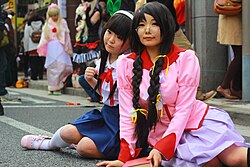
Monogatari series cosplayers at Nippombashi Street Festa 2014
  • Etymology: The word "cosplay" is a portmanteau of "costume" and "play."
  • Origins: Modern cosplay roots trace back to the 1939 World Science Fiction Convention.
  • Terminology: The term "cosplay" was coined in Japan in 1983.
  • Crossplay: This refers to the practice of cosplaying as a character of a different gender.
  • Scope: Subjects can include anime, manga, video games, movies, and original characters.

Frequently Asked Questions
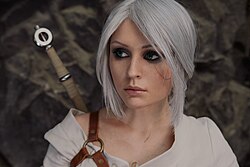
A model cosplaying Ciri, a main character of The Witcher 3: Wild Hunt
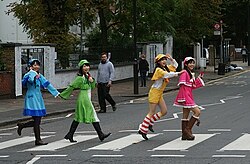
The four voice actresses of the Japanese manga/media franchise Milky Holmes reenacting the famous cover of the Beatles album Abbey Road (1969) during their London visit in 2010
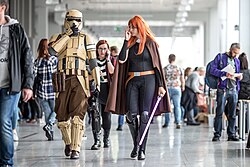
Cosplayers at the International Festival of Comics and Games in Łódź, 2019
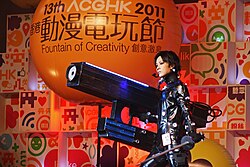
A cosplayer at the 2011 Animation-Comic-Game Hong Kong contest dressed as a character from Gantz
Hideaki Kobayashi, known for crossplaying as a schoolgirl.
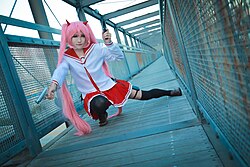
Aria H. Kanzaki from Aria the Scarlet Ammo by a crossplayer from New Zealand
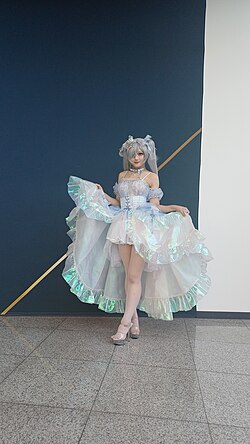
Goddess of Victory: Nikke Glass Princess Cinderella
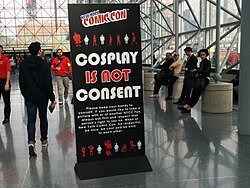
Tall black standing sign with the phrase "Cosplay Is Not Consent" in large lettering, alongside New York Comic Con branding and further explanatory text in smaller lettering.
"Cosplay Is Not Consent" sign at the 2014 New York Comic Con
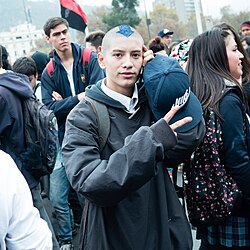
Student protest with a cosplay of Aang from Avatar: The Last Airbender
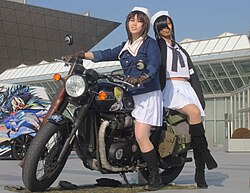
Women cosplaying as characters from Girls und Panzer in the itasha exhibition area during a fanzine sales event at Tokyo Big Sight.
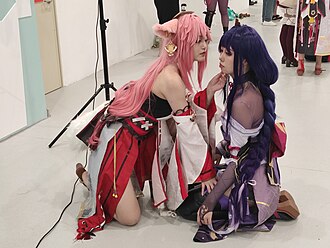
Yuri cosplay of Raiden Ei and Yae Miko from Genshin Impact at 2nd Nanjing Shuijing Guochao Games Carnival, 2023
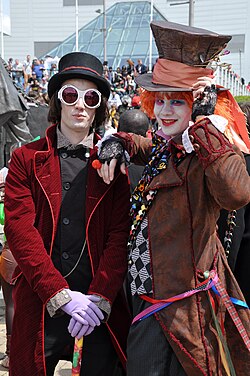
Willy Wonka (Charlie and the Chocolate Factory) and Tarrant Hightopp (Alice in Wonderland) at the 2013 London Comic Con. Both characters were portrayed by Johnny Depp in films directed by Tim Burton.

What is the difference between a costume and cosplay?

While a costume is simply the clothing worn, cosplay is considered a performance art. It involves not just wearing the outfit, but also embodying the character's personality, movements, and essence.

What is crossplay?

Crossplay, sometimes called gender-bending, is when a cosplayer chooses to portray a character of a different gender than their own.

How are cosplay competitions judged?

Judges typically look at three main areas: accuracy (how much the costume looks like the character), craftsmanship (the quality and detail of the construction), and presentation (the performer's ability to act like the character).

Can cosplay be used for things other than fun?

Yes. Cosplay has been used in various contexts, including student protests and as a form of professional modeling or commercial work.

What are some popular sources for cosplay?

Common inspirations include anime, manga, video games, comic books, television series, and musical artists.

References

  1. Mari Kotani's costume has sometimes been misreported as a Triton costume (from the manga Triton of the Sea) due to its visual similarity and because Kotani was known as a member of the TRITON fan club.
  2. Stuever, Hank (14 February 2000). "What Would Godzilla Say?". The Washington Post. Archived from the original on 29 September 2020. Retrieved 3 January 2008.
  3. "Meet the Woman Who Invented Cosplay". www.racked.com. 9 May 2016. Archived from the original on 24 October 2023. Retrieved 7 March 2023.
  4. "Nobuyuki (Nov) Takahashi " YeinJee's Asian Blog: The Origin of the word cosplay". Yeinjee.com. 3 July 2008. Archived from the original on 5 July 2012. Retrieved 3 October 2011.
  5. Ashcraft, Brian; Plunkett, Luke (2014). Cosplay World. Prestel Publishing. pp. 19–22. ISBN 9783791349251.