Coracoid Bone: Anatomy and Evolution Across Vertebrates
The coracoid is a specialized paired bone that forms a critical part of the shoulder assembly in the vast majority of vertebrates. Derived from the Greek words koraks (raven) and eidos (resembling), the name literally means "like the beak of a raven," a description coined by ancient anatomists who noted its distinct shape.
While it serves as a foundational element for limb attachment in fish, reptiles, and birds, its role and structure have shifted significantly throughout evolutionary history, particularly in the transition to mammals.
Key Facts
- The coracoid is a paired bone found in almost all vertebrates except therian mammals.
- In tetrapods, it connects the scapula (shoulder blade) to the sternum (breastbone).
- It helps form the socket for the proximal end of the humerus (upper arm bone).
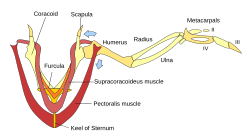
- In birds, the coracoid and scapula fuse into a rigid unit called the scapulocoracoid, which is essential for flight.
- Therian mammals possess a coracoid process, but it is not homologous to the coracoid bone found in other vertebrates.
The Coracoid in Different Species
Fish and Early Vertebrates
In fish, the coracoid serves a primary structural purpose by providing the necessary base for the pectoral fin, allowing for stability and movement in aquatic environments.
Tetrapods and Dinosaurs
In tetrapods (four-limbed vertebrates), the coracoid joins the scapula to the front end of the sternum. The bone features a notch on its dorsal (upper) surface; when paired with a similar notch on the ventral (lower) surface of the scapula, it creates the socket that houses the humerus.
Adjacent to this contact surface is the acrocoracoid process, an expansion that serves as the attachment point for the shoulderward end of the biceps brachii muscle. In non-avian dinosaurs, the coracoid and scapula both articulated directly with the clavicle.
Avian Anatomy and Flight
In birds, as well as theropods and related animals, the coracoid and scapula form a single, rigid unit known as the scapulocoracoid. This structural rigidity is a major adaptation that supports the mechanical stresses of bird flight.
Mammalian Evolution
The coracoid bone is absent in therian mammals (which include placentals and marsupials). While humans and other therians have a "coracoid process" as part of the scapula, this structure is not homologous—meaning it does not share a direct evolutionary origin—with the coracoid bone of other vertebrates.
Interestingly, monotremes (egg-laying mammals) and extinct therapsids represent an evolutionary middle ground. They possess both the reptile-like coracoid bone (also known as the procoracoid or anterior coracoid) and the mammalian coracoid process as a separate bone.
Comparative Anatomy Summary
| Group | Coracoid Status | Primary Function/Feature |
|---|---|---|
| Fish | Present | Base for pectoral fins |
| Tetrapods | Present | Connects scapula to sternum; forms humerus socket |
| Birds | Fused (Scapulocoracoid) | Provides rigidity for flight |
| Monotremes | Dual Presence | Possess both procoracoid and separate coracoid process |
| Therian Mammals | Absent (as a bone) | Coracoid process exists as part of the scapula |
Frequently Asked Questions
What is the coracoid bone?
The coracoid is a paired bone in the shoulder assembly of most vertebrates that typically connects the shoulder blade to the breastbone and helps form the shoulder joint.
Why is the coracoid important for birds?
In birds, the coracoid fuses with the scapula to form the scapulocoracoid. This rigid structure is essential for supporting the muscles and mechanical forces required for flight.
Do humans have a coracoid bone?
No. Humans are therian mammals, meaning we do not have a separate coracoid bone. We have a coracoid process, which is a projection of the scapula, but it is not the same structure as the coracoid bone found in other vertebrates.
What is the acrocoracoid process?
The acrocoracoid process is an expansion of the coracoid bone located near the shoulder socket, serving as the attachment point for the biceps brachii muscle in various animals.
How do monotremes differ from other mammals regarding the coracoid?
Unlike therian mammals, monotremes retain both the ancestral reptile-like coracoid bone (procoracoid) and the mammalian coracoid process as a distinct bone.