Copolymers: Chemistry, Structures, and Industrial Applications
In the field of polymer chemistry, a copolymer is a polymer derived from more than one species of monomer. While a homopolymer consists of a single repeating unit, copolymers allow scientists to blend the properties of different monomers into a single macromolecule. The process of creating these materials is known as copolymerization.
Depending on the number of monomer species involved, copolymers are categorized as bipolymers (two monomers), terpolymers (three), or quaterpolymers (four). These materials are essential in modern manufacturing, used in everything from high-performance adhesives to advanced drug delivery vehicles.
Key Facts
- Composition: Copolymers are formed from two or more different monomer species.
- Production: They are synthesized via chain-growth polymerization (e.g., ABS, SBR) or step-growth polymerization (e.g., nylon-12/6/66).
- Control: The final structure is determined by reactivity ratios and the Mayo–Lewis equation.
- Analysis: Common characterization techniques include NMR spectroscopy and size-exclusion chromatography.
- Self-Assembly: Certain block copolymers can undergo microphase separation to create periodic nanostructures.
The Science of Copolymerization
Reactivity Ratios and the Mayo–Lewis Equation
The arrangement of monomers in a copolymer chain is not random; it is governed by the reactivity ratio. This ratio compares the rate constant of a growing chain adding a monomer of its own type versus adding a monomer of a different type.
The Mayo–Lewis equation (also known as the copolymerization equation) uses these ratios to predict the instantaneous rates of monomer incorporation. This allows chemists to determine whether a polymer will be random, alternating, or blocky based on the initial mole fractions of the monomers.
Characterization Techniques
To ensure the material meets specific industrial standards, researchers use several analytical tools. NMR spectroscopy is used to determine composition, while size-exclusion chromatography helps identify the molecular weight and size distribution of the polymer chains.
Types of Linear Copolymers
Block Copolymers
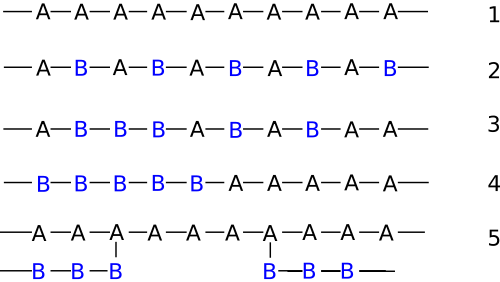
Block copolymers consist of long sequences of one monomer followed by long sequences of another. Synthesis requires reactivity ratios much larger than unity (r1 >> 1, r2 >> 1), meaning the chain prefers to add the same monomer repeatedly before switching. A measure called the block index is often used to quantify the deviation from a random distribution.
Alternating and Periodic Copolymers
An alternating copolymer follows a strict A-B-A-B pattern. This typically occurs when reactivity ratios are close to zero, meaning each monomer preferentially reacts with the opposite species. An example is the free-radical copolymerization of styrene and maleic anhydride.
Step-growth copolymers, such as nylon 66, are formed by the condensation of bifunctional monomers (A-A and B-B), resulting in a perfectly alternating structure, though these are often viewed as homopolymers of a dimeric repeat unit.
Statistical and Gradient Copolymers
In statistical copolymers, the sequence follows a statistical rule. If the probability of finding a monomer at a specific point equals its mole fraction in the chain, it is considered a random copolymer. In contrast, gradient copolymers feature a composition that changes gradually along the length of the chain.
Stereoblock Copolymers
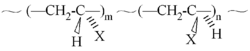
Stereoblock copolymers are unique because the blocks differ not by monomer species, but by tacticity (the spatial arrangement of the side groups along the polymer backbone).
Non-Linear and Branched Architectures
Beyond linear chains, copolymers can take on complex geometric shapes to alter their physical properties.
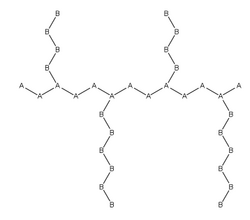
- Graft Copolymers: These consist of a main polymer backbone to which one or more side chains are covalently bonded.
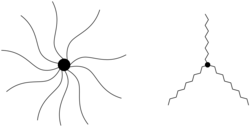
- Star Copolymers: Multiple polymer chains are connected to a single central core.
- Other Architectures: This includes comb-like, brush, cyclic, and network (cross-linked) structures.
Microphase Separation and Nanostructures
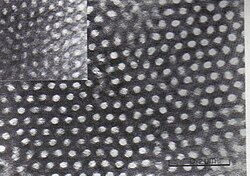
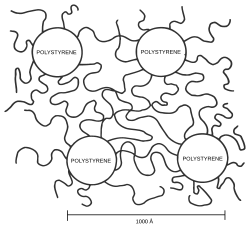
One of the most significant properties of block copolymers is their ability to microphase separate. Because the different blocks are often incompatible, they separate into periodic nanostructures. This is analyzed using the Flory-Huggins interaction parameter (χ). If the product of the degree of polymerization (n) and χ is greater than 10.5, the blocks will separate.
A commercial example is Kraton (styrene-butadiene-styrene block copolymer), used in adhesives and shoe soles. These materials can also self-assemble in selective solvents to form micelles, which are highly useful in nanotechnology and medicine.
Summary of Copolymer Classifications
| Copolymer Type | Linker/Prefix | Structural Characteristic |
|---|---|---|
| Random | -ran- | Statistical distribution of monomers |
| Alternating | -alt- | Regular A-B-A-B sequence |
| Block | -block- | Long sequences of identical monomers |
| Graft | branch- | Side chains attached to a main backbone |
| Star | star- | Chains radiating from a central core |
| Network | net- | Cross-linked three-dimensional structure |
Frequently Asked Questions
What is the difference between a copolymer and a homopolymer?
A homopolymer is made from only one type of monomer, whereas a copolymer is derived from two or more different species of monomers.
How does the Mayo–Lewis equation help chemists?
It allows chemists to predict the composition and structural type of a copolymer based on the reactivity ratios of the monomers involved.
What are some common commercial examples of copolymers?
Common examples include ABS (acrylonitrile butadiene styrene), SBR (styrene/butadiene rubber), nitrile rubber, and ethylene-vinyl acetate.
What is microphase separation?
Microphase separation occurs in block copolymers when incompatible polymer blocks separate into distinct, periodic nanostructures rather than mixing uniformly.
What is a graft copolymer?
A graft copolymer is a branched structure where side chains of one monomer are covalently bonded to the main backbone of a different monomer.