Copiapó Administration and Municipal Governance
Copiapó serves as a third-level administrative division within the Republic of Chile. As a commune, its local governance is structured around a municipal council, which is led by an alcalde (mayor). The alcalde is directly elected by the citizens every four years to oversee the administration of the commune.
The municipal council is composed of several members representing various political affiliations, ensuring a range of perspectives in local decision-making. For the 2012-2016 term, the council was headed by Independent alcalde Maglio Cicardini, supported by a diverse group of councilors including representatives from the Communist Party (PC), Party for Democracy (PPD), Socialist Party (PS), and National Renewal (RN).
Key Facts
- Administrative Level: Third-level administrative division of Chile.
- Leadership: Led by an alcalde elected every four years.
- Political Diversity: The council includes Independent members and representatives from PC, PPD, PS, and RN.
- Congressional Reach: Represented in both the Chamber of Deputies (5th district) and the Senate (3rd constituency).
Evolution of Municipal Politics
Since the return to democracy in 1990, Copiapó has held six mayoral elections, reflecting a dynamic political landscape characterized by shifts between independent and party-affiliated leadership.
The Tenure of Mónica Calcutta (1992–1996)
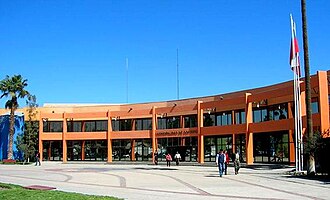
In 1992, Mónica Calcutta of the PPD won the election against 24 candidates. Her administration focused heavily on urban development and public infrastructure. Key achievements included the paving of streets and the creation of parks and green areas. Notable projects completed during her term include the new City Hall building (1994), the Estadio Techado (1996), and the Technological School (1997). She also promoted civic engagement through initiatives like the "Train of History" in 1994 and 1995, marking the 250th anniversary of Copiapó. Remarkably, despite these investments, the City Hall remained debt-free by 1996.
The Era of Marcos López (1996–2008)
In 1996, Marcos López of the Socialist Party defeated Calcutta by a narrow margin of 146 votes. López's first term was initially quiet regarding visible public spending, with most projects appearing just before the next election. In the confrontational 2000 election, López secured a decisive victory with 50.07% of the vote.
During his second term, López oversaw significant infrastructure improvements funded partly by the Central Government to prepare for the bicentennial of Chilean Independence. These projects included the redesign of the City Chamber, Matta Avenue, and the Central Square. López was elected to a third term in 2004, defeating René Aedo (RN) with 50.01% of the vote.
Recent Leadership Shifts (2008–2016)
The political tide shifted in 2008 when independent candidate Maglio Cicardini Neyra defeated López by less than 1% of the vote. Cicardini maintained his position in 2012, winning with over 50% of the vote. However, the cycle continued in 2016, when Marcos López returned to office after defeating Cicardini.
Congressional Representation
Beyond local municipal governance, Copiapó is represented at the national level in the Chilean legislature.
Chamber of Deputies
As part of the 5th electoral district—which includes Chañaral and Diego de Almagro—Copiapó is represented by Lautaro Carmona (PC) and Daniella Cicardini Milla (Independent, backed by the PS).
The Senate
At the senatorial level, the commune is part of the 3rd senatorial constituency covering the Atacama Region. It is represented by Isabel Allende Bussi (PS) and Baldo Prokurica Prokurica (RN).
Administrative Summary
| Governance Level | Representative/Body | Scope/District |
|---|---|---|
| Municipal | Alcalde and Municipal Council | Copiapó Commune |
| Legislative (Lower) | Chamber of Deputies | 5th Electoral District |
| Legislative (Upper) | Senate | 3rd Senatorial Constituency |
Frequently Asked Questions
How is the mayor of Copiapó selected?
The alcalde is directly elected by the citizens of the commune every four years.
What were the major infrastructure projects under Mónica Calcutta?
Her term saw the construction of the new City Hall (1994), the Estadio Techado (1996), and the Technological School (1997), alongside various street paving and green area projects.
Who represented Copiapó in the Senate for the Atacama Region?
The commune was represented by Isabel Allende Bussi of the Socialist Party (PS) and Baldo Prokurica Prokurica of National Renewal (RN).
Which electoral district does Copiapó belong to for the Chamber of Deputies?
Copiapó is part of the 5th electoral district, which it shares with Chañaral and Diego de Almagro.
How did the 2000 mayoral election conclude?
Despite surveys suggesting a tie, Marcos López won the election with 50.07% of the votes, while Mónica Calcutta received 31.52%.