Continental Poles of Inaccessibility: The Farthest Points from the Ocean
In geography, a continental pole of inaccessibility is defined as the location on a landmass that is the farthest possible distance from any coastline. These points represent the absolute heart of continents, often located in remote deserts or wilderness areas where the influence of the ocean is at its minimum.
While these locations may seem like mere mathematical curiosities, they often become targets for explorers and geographers seeking to reach the most isolated spots on Earth. Because coastline definitions can vary based on the datasets used, some continents have multiple proposed poles.
Key Facts
- The Eurasian pole is the farthest point from any ocean anywhere on Earth.
- The African pole was first knowingly reached by a human in December 2021.
- The North American pole is located on the Pine Ridge Reservation in South Dakota.
- Australia's pole is the closest of the five continental poles to a coastline, at 920 km.
- Some poles, such as those in Eurasia and South America, have multiple proposed locations due to differing coastline data.
Eurasia: The Earth's Most Isolated Land Point
The Eurasian pole of inaccessibility (EPIA) is located in northwestern China, near the border of Kazakhstan. Because Eurasia is the largest continent, this region contains the point farthest from the ocean on the entire planet.
Earlier calculations placed the pole in the Gurbantünggüt Desert, approximately 320 km north of Ürümqi in the Xinjiang Autonomous Region, at a distance of 2,645 km from the nearest coast. This location is surrounded by small settlements including Suluk, Xazgat Township, and Hoxtolgay Town.
However, a 2007 study suggested that previous calculations ignored the Gulf of Ob. This led to the proposal of two alternative locations: EPIA1 and EPIA2. These points are located near the Dzungarian Gate—a historical migration route—and are approximately 2,510 km and 2,514 km from the ocean, respectively. EPIA2 is situated near the settlement of K̂as K̂îr Su in the K̂îzîlk̂um region.
Separately, in 1992, local experts designated a site in the southwestern suburbs of Ürümqi as the "center point of Asia," which now serves as a tourist attraction with a commemorative monument.
Africa: The Heart of the Continent
The African pole of inaccessibility is located at 5°39′N 26°10′E, approximately 1,814 km from the coast. This remote point is situated near the town of Obo in the Central African Republic, close to the tripoint where the borders of the Central African Republic, South Sudan, and the Democratic Republic of the Congo meet.
For decades, this point remained unvisited by those aware of its exact location until December 7, 2021, when Chris Brown became the first person to knowingly reach it.
North America: The American Interior
In North America, the pole of inaccessibility is found in southwest South Dakota on the Pine Ridge Reservation. Located about 11 km north of the town of Allen, it sits 1,650 km from the nearest coastline.
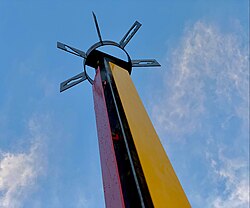
The first documented visit occurred on October 3, 2014, by Jerry and Jenny Penry and local resident Joey Bear Killer. In 2021, a marker was installed at the site to represent the four colors of the Lakota Medicine Wheel and the 7 Lakota Values.
South America: Brazilian Isolation
The primary South American pole of inaccessibility is located in Brazil near Arenápolis, Mato Grosso, at a distance of 1,504 km from the coast. In 2017, the Turner Twins completed a journey on foot from the coast of Chile to this point, becoming the first to do so.
Interestingly, research in 2019 revealed a second potential pole of inaccessibility to the north. The exact position of this second pole varies significantly depending on which coastline dataset is utilized.
Australia: The Island Continent
Due to its smaller size and island nature, Australia's pole of inaccessibility is much closer to the sea than those of other continents. It is located 920 km from the nearest coastline, approximately 161 km west-northwest of Alice Springs.
The nearest inhabited area is the town of Papunya in the Northern Territory, located about 30 km west-southwest of the pole.

Summary of Continental Poles
| Continent | Approximate Distance to Coast | Primary Location/Region | Notable Feature |
|---|---|---|---|
| Eurasia | 2,510 – 2,645 km | Xinjiang, China | Farthest point from ocean on Earth |
| Africa | 1,814 km | Central African Republic | Near the CAR/South Sudan/DRC tripoint |
| North America | 1,650 km | South Dakota, USA | Located on Pine Ridge Reservation |
| South America | 1,504 km | Mato Grosso, Brazil | Two proposed poles exist |
| Australia | 920 km | Northern Territory, Australia | Closest to coast of all continental poles |
Frequently Asked Questions
Which is the farthest point from the ocean on Earth?
The Eurasian pole of inaccessibility, located in northwestern China, is the farthest point from any ocean on the planet, with distances estimated between 2,510 km and 2,645 km depending on the coastline definition used.
Why are there different coordinates for the Eurasian pole?
Different coordinates exist because some calculations include the Gulf of Ob as part of the ocean while others do not. A 2007 study proposed two alternative locations (EPIA1 and EPIA2) to account for these differences in coastline definition.
Who was the first person to reach the African pole of inaccessibility?
Chris Brown became the first person to knowingly reach the African pole of inaccessibility on December 7, 2021.
Where is the North American pole of inaccessibility located?
It is located in southwest South Dakota on the Pine Ridge Reservation, approximately 11 km north of the town of Allen.
Does South America have more than one pole of inaccessibility?
Yes, while the primary pole is in Mato Grosso, Brazil, a second pole was discovered to the north in 2019, though its exact position varies based on the coastline dataset used.