Constantius II: The Turbulent Reign of a Constantinian Emperor
Constantius II (7 August 317 – 3 November 361) was a Roman emperor whose rule was defined by a relentless struggle for stability. As a member of the Constantinian dynasty, he ascended to power during a period of immense transition, facing the dual pressures of external invasions and internal betrayal. His reign was a cycle of constant warfare on the empire's borders and a series of bloody civil wars that tested the resilience of the Roman state.
From his early appointment as Caesar to his eventual status as the sole ruler of the empire, Constantius II navigated a world of court intrigue and religious upheaval. While he sought to maintain the legacy of his father, Constantine the Great, his policies often inflamed the very conflicts he sought to resolve.
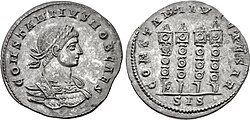
Key Facts
![Bust of youthful Constantius II or Constans, Capitoline Museums[13][14]](/images/06/8b/068b3a9523c96bffb44411bea9f0a7b7694324651052f2ca953cad6ebbe963e1.jpg)
- Reign: 337 to 361 AD.
- Dynasty: Constantinian.
- Major Conflicts: Wars against the Sasanian Empire, Germanic tribes, and the usurper Magnentius.
- Religious Affiliation: Semi-Arianism.
- Successor: Julian.
- Death: Died at age 44 in Mopsuestia, Cilicia.
Rise to Power and Early Rule
![Section of a belt containing two gold medallions, the larger coin depicting the triumphant emperor in his chariot;[63] The Walters Art Museum](/images/00/1d/001d059b05789752344d2397063f64ce57522b1d9b55af8c0840b8ae58924423.jpg)
Born in Sirmium, Pannonia Inferior, Constantius was the son of Constantine the Great and Fausta. He was appointed to the rank of Caesar (a subordinate imperial rank) on 8 November 324, serving as a junior emperor before becoming an Augustus (the senior imperial title) in 337.
![Bust of Constantius II while he was a prince, Romano-Germanic Museum, Cologne[5]](/images/19/57/1957d80c9e9dfdd22b578a6b67fecac4cc96b13f93e72f400375f5cf22f65037.jpg)
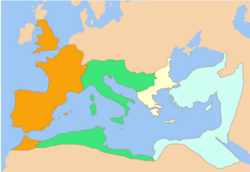
The early years of his reign were characterized by shared power. He co-ruled with his brothers, Constantine II and Constans I, as well as various other figures over the decades. This division of power was intended to manage the vast territories of the empire but often led to friction and rivalry.
The War Against Magnentius
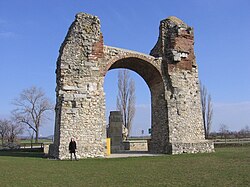
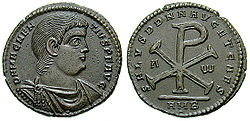
One of the most significant challenges to Constantius II's authority was the rise of the usurper Magnentius. Refusing to accept Magnentius as a legitimate co-ruler, Constantius engaged in a brutal civil war to reclaim control of the Western provinces.
The conflict reached its peak at two decisive engagements: the Battle of Mursa Major in 351 and the Battle of Mons Seleucus in 353. Following the defeat at Mons Seleucus, Magnentius committed suicide, finally leaving Constantius as the sole ruler of the Roman Empire.
Solo Reign and Internal Strife
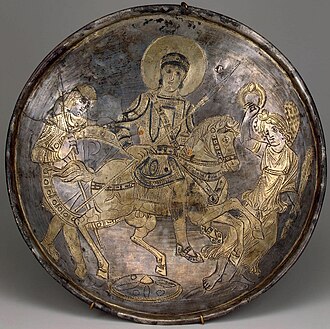
Despite achieving sole rule, Constantius II continued to struggle with administrative stability. In 351, he appointed his cousin, Constantius Gallus, as Caesar to govern the east. However, reports of Gallus's corruption and violent nature led the emperor to have him executed in 354.
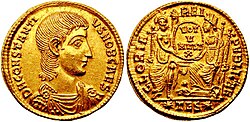
To fill the void in the east, Constantius promoted another cousin, Julian, to the rank of Caesar in 355. This appointment would eventually lead to further crises as Julian's own ambitions and differing ideologies clashed with those of the emperor.
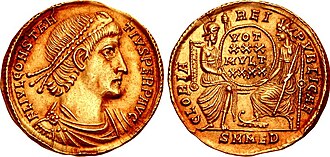
Religious Policies and Social Conflict
![Presumed bust of Constantius II (or Valens), from an exhibition at the Colosseum, 2013[117]](/images/c9/48/c948b73ecd93f1af80d9d958dfd5dd98126741c857e5ee98194e4a63bb0626ed.png)
Constantius II was a proponent of Semi-Arianism, a theological position regarding the nature of Christ that differed from the Nicene creed. His attempts to enforce this religious view across the empire created deep divisions within the Christian church and led to domestic conflicts.
His religious policies extended beyond Christianity, affecting the empire's relationship with Pagans and Jewish communities. These tensions created a volatile social atmosphere that persisted long after his death.
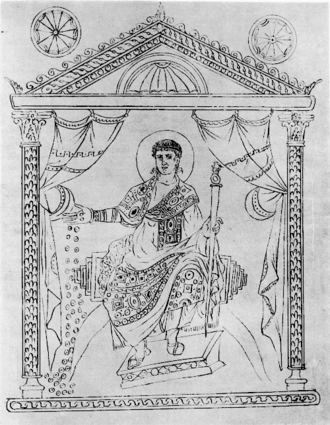
Final Years and Legacy
The latter part of his reign was marred by the usurpation of Julian and continued pressure from the Sasanian Empire. Constantius II died on 3 November 361 in Mopsuestia, Cilicia, at the age of 44. He was buried in the Church of the Holy Apostles.
![Base of a equestrian statue of Constantius in the Roman Forum (CIL VI, 1158)[86]](/images/30/f4/30f43f5fb1f094455d7141442f9d19077bd120215fe1cd4ffe5d290ae970cce7.jpg)
His legacy is one of endurance and controversy. While he successfully defended the borders and unified the empire after the fall of Magnentius, his reliance on court intrigue and his rigid religious policies left a fractured state for his successor, Julian.
![Solidus of Constantius II with a three-quarter facing portrait, struck c. 355. This obverse later served as the model for most Byzantine coinage after 395.[121]](/images/06/d8/06d8986a8cda8ff9c53609d5d53ec3048d43c65ab9a64c662f5a9536a71c0a1d.jpg)
Summary of Imperial Profile
| Attribute | Details |
|---|---|
| Full Name | Flavius Julius Constantius |
| Born | 7 August 317, Sirmium |
| Died | 3 November 361, Mopsuestia |
| Parents | Constantine the Great and Fausta |
| Spouse | Faustina (daughter of Julius Constantius Eusebia) |
| Key Successor | Julian |
Frequently Asked Questions
Who was Constantius II?
Constantius II was a Roman emperor of the Constantinian dynasty who ruled from 337 to 361 AD. He is known for his long struggle against usurpers and his efforts to defend the empire against the Sasanian and Germanic peoples.
How did Constantius II deal with the usurper Magnentius?
Constantius II waged a civil war against Magnentius, defeating him in two major battles: Mursa Major in 351 and Mons Seleucus in 353. Magnentius committed suicide following the second defeat.
What was the religious stance of Constantius II?
Constantius II followed Semi-Arianism. His efforts to impose this specific theological view on the empire caused significant internal conflict and religious strife.
Who were the Caesars appointed by Constantius II?
Constantius II appointed his cousin Constantius Gallus as Caesar in 351 (who was later executed) and his other cousin, Julian, as Caesar in 355.
Where did Constantius II die and where was he buried?
He died in Mopsuestia, Cilicia, on 3 November 361 and was buried in the Church of the Holy Apostles.