Conspicuous Gallantry Cross
The Conspicuous Gallantry Cross (CGC) is a prestigious second-level military decoration awarded by the United Kingdom. It recognizes exceptional bravery and acts of conspicuous gallantry during active operations against an enemy. As one of the highest honors in the British honours system, it is surpassed only by the Victoria Cross in terms of combat gallantry.
Key Facts
- Established: October 1993; first awarded in 1995.
- Eligibility: All ranks of the British and allied forces.
- Purpose: To recognize conspicuous gallantry during active operations against the enemy.
- Total Awards: 61 (including one unit award).
- Posthumous Awards: 3 recipients.
- Design: A silver cross patée with a laurel wreath and the Royal Crown.
History and Evolution
The CGC was instituted following a comprehensive 1993 review of the British honours system. The primary objective of this reform was to remove distinctions of rank when awarding gallantry decorations, ensuring that bravery was recognized equally regardless of a service member's position.
Before the creation of the CGC, different medals were awarded based on rank. The CGC replaced the Distinguished Conduct Medal (for Army other ranks) and the Conspicuous Gallantry Medal (for Naval and Air other ranks). It also took over the role of the Distinguished Service Order (DSO) as the second-level gallantry award for officers, although the DSO was retained specifically to recognize outstanding leadership. Designed and sculpted by Michael Rizzello for the Royal Mint, the CGC now serves as the universal second-level award for all ranks across the Royal Navy, Royal Marines, British Army, and Royal Air Force.
Eligibility and Recognition
The CGC is awarded to members of British and allied forces who perform acts of conspicuous gallantry during active combat operations. Because the award recognizes extreme bravery, it can be granted posthumously. Recipients are entitled to use the postnominal letters CGC after their name.
In cases where a recipient performs further acts of gallantry that would merit the award again, a bar is added to the medal. For those wearing only the ribbon bar, a silver rosette is used to indicate that a bar has been awarded. To date, no second award bars have been issued.
Physical Appearance and Design
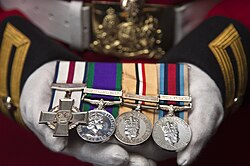
The medal is a silver cross patée (a type of Christian cross with arms that are narrow at the center and broad at the perimeter), measuring up to 36 mm in width. A laurel wreath is positioned behind the cross, visible between its arms.
The obverse (front) features a circular central panel depicting the St Edward's crown. The reverse is left plain to allow for the engraving of the recipient's rank, name, unit, and the date the award was granted. The medal is suspended from a 32 mm wide white ribbon, characterized by two narrow dark blue edges and a central crimson stripe.
Summary of the Conspicuous Gallantry Cross
| Feature | Details |
|---|---|
| Country | United Kingdom of Great Britain and Northern Ireland |
| Presented By | Monarch of the United Kingdom |
| Order of Wear | Below MBE; Above Distinguished Conduct Medal |
| Material | Silver |
| Total Awarded | 61 (including 1 unit award) |
| Posthumous Awards | 3 |
Frequently Asked Questions
What is the difference between the Victoria Cross and the CGC?
The Victoria Cross is the highest award for gallantry in the face of the enemy, while the Conspicuous Gallantry Cross is the second-level award.
Who is eligible to receive the Conspicuous Gallantry Cross?
All ranks of the Royal Navy, Royal Marines, British Army, and Royal Air Force, as well as allied forces, are eligible.
Can the CGC be awarded to a whole military unit?
Yes. While primarily an individual award, one unit award has been granted, specifically to the Royal Irish Regiment / Ulster Defence Regiment in 2006.
What do the postnominal letters CGC signify?
The letters CGC are postnominal titles that recipients are entitled to use after their name to signify they have been awarded the Conspicuous Gallantry Cross.
How is a second award of the CGC recognized?
A second award is recognized by a bar added to the medal. On a ribbon bar, this is indicated by a silver rosette.