Confucianism: Philosophy, Ethics, and the Social Order of East Asia
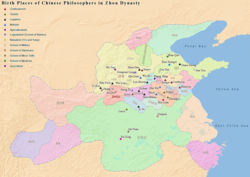
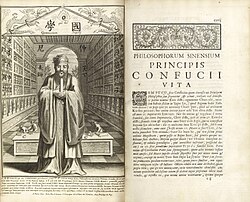
Confucianism is a profound system of thought that has shaped the cultural, political, and social fabric of East Asia for millennia. Known in Chinese as Rújiā (the Ru school of thought), Rújiào (Ru religious doctrine), or Rúxué (Ru studies), it transcends a simple definition, functioning simultaneously as a philosophy, a social code, and a religious tradition. From its origins in the Zhou dynasty to its influence on modern governance, Confucianism emphasizes the cultivation of virtue and the maintenance of social harmony through structured relationships.
At its core, the tradition seeks to align human behavior with the cosmic order, promoting a vision of society where merit, righteousness, and respect for tradition create a stable and flourishing civilization.
Key Facts
- Core Goal: Achieving social harmony through personal virtue and the rectification of relationships.
- Central Figures: Founded on the teachings of Confucius, later expanded by various schools including Neo-Confucianism.
- Key Virtues: Ren (benevolence), Yi (righteousness), Li (propriety), Zhi (wisdom), and Xin (faithfulness).
- Political Legacy: Established a system of political meritocracy and the imperial examination system in China, Korea, and Vietnam.
- Cosmology: Centers on Tian (Heaven), the supreme pivot and vault of the sky.
Theology and the Concept of Tian
Confucianism views the universe through the lens of Tian (Heaven). Rather than a personal deity in the Western sense, Tian represents the northern celestial pole—the pivot around which the constellations spin. It is the supreme power that governs the natural and moral order of the world.
![Zhou dynasty oracular version of the grapheme for Tian, representing a man with a head informed by the north celestial pole[28]](/images/de/90/de90a49366d69b134e95251cab33855a92316322bbed05e172d88e482ba7ba84.webp)
Confucius taught that to pray to the gods appropriately, one must first know and respect Heaven. He emphasized that religious rituals are not mere formalities but meaningful experiences. To Confucius, offering sacrifices in person is essential; without presence and sincerity, the act is considered meaningless. These rites serve an ethical purpose, helping the individual overcome the self and connect with the divine and ancestral lineages.
![Like other symbols such as the sauwastika,[34] 卍 (wàn; 'all things') in Chinese, the Mesopotamian dingir or anu 𒀭𒀭,[35] and also the Chinese 巫; wu; 'shaman' (in Shang script represented by a graph resembling the cross potent ☩),[36] Tian refers to the northern celestial pole (北極; běijí), the pivot and the vault of the sky with its spinning constellations.[37] Here is an approximate representation of the tiānmén (天門; 'gate of heaven').[38] or tiānshū (天樞; 'pivot of heaven')[39] as the precessional north celestial pole, with α Ursae Minoris as the pole star, with the spinning Chariot constellations in the four phases of time. According to Reza Assasi's theories, the 卍 may not only be centred in the current precessional pole at α Ursae Minoris, but also very near to the north ecliptic pole if Draco (天龙; 天龍; Tiānlóng) is conceived as one of its two beams.[40][note 1]](/images/5e/1d/5e1dab3794f963bab34667f49edefe80feb4eeafce1ad388e01d3a5a73acd3cc.webp)
The dragon is often used as a symbol of this supreme godhead (Di or Tian), representing a protean power that encompasses both yin and yang, coiling around the north ecliptic pole.
![The dragon is one of the oldest symbols of Chinese religious culture. It symbolises the supreme godhead, Di or Tian, at the north ecliptic pole, around which it coils itself as the homonymous constellation. It is a symbol of the "protean" supreme power which has in itself both yin and yang.[72]](/images/0b/f2/0bf2ac8af95f6b0c0f42c26ae9a2909a93f4bff7b826e875e5833cbe6ae2f518.jpg)
Social Morality and Ethical Pillars
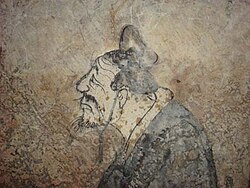
The practical application of Confucianism lies in its rigorous ethical framework. The goal is to become a Junzi, or an exemplary person, through the cultivation of specific virtues:
- Ren (Benevolence): The fundamental virtue of humaneness and empathy toward others.
- Yi (Righteousness): The moral disposition to do what is right and just.
- Li (Propriety): The adherence to rites, etiquette, and social norms that maintain order.
- Zhi (Wisdom): The ability to discern right from wrong.
- Xin (Sincerity): Faithfulness and trustworthiness in one's words and actions.
Beyond these pillars, Confucianism places immense value on Filial Piety (xiào), the respect for one's parents and ancestors, and Loyalty (zhōng), the devotion to one's superiors and state. These values create a hierarchical but reciprocal social structure where each person has a specific role to play.
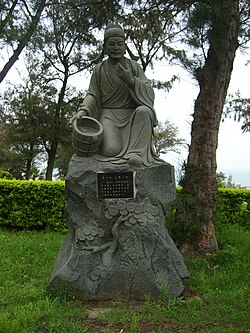
The Rectification of Names
A key concept in maintaining this order is the "rectification of names," the idea that social harmony is achieved when people act according to their titles. For example, a ruler must act like a ruler, and a minister must act like a minister.
![Statue of Liu Bei and Zhuge Liang, considered the ideal example of the loyalty, integrity and shared governance between a lord and minister in Chinese history[note 2]](/images/a6/11/a61166fd2e217818854f680c37d70de247515e35cdf6ec699c0ec877482d794b.jpg)
Governance and Meritocracy
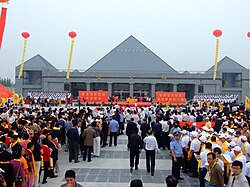
Confucianism profoundly influenced the administration of East Asian states by introducing political meritocracy. Confucius famously stated, "In teaching, there should be no distinction of classes," suggesting that leadership should be based on virtue and ability rather than hereditary birthright.
This philosophy led to the creation of the imperial examination system, which required candidates to demonstrate mastery of the Confucian classics to enter civil service. This system remained the primary path to political power in Korea, China, and Vietnam until its abolition between 1894 and 1919.
| Country | Local Name | Examination System Abolished | Primary Focus |
|---|---|---|---|
| China | Rújiā / Rújiào | 1905 | Social harmony and state ethics |
| Korea | Yugyo | 1894 | Ancestral rites and scholarly virtue |
| Vietnam | Nho giáo | 1919 | Administrative merit and morality |
Rituals and Worship
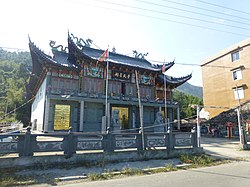
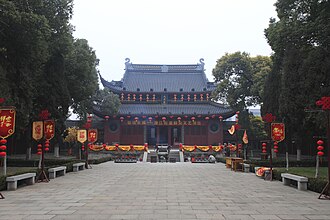
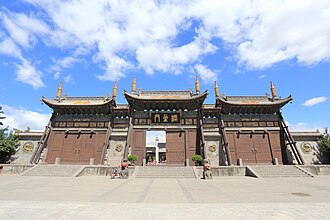
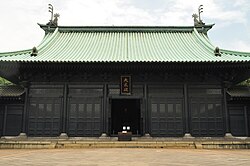
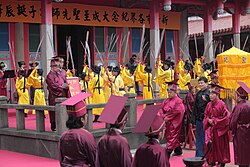
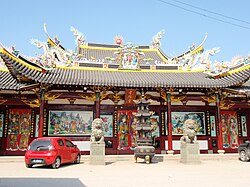
Confucian practice is characterized by the wenmiao (Temple of Confucius), where Confucius is worshipped as Wendi, the "God of Culture." These temples serve as centers for learning and ritual homage.
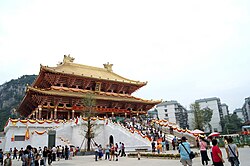
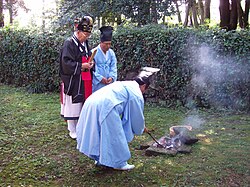
Rituals are not limited to state temples; they extend to ancestral shrines and lineage corporations. These ceremonies reinforce the bond between the living and the dead, ensuring that the virtues of ancestors continue to guide the current generation.
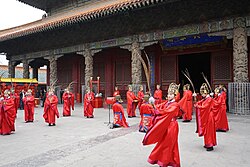
Similar rites are observed across East Asia, from the Confucian ceremonies in Jeju, Korea, to Teachers' Day observances in Taiwan, and the Yushima Seidō in Tokyo, Japan.
Frequently Asked Questions
Is Confucianism a religion or a philosophy?
It is often viewed as both. While it provides a philosophical framework for ethics and governance (Rúxué), it also includes religious elements such as the worship of Heaven (Tian), ancestral veneration, and the ritualization of daily life (Rújiào).
What is the meaning of 'Ren' in Confucian thought?
Ren is often translated as benevolence, humaneness, or love. It is the highest Confucian virtue, representing the essence of being human and the ability to feel empathy and care for others.
How did Confucianism impact women's roles in society?
Historically, Confucianism has been criticized for creating social injustices against women, often confining their roles to the domestic sphere as daughters, wives, and mothers, and emphasizing their subordination to men.
What happened to the Confucian examination system?
The system was abolished in the late 19th and early 20th centuries (Korea 1894, China 1905, Vietnam 1919). This shift allowed individuals with different ideologies, such as nationalists and socialists, to enter civil service and political leadership.
What is a 'Junzi'?
A Junzi is an "exemplary person" or "gentleman." It refers to an individual who has cultivated high moral character through the practice of the five constant virtues and adheres strictly to the rites (Li).