Competitive Swimming: History, Techniques, and Olympic Standards
Competitive swimming is a global sport that blends raw power with technical precision. From its early roots as a recreational activity in 19th-century England to its current status as a centerpiece of the Summer Olympic Games, the sport has evolved through revolutionary techniques and rigorous standardization. Today, it is governed internationally by World Aquatics (formerly known as FINA), ensuring that athletes from every continent compete under the same stringent rules.
The journey of competitive swimming began in the 1830s. By 1837, the National Swimming Society was already hosting competitions in artificial pools across London. The sport's formalization accelerated with the creation of the Amateur Swimming Association in 1880, followed by the establishment of national federations in Germany, France, and Hungary. Men's swimming debuted at the first modern Olympic Games in 1896, while women's events were introduced in 1912.

Key Facts
- Governing Body: World Aquatics (established as FINA in 1908).
- Olympic Debut: Men in 1896; Women in 1912.
- Standard Pool: Long course pools are 50 meters in length.
- Core Styles: Butterfly, Backstroke, Breaststroke, and Freestyle.
- Recent Expansion: The IOC announced the addition of 50m butterfly, backstroke, and breaststroke events for 2025, increasing the total to 41 events.
The Four Primary Swim Styles
In professional competition, swimmers must adhere to specific technical requirements for each stroke. While most races focus on a single style, the Individual Medley (IM) requires athletes to swim all four in a specific order: butterfly, backstroke, breaststroke, and finally, freestyle.
Freestyle and Butterfly
Freestyle is the fastest stroke, often utilizing the front crawl. The butterfly, developed in the 1930s, was originally a variation of the breaststroke before being recognized as a distinct style in 1952.
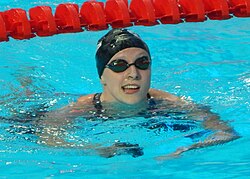
Backstroke and Breaststroke
Backstroke is the only competitive style swum on the back, while breaststroke is characterized by simultaneous arm and leg movements. These styles require immense coordination and strength to maintain efficiency over distance.
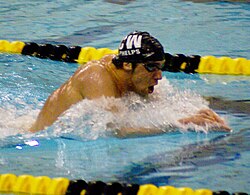
Technical Innovations and the Dolphin Kick
One of the most significant shifts in modern swimming is the adoption of the underwater dolphin kick. This technique involves a rhythmic, undulating movement of the hips and legs to maximize speed during starts and turns.
David Berkoff pioneered this approach in the 100m backstroke at the 1988 Olympics, and Denis Pankratov later used it to dominate the 100m butterfly in 1996. The technique also entered freestyle sprinting around 2008, coinciding with the introduction of "technical" swimsuits that reduced drag and allowed swimmers like Amaury Leveaux to spend more time submerged.
Competition Venues and Standards
Competitive swimming is divided into two primary formats: long course and short course. Long course refers to the 50-meter pool standard used in the World Championships and Olympics. Short course pools are 25 meters long.

World Championship pools must be 25 meters wide with ten lanes, each at least 2.5 meters wide. These facilities utilize Automatic Officiating Equipment, including touch pads for precise timing and sensors to monitor relay takeovers.

Regional Variations in Distance
While meters are the global standard, the United States utilizes yards for its short course season. This leads to different event distances; for example, American short course swimmers compete in 500, 1000, and 1650-yard freestyle events, whereas long course athletes swim 400, 800, and 1500-meter events.
Equipment and Gear
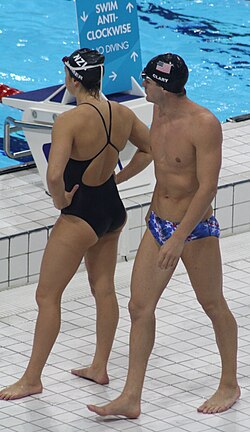
Modern swimwear is designed to minimize resistance. While basic gear includes swim caps and goggles, elite athletes use specialized suits. A major controversy erupted after the 2008 Beijing Olympics when full-leg "technical" suits led to an unprecedented 70 world records being broken in a single year.
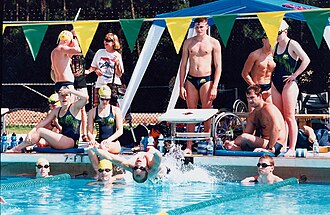
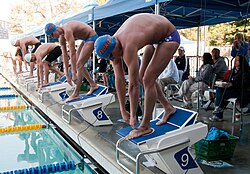
Beyond suits, swimmers use various training tools to improve performance, such as drag suits, hand paddles, kickboards, pull buoys, and snorkels. The start of the race is equally technical, with athletes using wedged starting blocks to perform an isometric press, preloading muscles for a more powerful dive.
Open Water Swimming
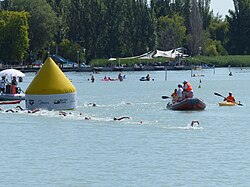
Unlike pool events, open water swimming takes place in lakes or oceans. While the first four Olympic Games were held in open water (including the Mediterranean and the Seine river), the sport returned to the Olympic program in 2008 with the 10km event.
Summary of Competitive Swimming Standards
| Feature | Long Course (Olympic) | Short Course |
|---|---|---|
| Pool Length | 50 Meters | 25 Meters / 25 Yards (US) |
| Standard Width | 25 Meters | Varies |
| Minimum Depth | 2 Meters | Varies |
| Governing Body | World Aquatics | World Aquatics / National Bodies |
Frequently Asked Questions
What is the difference between long course and short course swimming?
Long course refers to competitions held in a 50-meter pool, which is the Olympic standard. Short course refers to 25-meter (or 25-yard in the US) pools, which allow for more frequent turns.
What is the Individual Medley (IM)?
The Individual Medley is a race where a single swimmer competes in all four styles in a specific sequence: butterfly, backstroke, breaststroke, and freestyle.
How did the dolphin kick change the sport?
The dolphin kick allows swimmers to maintain higher speeds underwater after the start and during turns, significantly reducing the time spent on the surface where drag is higher.
Why were there so many world records broken in 2008?
The surge in records was largely attributed to the introduction of revolutionary "technical" swimsuits that covered the legs and significantly reduced water resistance.
What is the role of World Aquatics?
World Aquatics (formerly FINA) is the highest governing body for competitive swimming, responsible for setting international rules, ratifying world records, and organizing World Championships.