Comparative Anatomy: Tracing Evolutionary History Through Biological Structure
Comparative anatomy is the scientific study of similarities and differences in the anatomy of different species. By examining the physical structures of various organisms, scientists can uncover deep connections between species, making this field closely related to evolutionary biology and phylogeny—the study of the evolutionary history and relationships among individuals or groups of organisms.
From the classical era to the modern age, this discipline has provided critical evidence of common descent and has served as a cornerstone for the classification of the animal kingdom.
Key Facts
- Purpose: Used to identify common ancestors and classify animals based on anatomical similarities.
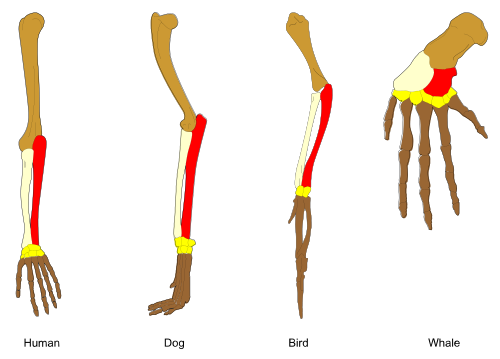
- Homology: Structures that are similar due to shared ancestry, regardless of their current function.
- Analogy: Structures that look similar because they evolved to solve the same problem in similar environments, not because of a recent common ancestor.
- Historical Impact: Provided the anatomical foundation for Charles Darwin's theory of Natural Selection.
- Modern Integration: Now works alongside comparative genomics and DNA sequencing to map the tree of life.
The History of Anatomical Comparison
The roots of comparative anatomy stretch back to the classical era. One of the first anatomical investigations independent of medical or surgical procedures is attributed to Alcmaeon of Croton. Later, during the Renaissance, Leonardo da Vinci planned an anatomical treatise that included comparisons of animal hands, such as those of bears.
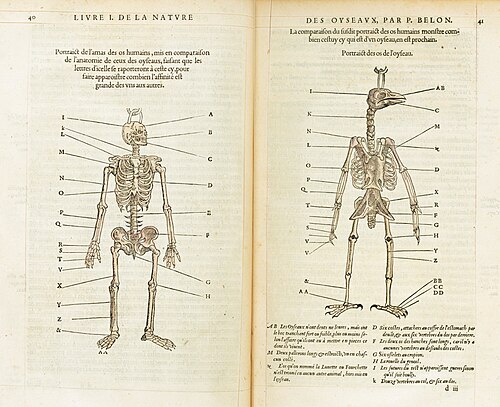
In the 16th century, French naturalist Pierre Belon advanced the field by studying dolphin embryos and noting the striking similarities between the skeletons of birds and humans.
The Shift Toward Observation: Vesalius and Galen
During this same period, Andreas Vesalius began systematically correcting the anatomical knowledge of the Greek physician Galen. Vesalius discovered that Galen's observations were often based on animals—such as oxen, monkeys, and non-human apes—rather than humans.
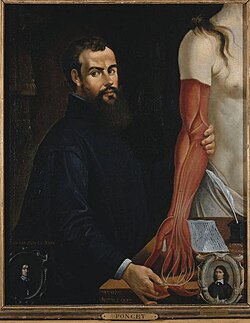
Vesalius encouraged his students to dissect apes to better understand human bone structure, arguing that one should master the anatomy of both to truly understand the human body. This shift toward direct observation led other physicians to notice homologous structures across various species, observations that would later influence Charles Darwin.
The Foundations of Modern Comparative Anatomy
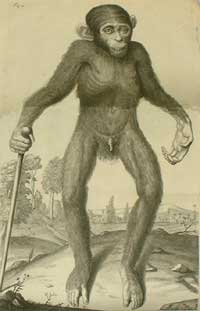
Edward Tyson is widely regarded as the founder of modern comparative anatomy. His work was pivotal in determining that whales and dolphins are mammals and concluding that chimpanzees are more closely related to humans than to monkeys based on their arm structure.
Other early contributors include Marco Aurelio Severino, who compared birds in his work Zootomia democritaea. In the 18th and 19th centuries, anatomists such as George Cuvier, Richard Owen, and Thomas Henry Huxley revolutionized the understanding of vertebrate systematics. In the 20th century, Victor Negus contributed research on the evolution of the larynx, while Alfred Romer utilized comparative anatomy and embryology as primary tools for understanding phylogeny before the rise of DNA sequencing.
Core Concepts: Homology vs. Analogy
To understand how species are related, comparative anatomists distinguish between two types of biological structures:
Homologous Structures
Homologous structures are body parts that are similar across different species because they were inherited from a common ancestor. These structures may evolve to perform entirely different functions—a process known as divergent evolution. For example, the forelimb structure shared by cats and whales is homologous; while one is used for walking and the other for swimming, the underlying bone arrangement is the same.
Analogous Structures
Analogous structures are similar in appearance or function but evolved independently. This occurs through convergent evolution, where different species adapt to similar environments. This phenomenon is known as a homoplasy. A classic example is the streamlined, torpedo-shaped bodies of sharks (fish) and porpoises (mammals), which both evolved for efficient movement through water despite having different ancestors.
Applications in Science
Comparative anatomy serves as a primary line of evidence for evolution, demonstrating that organisms share a common ancestor through descent with modification. This concept explains how random mutations and natural selection gradually adapt anatomical structures to suit specific habitats.
For instance, the forelimbs of humans, bats, cats, and whales all consist of the same basic skeletal parts. However, these parts have been modified over millions of years to serve as wings, paws, hands, or fins. The specific rules governing how these specialized characteristics deviate from general homology were later defined by Karl Ernst von Baer as "Baer's Laws."
| Feature | Homologous Structures | Analogous Structures |
|---|---|---|
| Origin | Shared common ancestor | Different ancestors |
| Evolutionary Process | Divergent Evolution | Convergent Evolution |
| Function | May be different | Usually similar |
| Example | Human arm / Whale fin | Shark body / Porpoise body |
Frequently Asked Questions
What is the difference between homology and analogy?
Homology refers to structures that are similar because of shared ancestry (e.g., the bones in a bat's wing and a human's arm), whereas analogy refers to structures that are similar because they evolved to perform the same function in similar environments (e.g., the wings of a butterfly and the wings of a bird).
Who is considered the founder of modern comparative anatomy?
Edward Tyson is regarded as the founder of modern comparative anatomy, specifically for his work identifying whales and dolphins as mammals and analyzing the similarities between chimpanzees and humans.
How did Andreas Vesalius change the field of anatomy?
Vesalius challenged the long-held authority of the Greek physician Galen by proving that many of Galen's human anatomical descriptions were actually based on animals like apes and oxen, thereby promoting direct human dissection and observation.
How is comparative anatomy used today?
While genetic techniques like DNA sequencing are now prominent, comparative anatomy is still used to classify organisms and provide physical evidence of evolutionary relationships and common descent.
What is a homoplasy?
A homoplasy is a shared character between species that was not present in their common ancestor, resulting from convergent evolution rather than shared inheritance.