Common Stinkhorn: The Fascinating Biology of Phallus impudicus
The common stinkhorn (Phallus impudicus) is a widespread and striking species of fungus belonging to the Phallaceae family. Known for its distinctive phallic shape and a pungent odor reminiscent of decaying flesh, this fungus has captured the attention of naturalists, botanists, and cultural historians for centuries. Found across Europe and North America, it thrives in environments rich in organic debris, turning the forest floor into a stage for one of nature's most unusual reproductive strategies.
Key Facts
- Scientific Name: Phallus impudicus
- Distinguishing Feature: A foul, carrion-like smell used to attract insects for spore dispersal.
- Growth Rate: Extremely rapid, measuring between 10–15 cm per hour.
- Habitat: Saprotrophic (feeding on decaying matter), typically found in deciduous and conifer woods.
- Edibility: Immature "eggs" are edible, though mature forms are unpalatable.
Lifecycle and Physical Description
The development of the common stinkhorn is a rapid transformation. It begins as an immature fruiting body often referred to as a witch's egg. This egg-shaped structure is typically 4 to 6 cm long and 3 to 5 cm wide, encased in a thick, whitish outer layer called the peridium (or volva). Inside this protective shell lies the olive-colored, gelatinous gleba—the spore-bearing mass—and a spongy white internal structure known as the receptaculum.
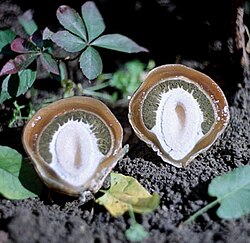
Within a day or two, the fungus expands with surprising force, capable of exerting up to 1.33 kPa of pressure—enough to push through asphalt. The mature stinkhorn reaches heights of 10 to 30 cm, topped with a conical cap covered in the slimy, greenish-brown gleba. As the fungus ages, the slime disappears, leaving behind a yellowish, pitted, and ridged (reticulate) surface that can be mistaken for a common morel.
Ecology and Spore Dispersal
Unlike most mushrooms that rely on wind to spread their spores, Phallus impudicus employs a biological trick. It produces a sticky spore mass that emits a sickly-sweet odor of carrion. This scent is created by a complex mix of chemicals, including methanethiol, hydrogen sulfide, and dimethyl trisulfide. This aroma attracts blow-flies and beetles, which land on the gleba and inadvertently carry the spores to new locations on their legs or through their waste.
Interestingly, research suggests a symbiotic relationship between these fungi and badger setts. Stinkhorns often cluster near badger entrances, where the high mortality rate of cubs provides a steady supply of carrion. The fungi attract blow-flies that help eliminate carcasses, reducing disease risks for the badger colony, while the badgers' environment ensures the continued proliferation of the fungus.
Taxonomy and Distribution
First described by the Italian naturalist Ulisse Aldrovandi in 1560, the fungus was later formally named by Linnaeus in 1753. The specific epithet impudicus is Latin for "shameless" or "immodest," referring to its bold appearance. While most common in Europe and North America (specifically west of the Mississippi River), it has also been documented in Asia, Costa Rica, Iceland, Tanzania, and southeast Australia.
| Feature | Description |
|---|---|
| Kingdom | Fungi |
| Family | Phallaceae |
| Ecology | Saprotrophic |
| Spore Dispersal | Insect-mediated (via scent) |
| Growth Speed | 10–15 cm per hour |
| Primary Habitat | Wood debris, forests, mulched gardens |
Human Uses and Cultural Significance
While the mature fungus is repulsive to most, the immature "egg" stage is considered edible in parts of France, Germany, and the Czech Republic. The inner receptaculum is described as having a crisp, radish-like taste when eaten raw. In medieval times, it was used as a purported cure for gout and as a love potion.
Modern research has explored the medicinal properties of P. impudicus, with some studies suggesting that its extracts may reduce platelet aggregation, potentially lowering the risk of venous thrombosis (blood clots in veins) for breast cancer patients.
Culturally, the fungus has appeared in literature and folklore. From being called "daemon's eggs" in Thuringia to appearing in the novels of Thomas Mann and Danilo Kiš, the stinkhorn has long been associated with themes of love, death, and the grotesque.
Frequently Asked Questions
Is the common stinkhorn poisonous?
It is generally not poisonous. The immature "egg" stage is consumed in several European cuisines, although the mature fruiting body is considered unpalatable due to its smell.
Why does the stinkhorn smell like rotting meat?
The smell is a biological adaptation to attract carrion-feeding insects, such as blow-flies, which then transport the fungus's spores to new environments.
How fast does a stinkhorn grow?
It is one of the fastest-growing fungi, with measured growth rates between 10 and 15 cm per hour.
How can I tell the difference between P. impudicus and P. hadriani?
In North America, P. hadriani can be distinguished by its purplish-tinted volva (the outer shell of the egg), whereas P. impudicus has a whitish volva.
Can it really grow through asphalt?
Yes, the growing fruit body can exert up to 1.33 kPa of pressure, which is sufficient to push through materials like asphalt.