Commercial Carrying: The Evolution of British Canals
Long before the advent of modern highways and high-speed rail, the arteries of British commerce were its waterways. The history of commercial carrying via canals is a story of industrial ambition, engineering breakthroughs, and an eventual transition toward the modern logistics networks we use today.
The use of canals in Great Britain dates back to the Roman occupation, where they were primarily utilized for irrigation. However, the Romans also engineered navigable canals, such as the Foss Dyke, to link rivers and facilitate the movement of goods further inland.
The Catalyst of the Industrial Revolution
As the Industrial Revolution accelerated, the demand for efficient industrial transport surged. At the time, existing roads were inadequate for heavy traffic; while pack horse trains were common, few roads could support wheeled vehicles capable of transporting large volumes of materials—particularly fragile goods like pottery—quickly and safely.
Canal boats emerged as a superior alternative, offering higher capacity, greater speed, and increased safety for delicate cargo. Following the success of the Sankey Canal and the Bridgewater Canal, a network of waterways began to connect industrial centers, cities, and ports. These canals transported essential raw materials, most notably lumber and coal. The economic impact was immediate; for example, the arrival of the Bridgewater Canal in Manchester triggered a 75% drop in the cost of coal for local households.
Engineering Advancements
By the late 18th and early 19th centuries, engineering capabilities evolved. While early canals followed the natural contours of hills and valleys, later constructions were straighter and more efficient. To overcome geographical obstacles, engineers implemented locks (devices used to raise and lower boats between different water levels), long tunnels, and towering aqueducts to span valleys.
The Rise of Competition and Decline
The mid-19th century marked a turning point as railways began to replace canals. This was particularly true for the narrow canal system, characterized by bridges and locks with a standard width of 7 feet (2.1 m). Trains and road vehicles eventually became faster, cheaper, and capable of carrying significantly larger cargoes.
As the network declined, many canals were purchased by railway companies, sometimes as a strategic move to enter a competitor's territory. Over time, many narrow canals became unusable—clogged with silt, weeds, and rubbish—or were entirely converted into railway lines.
Innovation and the "Life Afloat"
Despite the general decline, there was a late surge in the construction of wide waterways, such as the Caledonian Canal and the Manchester Ship Canal. This era also saw remarkable innovation, such as the "Tom Pudding" compartment boats developed by Bartholomew of the Aire and Calder company. These trains of nineteen coal-filled boats were pulled from the Yorkshire coalfields and lifted to empty their contents directly into seagoing colliers at Goole Docks. A variation of this system lasted as late as 2004.
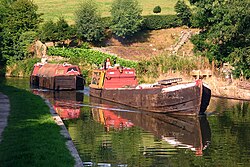
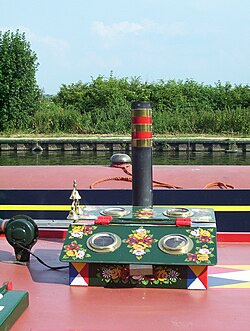
As competition intensified, the industry shifted from horse-drawn single narrowboats to steam and diesel-powered vessels towing an unpowered butty (a second boat used to increase cargo capacity). This shift led many boatmen's families to move their homes onto the boats to reduce costs and assist with handling. This gave rise to the iconic "boatman's cabin," decorated with bright white lace, gleaming brass, and colorful metalware. This lifestyle became known colloquially as "a cruise on the cut."
The End of the Narrowboat Era
While some bulky, non-perishable goods continued to move by water due to lowered tolls, the winter of 1962–63 dealt a decisive blow. A severe frost kept goods icebound for three months, forcing customers to switch to road and rail for reliability. The transition from coal to oil, the closure of canalside factories, and the general decline of British heavy industry further eroded the trade.
The final long-distance narrowboat traffics—carrying coal to Dickinson's paper mills at Croxley and the Kearley and Tonge jam factory at Southall—ended in 1970. Other niche traffics persisted longer, such as lime juice transport to Boxmoor until 1981 and aggregates on the River Soar until 1988.
Modern Status of Waterways
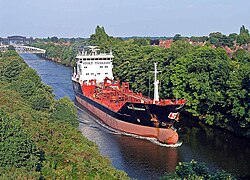
Today, a few large waterways, including the Aire and Calder Navigation and the Manchester Ship Canal, remain commercially viable, moving millions of tonnes annually. However, the rise of containerization and road haulage has limited their growth. Even the Manchester Ship Canal no longer conveys cargo ships to the Salford docks, which have been transformed into "Salford Quays," a hub for offices, apartments, and cultural institutions.
| Period/Event | Key Development/Impact |
|---|---|
| Roman Occupation | Initial use for irrigation and navigable links like Foss Dyke. |
| Industrial Revolution | Rapid growth of networks; coal prices in Manchester fell by 75%. |
| Mid-19th Century | Rise of railways; decline of 7ft narrow canal system. |
| 1905 | Completion of the New Junction Canal (the last new canal). |
| Winter 1962–63 | Severe frost leads to a permanent shift toward road and rail. |
| 1970 | Cessation of last long-distance narrowboat coal traffics. |
Key Facts
- Economic Impact: The Bridgewater Canal reduced coal costs in Manchester by 75%.
- Standard Width: Narrow canal bridges and locks were typically 7 feet (2.1 m) wide.
- Last Construction: The New Junction Canal in Yorkshire (1905) was the last new canal built before the 20th century ended.
- Technical Innovation: "Tom Pudding" boats allowed for the direct transfer of coal into seagoing ships.
- The Final Blow: The hard frost of 1962–63 drove remaining commercial customers away from narrow canals.
Frequently Asked Questions
Why were canals preferred over roads during the early Industrial Revolution?
Roads were unsuitable for large volumes of traffic and wheeled vehicles. Canal boats were faster, could carry much larger loads, and were safer for transporting fragile manufactured goods like pottery.
What is a "butty" in the context of canal transport?
A butty is an unpowered boat towed by a powered steam or diesel boat to increase the total amount of cargo that could be transported in a single trip.
How did the 1962–63 winter affect commercial carrying?
A prolonged hard frost kept goods icebound on the canals for three months. This lack of reliability forced many remaining customers to switch to road and rail haulage permanently.
What happened to the Salford docks?
The wharves and warehouses were replaced by "Salford Quays," which now serves as a center for cultural institutions, offices, and apartments, with the docks acting primarily as a water feature.
What were "Tom Pudding" boats?
They were trains of nineteen coal-filled compartment boats used on the Aire and Calder Navigation that could be lifted and upturned to empty coal directly into ships at Goole Docks.