Columbia University Libraries: A History of Growth and Resilience
The story of the Columbia University Libraries is one of dramatic transformation, spanning centuries of academic evolution and survival. From its origins as a colonial collection at King's College to its current status as a global research powerhouse, the library system has mirrored the growth of the institution itself, overcoming the devastation of war and the challenges of rapid expansion.
The Colonial Era and Early Acquisitions
The foundation of the library began in 1756 with a landmark donation from Joseph Murray. His estate and library, valued at approximately £8,000, represented the largest single philanthropic gift in colonial America at the time. This initial momentum continued with further contributions, including over 1,000 volumes provided in 1763 by Reverend Duncombe Bristowe of London via the Society for the Propagation of the Gospel in Foreign Parts.
The early collection was further enriched by contributions from Oxford. Various gentlemen from Oxford donated books, and in 1772, at the request of President Myles Cooper, Oxford University provided a copy of every book published by the Oxford University Press.
War, Loss, and Reconstruction
The American Revolutionary War brought significant hardship to the collection. In 1776, the New York Committee of Safety commandeered College Hall to serve as a military hospital. Before instruction was suspended, the library's contents were moved to the New York City Hall for safekeeping. However, the transition was not seamless; only six or seven hundred items were recovered after the war, and today, only 111 of those original King's College volumes remain.
Following the conflict, the institution—renamed Columbia College—began the arduous task of rebuilding. Through a combination of purchases, deposits, and gifts, the library grew to nearly 15,000 volumes by 1863. Notable additions during this recovery period included the 1825 purchase of 264 books from the library of Lorenzo Da Ponte and a donation from Nathaniel Fish Moore.
The Era of Professionalization and Expansion
As the university grew, so did its physical footprint. The library moved from its original home at the Park Place campus to the Madison Avenue campus in 1857, eventually occupying a new building designed by Charles C. Haight in 1883.
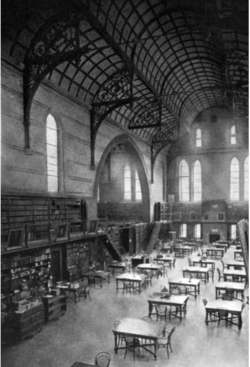
This period marked a turning point in library science. From 1883 to 1888, Melvil Dewey—the creator of the Dewey Decimal Classification (a proprietary system of library classification) and a founder of the American Library Association—served as chief librarian. Dewey reorganized the libraries under a unified administration and established the world's first library school in 1887.
The Move to Morningside Heights
In the 1890s, Columbia transitioned to university status and relocated to its current site in Morningside Heights. The centerpiece of this new campus was the Low Memorial Library, completed in 1895. Funded by a $1 million personal donation from University President Seth Low, the facility was designed to hold 1.9 million volumes.
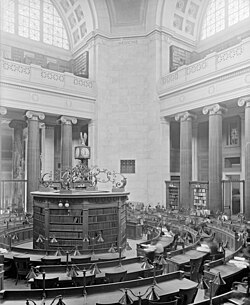
Despite its size, the collection grew faster than anticipated. By 1904, the libraries held roughly 400,000 books, a figure that exceeded one million within two decades. This rapid growth necessitated the construction of Butler Library, which opened in 1934. Funded by a $4 million gift from alumnus Edward Harkness, Butler became the main library, leaving Low Library to house only special collections (rare or unique materials), Columbiana, and sections for East Asian studies, mathematics, and general sciences.
Modern Collaboration
In 1974, Columbia University Libraries expanded its reach by becoming a founding member of the Research Libraries Group, joining forces with the libraries of Harvard, Yale, and the New York Public Library to enhance scholarly resources.
Key Facts
- First Major Gift: Joseph Murray's 1756 donation was the largest philanthropic gift in colonial America.
- War Losses: Most of the King's College collection was lost during the American Revolutionary War; only 111 items survive today.
- Pioneering Education: The world's first library school was founded at Columbia in 1887 by Melvil Dewey.
- Major Facilities: Low Memorial Library (1895) and Butler Library (1934) serve as the historic anchors of the campus.
- Collaborative Network: Founding member of the Research Libraries Group since 1974.
| Year | Event/Milestone | Key Figure/Detail |
|---|---|---|
| 1756 | Initial major donation | Joseph Murray (£8,000 value) |
| 1776 | War-time displacement | College Hall used as military hospital |
| 1887 | First library school founded | Melvil Dewey |
| 1895 | Low Memorial Library opens | President Seth Low ($1M donation) |
| 1934 | Butler Library opens | Edward Harkness ($4M donation) |
Frequently Asked Questions
What happened to the original King's College library?
During the American Revolutionary War in 1776, the library was moved to New York City Hall when College Hall became a military hospital. Most of the collection was lost, with only 111 items remaining in the university's current collections.
Who was Melvil Dewey and what was his impact on Columbia?
Melvil Dewey was the chief librarian from 1883 to 1888. He unified the library administration, created a staff service, and founded the world's first library school in 1887.
How was the Low Memorial Library funded?
The library was financed through a $1 million personal donation from University President Seth Low.
Why was Butler Library built?
Butler Library was built to accommodate a rapidly growing collection that had exceeded the capacity of Low Library. It was funded by a $4 million gift from alumnus Edward Harkness and opened in 1934.
What is the Research Libraries Group?
The Research Libraries Group is a collaborative organization founded in 1974 of which Columbia University Libraries is a founding member, alongside Yale, Harvard, and the New York Public Library.