Collatz Conjecture Extensions: From Integers to Complex Planes
The Collatz conjecture is famous for its simple premise: start with any positive integer, and if it is even, divide by two; if it is odd, multiply by three and add one. While the original conjecture focuses on positive integers, mathematicians have extended this map to larger domains, including all integers, rational numbers, 2-adic integers, and even the complex plane. These extensions reveal a rich landscape of dynamical systems and fractal geometry.
Iterating on All Integers
When the Collatz map is extended to include all integers (positive and negative), the behavior becomes more varied. While the positive integers are conjectured to always fall into the 4-2-1 cycle, negative integers reveal additional patterns. Excluding the trivial cycle of 0 → 0, there are four known cycles that all nonzero integers seem to eventually enter.
| Cycle Sequence | Odd-Value Cycle Length | Full Cycle Length |
|---|---|---|
| 1 → 4 → 2 → 1... | 1 | 3 |
| −1 → −2 → −1... | 1 | 2 |
| −5 → −14 → −7 → −20 → −10 → −5... | 2 | 5 |
| −17 → −50 → −25 → ... → −17... | 7 | 18 |
The generalized Collatz conjecture asserts that every integer will eventually fall into one of these four cycles or the 0 → 0 cycle.
Rationals and the Periodicity Conjecture
The map can be further extended to rational numbers that have odd denominators when written in lowest terms. In this domain, a rational is considered "odd" or "even" based on its numerator. The rules remain the same: even numerators are divided by 2, and odd numerators are multiplied by 3 and increased by 1.
A key concept here is the parity sequence—the sequence of odd/even results generated by the iteration. It is known that any periodic parity sequence is generated by exactly one rational number. The Periodicity Conjecture suggests that every rational with an odd denominator has an eventually cyclic parity sequence.
For example, a parity cycle of (1 0 1 1 0 0 1) corresponds to the fraction 151/47. If the odd denominator is not a multiple of 3, the iterates maintain the same denominator, and the numerators follow a generalized "3n + d" function.
The 2-adic Extension
The Collatz function is also well-defined on the ring of 2-adic integers (&Z2), a system where distance is based on divisibility by powers of 2. In this domain, the function is continuous, measure-preserving, and its dynamics are ergodic, meaning it explores the space in a statistically uniform way.
Using a parity vector function Q, it can be shown that every infinite parity sequence corresponds to exactly one 2-adic integer. This implies that almost all trajectories in the 2-adic realm are acyclic. Interestingly, the original Collatz conjecture can be reformulated as a statement about the range of this function Q over positive integers.
Real and Complex Interpolations
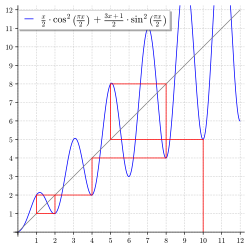
To move the Collatz map onto the real line or complex plane, mathematicians use an interpolating function—a smooth function that matches the Collatz values at integer points. One common method uses trigonometric switches, such as cos2(πx/2) and sin2(πx/2), to toggle between the x/2 and (3x+1)/2 operations.
Research by Marc Chamberland showed that the conjecture does not hold for positive real numbers; there are infinitely many fixed points and orbits that escape to infinity. However, there are two attracting cycles of period 2: (1; 2) and approximately (1.1925...; 2.1386...).
Extending this to the complex plane, researchers Letherman, Schleicher, and Wood added specific terms to ensure all integers are critical points. This prevents integers from residing in a Baker domain (a region where points move toward a boundary), suggesting that integer orbits are either eventually periodic or belong to a wandering domain.
Visualizing these complex orbits creates a Collatz fractal. By coloring points based on their divergence speed, the boundary between the Fatou components (stable regions) and the rest of the plane forms the Julia set.

Alternative interpolations exist, such as those using complex exponentials. These produce different dynamics; for instance, when the imaginary part of z is very large, the function behaves like f(z) ≈ z + 1/4. The resulting Julia set in these cases consists of uncountably many curves known as "hairs" or rays.

Key Facts
- Four Cycles: In the domain of all integers, there are four known non-zero cycles (including the 4-2-1 cycle).
- Rational Domain: The map applies to rationals with odd denominators, where parity is determined by the numerator.
- 2-adic Ergodicity: On 2-adic integers, the Collatz map is continuous and ergodic, with most trajectories being acyclic.
- Real Line Divergence: Unlike positive integers, the real-number extension contains orbits that escape to infinity.
- Fractal Geometry: Complex interpolations of the map generate Julia sets and Collatz fractals.
Frequently Asked Questions
What happens to negative integers in the Collatz map?
Negative integers appear to fall into one of three specific cycles: −1 → −2 → −1; −5 → −14 → −7 → −20 → −10 → −5; or a longer cycle starting with −17.
What is a parity sequence?
A parity sequence is the string of "even" (0) or "odd" (1) results encountered as a number is iterated through the Collatz map.
Can the Collatz map be applied to fractions?
Yes, provided the fraction has an odd denominator when reduced to lowest terms. The numerator determines whether the "even" or "odd" rule is applied.
What is a Collatz fractal?
A Collatz fractal is a visual representation of the Collatz map extended to the complex plane, where colors represent the speed at which points diverge to infinity, and the boundary forms a Julia set.
Why use 2-adic integers for this problem?
The 2-adic system is naturally suited for the Collatz map because the map's primary operation is division by 2, making the function continuous and allowing for the use of ergodic theory.