Cognitive Semantics and the Structure of Concepts
Traditional theories of meaning often rely on truth-conditional semantics—the idea that the meaning of a sentence is defined by the conditions under which it is true—and the use of necessary and sufficient conditions to define words. However, cognitive semantics challenges these frameworks. By examining the internal structure of concepts, cognitive semantics seeks to provide a more nuanced account of how humans actually process meaning, moving beyond rigid definitions to incorporate cultural experience and mental organization.
Frame Semantics
Developed by Charles J. Fillmore, frame semantics proposes that meaning cannot be understood in isolation. Instead, it is defined by its relationship to a "frame"—a larger system of concepts that provides the necessary context for a specific word to make sense.
Fillmore argues that word meaning is an extension of our bodily and cultural experiences. For example, the concept of a "restaurant" is not just a set of defining features, but a rich network of associations including food, waiters, tables, and service. These contingent associations are essential to our understanding but cannot be captured by simple necessary and sufficient conditions.
Furthermore, frame semantics explains asymmetries in language that feature analysis misses. While a semantic feature analysis might define a "boy" simply as [+MALE, +YOUNG] and a "girl" as [+FEMALE, +YOUNG], real-world usage differs. People are generally more likely to categorize a borderline-young female as a "girl" than a borderline-young male as a "boy." This suggests a latent frame of cultural attitudes and background assumptions that influence meaning.
This approach also clarifies sentence-level meanings. In the sentence, "You didn't spare me a day at the seaside; you deprived me of one," the speaker is not denying the truth of the first clause, but rather the way the event is framed. Additionally, it explains why synonyms like "land" and "ground" differ; while they share definitions, they operate in different domains, contrasting with "sea" and "air," respectively.
Profile and Base
Ronald Langacker expanded on this by distinguishing between the profile and the base. The profile is the specific concept symbolized by a word, while the base is the encyclopedic knowledge required to understand it. For instance, to understand the profile of a "radius," one must first grasp the base concept of a "circle." When a single base supports multiple profiles (such as arc, center, and circumference), it is referred to as a domain.
Categorization and Cognition
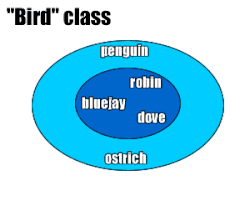
A central debate in cognitive semantics concerns how we categorize the world. Classical models suggest categories have crisp boundaries, but prototype theories, investigated by Eleanor Rosch, suggest that category structures are graded. In this view, some members are "prototypical" (e.g., a robin is a more prototypical "bird" than a penguin), creating a spectrum of central and peripheral members.
George Lakoff, influenced by Ludwig Wittgenstein, identified different types of category structures:
- Generative Categories: Formed by taking a central case and applying principles, such as similarity, to expand membership.
- Radial Categories: Instances that may share only one or a few traits with the center. For example, the concept of "mother" can be a hub of various conditions (biological, legal, caregiving) that do not always overlap in every instance.
Lakoff attributes these effects to idealized cognitive models—mental ideals that may not perfectly align with reality. The concept of a "bachelor" (unmarried adult male) often includes an ideal of independence and social activity. This leads speakers to include "false positives" (like a wealthy 17-year-old) or exclude those who fit the literal definition but not the ideal (like the Pope).
Mental Spaces
While traditional semantics uses propositional attitudes (beliefs, desires, and mental states) to explain sentences like "Frank believes the Red Sox will win," some find the resulting "possible-worlds" ontology inefficient.
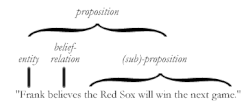
Gilles Fauconnier proposed mental spaces as an alternative. These are cognitive structures created in the minds of speakers and listeners. Fauconnier distinguishes between the base space (representing reality) and space builders (built spaces for fiction, hypothetical worlds, or specific time periods). He also differentiates between roles (category descriptions) and values (specific instances).
This framework explains seemingly contradictory sentences. For example, "In 1929, the lady with white hair was blonde" is not a contradiction because it involves two mental spaces: the present-space (where she has white hair) and the 1929-space (where she was blonde). The "value" in the 1929-space is described using the "role" she holds in the present-space.
Key Facts
- Frame Semantics: Meaning is derived from a larger system of related concepts (frames) rather than isolated definitions.
- Profile vs. Base: The profile is the specific focus of a word; the base is the background knowledge required to understand it.
- Prototype Theory: Categories are graded, with some members being more central or "typical" than others.
- Radial Categories: Categories where members are linked to a central prototype via a single shared trait, resembling a hub-and-spoke model.
- Mental Spaces: Cognitive structures used to manage reality, hypothetical scenarios, and temporal shifts in conversation.
| Framework | Key Proponent | Core Concept | View of Meaning |
|---|---|---|---|
| Frame Semantics | Charles Fillmore | Frames | Contextual and experiential |
| Profile/Base | Ronald Langacker | Domains | Hierarchical (Specific to General) |
| Prototype Theory | Eleanor Rosch / George Lakoff | Graded Membership | Central vs. Peripheral members |
| Mental Spaces | Gilles Fauconnier | Base vs. Built Spaces | Dynamic cognitive constructions |
Frequently Asked Questions
What is the difference between a profile and a base?
The profile is the specific entity a word refers to, while the base is the broader knowledge necessary to understand that entity. For example, you cannot understand the profile of a "radius" without the base knowledge of what a "circle" is.
How do radial categories differ from classical categories?
Classical categories rely on necessary and sufficient conditions for membership. Radial categories are organized around a central prototype, and members may join the category by sharing only one specific trait with that center, rather than meeting all criteria.
What are idealized cognitive models?
These are mental frameworks of how the world "should" be. They can cause us to expand or contract the meaning of a word based on a stereotype or ideal rather than a literal definition, such as the social expectations associated with the word "bachelor."
How do mental spaces resolve contradictions in time?
Mental spaces allow a speaker to maintain two different contexts simultaneously. By creating a "built space" for a specific time (e.g., 1929) and a "base space" for the present, a person can describe a subject's changing attributes without creating a logical contradiction.