Code and Other Laws of Cyberspace: How Software Regulates Society
In the modern digital era, we often think of the law as a set of rules written in books and enforced by courts. However, there is another form of regulation that governs our daily interactions more invisibly and immediately: computer code. This concept suggests that the software architecture of our digital world—often referred to as West Coast Code in reference to Silicon Valley—functions as a regulatory force similar to the legal statutes created in Washington, D.C., known as East Coast Code.
The Four Regulators of Conduct
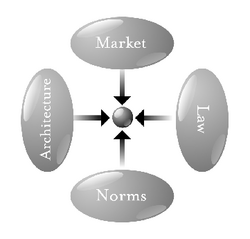
To understand how society is shaped, it is necessary to look beyond just the legal system. There are four primary regulators that dictate human behavior and constrain the individual (a concept sometimes referred to as the pathetic dot theory, where the "dot" represents the person constrained by these forces).
- Law: Formal rules enforced by the state through sanctions.
- Norms: Social expectations and pressures that discourage certain behaviors.
- Market: Economic incentives and pricing that drive choices.
- Architecture: The physical or digital environment (code) that makes certain actions possible or impossible.
The Impact of Code on Copyright Law
The shift toward software-based regulation has profound implications for copyright law. While traditional law focuses on the legality of copying, cyberspace changes both the technology used for copying and the ability of the law to prevent it. The most critical concern is that code can displace the traditional balance of copyright doctrines.
The Erosion of Fair Use
One of the most significant risks is the potential disappearance of fair use—the legal doctrine that allows limited use of copyrighted material without permission for purposes such as criticism, news reporting, or teaching. If software architecture allows for the licensing of every single aspect of a digital work through trusted systems, the technical constraints of the code may override legal protections. In such a scenario, if the code prevents an action, the legal right to "fair use" becomes irrelevant because the technology simply does not permit the act to occur.
Too often, code is viewed merely as a tool to combat unlimited copying. However, when code becomes the primary regulator, it ceases to be a tool and instead becomes the law itself.
Summary of Regulatory Forces
| Regulator | Source/Origin | Mechanism of Control |
|---|---|---|
| Law (East Coast Code) | Government/Legislature | Legal sanctions and penalties |
| Architecture (West Coast Code) | Software/Hardware Design | Technical impossibility or restriction |
| Norms | Society/Community | Social stigma or approval |
| Market | Economic Systems | Price and financial incentive |
Key Facts
- West Coast Code refers to the regulatory power of software developed in Silicon Valley.
- East Coast Code refers to the legal regulations established in Washington, D.C.
- The pathetic dot theory describes the individual as being constrained by four regulators: Law, Norms, Market, and Architecture.
- Code can effectively eliminate fair use by technically restricting access regardless of legal permissions.
- Cyberspace alters both the method of copying and the efficacy of legal protections against it.
Frequently Asked Questions
What is the difference between East Coast Code and West Coast Code?
East Coast Code refers to traditional legal statutes and regulations created by the government, while West Coast Code refers to the computer code and software architecture that regulates behavior through technical constraints.
What is the "pathetic dot theory"?
It is a conceptual framework illustrating how a single individual (the "dot") is shaped and constrained by four distinct regulatory forces: law, social norms, market pressures, and technical architecture.
How does code affect fair use in copyright?
Code can override fair use by implementing technical locks or licensing requirements that prevent a user from accessing or using a work, even if that use would be legally permitted under fair use doctrines.
Why is architecture considered a regulator?
Architecture is a regulator because it defines what is physically or digitally possible. For example, a wall prevents you from walking through it, and a piece of code can prevent you from copying a file, thereby regulating your conduct.
Is code just a tool to stop illegal copying?
While often viewed as a tool for enforcement, code actually functions as a regulator that can displace legal balances and change the power dynamics of copyright law entirely.