Climatology: The Science of Earth's Long-Term Atmospheric Patterns
While weather tells us what is happening outside our window right now, climatology tells us what to expect over decades and centuries. Climatology, or climate science, is the scientific study of Earth's climate, which is defined as the average of weather conditions over a period of at least 30 years. By analyzing these long-term patterns, scientists can distinguish between temporary atmospheric fluctuations and fundamental shifts in our planet's systems.
As a subdivision of physical geography and a key part of the atmospheric sciences, climatology bridges several disciplines, including oceanography and biogeochemistry. Researchers in this field focus on three primary areas: climate variability, the mechanisms that drive climate change, and the phenomenon of modern climate change.
Key Facts
- Definition: Climatology studies weather patterns averaged over a minimum of 30 years.
- Core Focus: Research centers on climate variability, change mechanisms, and modern climate shifts.
- Methodology: Scientists use a combination of direct observations and complex numerical modeling.
- Subfields: Includes specialized areas like paleoclimatology (past climates) and hydroclimatology (the water cycle).
- Climate Change: Modern shifts are largely driven by human emissions of greenhouse gases.
The Evolution of Climate Science
The roots of climatology stretch back to Ancient Greece, where the term klima (meaning "slope") was used to describe the inclination of the Earth's axis. One of the earliest influential texts was Hippocrates' On Airs, Water and Places (circa 400 BCE), which explored how climate affects human health and cultural differences. Later, the Chinese scientist Shen Kuo (1031–1095) provided early evidence of shifting climates by observing petrified bamboo in regions where such plants could no longer grow.
The Scientific Revolution brought precision to the field through the invention of thermometers and barometers. This era saw significant milestones, such as Edmund Halley mapping trade winds in 1686 and Benjamin Franklin mapping the Gulf Stream. By the early 20th century, climatology was primarily a descriptive science, providing "climate normals"—30-year averages—to help industries like agriculture prepare for seasonal extremes. It wasn't until the 1970s that climate change became a central pillar of the discipline.
Specialized Subfields of Climatology
Because the climate system is so vast, the field is divided into several specialized branches based on the complexity and purpose of the research:
Historical and Past Climates
- Paleoclimatology: Reconstructs ancient climates using proxies like ice cores and tree rings (known as dendroclimatology).
- Paleotempestology: Uses historical records to study the frequency of hurricanes over millennia.
- Historical Climatology: Focuses on the relationship between climate and human history over the last few thousand years.
Physical and Applied Branches
The American Meteorological Society categorizes the field into descriptive, scientific, and applied climatology. Applied climatologists work with industries like manufacturing and agriculture to manage risks. Other technical subfields include hydroclimatology (the study of the water cycle), bioclimatology, and boundary-layer climatology, which examines energy and momentum exchanges near the Earth's surface.
How Climatologists Model the Earth
Studying the climate is challenging due to the massive scales and nonlinear processes involved. To manage this complexity, scientists use climate models—quantitative simulations that represent the interactions between the atmosphere, oceans, land, and ice. These models rely on differential equations to solve for mass and energy transfer.
Models vary in complexity:
- Simple Radiant Heat Transfer Models: Treat the Earth as a single point to average outgoing energy.
- Radiative-Convective Models: Expand the analysis vertically or horizontally.
- Coupled Global Climate Models: Solve full equations for mass, energy, and radiant exchange across the atmosphere and oceans.
- Earth System Models: The most complex tier, which includes the biosphere in its simulations.
Understanding Variability and Change
Climate is not static; it is subject to climate variability—recurring patterns in temperature and other variables. These are often tracked using indices. For example, the El Niño–Southern Oscillation (ENSO) is a major ocean-atmosphere phenomenon in the Pacific that influences global temperatures every two to seven years. Other cycles include the North Atlantic Oscillation (NAO) and the Madden–Julian oscillation (MJO).
Climate change occurs when these patterns shift into new states that persist for decades or even millions of years. A critical factor is the Earth's energy budget: the balance between incoming solar radiation and outgoing infrared radiation. When more energy enters the system than leaves it, the planet warms. Modern climate change is primarily driven by human-induced greenhouse gas emissions, leading to rising surface temperatures, melting glaciers, and rising sea levels.
Summary of Climatological Concepts
| Concept | Primary Focus | Time Scale |
|---|---|---|
| Weather | Atmospheric conditions | Short-term (minutes to weeks) |
| Climate | Averaged atmospheric patterns | Long-term (30+ years) |
| Climate Variability | Recurring cycles (e.g., ENSO) | Seasonal to decadal |
| Climate Change | Shifts in long-term averages | Decades to millions of years |
Frequently Asked Questions
What is the difference between meteorology and climatology?
Meteorology focuses on short-term weather systems that typically last no more than a few weeks. Climatology studies the frequency, trends, and periodicity of those systems over much longer periods, such as years, centuries, or millennia.
How do scientists know what the climate was like thousands of years ago?
Scientists use paleoclimatology to reconstruct past climates. They examine indirect evidence, or proxies, such as ice cores extracted from glaciers and tree rings (dendroclimatology), to understand historical environmental conditions.
What is a "climate normal"?
A climate normal is a statistical average of weather elements and extremes calculated over a standard period, typically 30 years. This provides a baseline for understanding what is considered "normal" for a specific region.
How does the Earth's energy budget affect temperature?
The energy budget is the balance between the energy the Earth receives from the sun and the energy it radiates back into space. If the incoming energy exceeds the outgoing energy, the Earth's system warms; if more energy is lost than gained, the system cools.
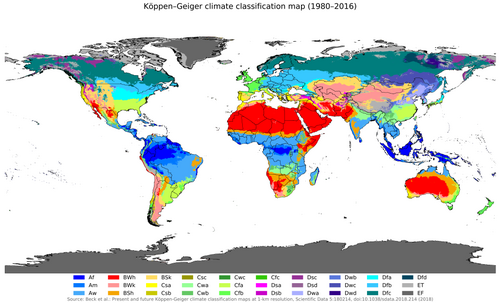
Why is the Köppen climate classification important?
The Köppen classification is one of the most widely used systems for categorizing climates. Developed in the late 19th century, it uses monthly temperature and precipitation data to classify regions based on their vegetation patterns.