Cleveland Browns Radio History: From the AAFC to the Modern Era
The voice of the Cleveland Browns has evolved over nearly eight decades, mirroring the team's own journey through different leagues, ownership changes, and eras of football. From the early days of the All-America Football Conference (AAFC) to the high-definition broadcasts of today, the Browns' radio network has served as a vital link between the franchise and its dedicated fanbase.
The Original Franchise Era (1946–1995)
Radio coverage began with the team's inaugural 1946 season in the AAFC. WGAR (1220 AM) served as the first flagship station, with Bob Neal and Stan Gee acting as the first announcers. By 1947, Bill Mayer joined as a color commentator—the analyst who provides expert commentary to supplement the play-by-play announcer. The network expanded rapidly, growing from a five-station setup in 1948 to a 16-station network by 1952, covering Ohio, West Virginia, Kentucky, and Pennsylvania.
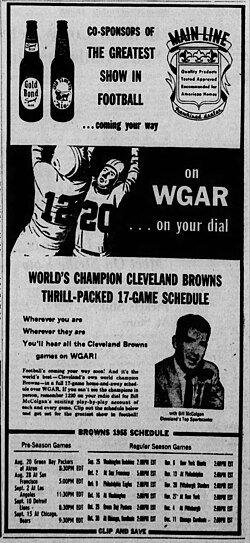
As the Browns transitioned to the National Football League (NFL) in 1950, the flagship rights shifted to WERE (1300 AM). However, the rights remained fluid during the 1950s, moving to WTAM briefly before returning to WGAR. During this second stint at WGAR, Bill McColgan became the primary play-by-play voice, later joined by Jim Graner. By 1961, Gib Shanley took over as the sole announcer and WGAR's sports director.
The 1960s and 70s saw further shifts. Games returned to WERE in 1962, and later moved to WHK in 1968. By 1974, the network had grown to 34 affiliates. The broadcasting booth saw a transition in 1975 when Jim Graner retired due to a brain tumor and was replaced by Jim Mueller.
Ownership Disputes and the Move to Baltimore
The 1980s were marked by corporate turmoil. Owner Art Modell attempted to move broadcast rights to his own struggling station, WJW, leading to a lawsuit from minority owner Robert Gries. Eventually, Modell's Lake Erie Broadcasting purchased WWWE and WDOK, transferring the rights there in 1985. This era also saw the arrival of Doug Dieken, a retired left tackle who brought his professional playing experience to the booth as a color commentator.
The early 1990s were a period of volatility. WHK and WMMS served as co-flagships from 1991 to 1994. Following the death of announcer Nev Chandler in 1994, Casey Coleman took over as lead announcer. However, the 1995 season was marred by the announcement that Modell was relocating the team to Baltimore. As advertisers cancelled their sponsorships, the network aired public service announcements during the team's final games in Cleveland.
The Expansion Franchise Era (1999–Present)
When the Cleveland Browns were reactivated in 1999, a new broadcasting era began. Flagship rights were initially awarded to WMJI and WTAM. This period introduced Jim Donovan as the lead announcer, pairing him with Doug Dieken and sideline reporter Casey Coleman. In 2002, the flagship rights moved to WMMS to help improve the station's ratings.

The broadcasting team remained stable for two decades, though it faced personal tragedies. Casey Coleman passed away from pancreatic cancer in 2006, and Jim Donovan battled leukemia starting in 2011. Despite these challenges, the duo of Donovan and Dieken became the definitive voices of the modern Browns.
Modern Partnerships and Regional Expansion
In 2013, the Browns entered a long-term agreement with Good Karma Broadcasting and CBS Radio, moving the flagship rights to WKNR (850 AM), WKRK-FM, and WNCX. This deal significantly increased the amount of ancillary programming, including the year-round Cleveland Browns Daily.
Interestingly, the network expanded into Oklahoma during the tenure of quarterback Baker Mayfield. KREF in Norman and KAKC in Tulsa joined the network to satisfy local demand from Oklahoma Sooners fans, though both dropped their affiliations after Mayfield left the team in 2022.
Recent Transitions and Legacies
The end of an era arrived in 2021 when Doug Dieken retired after 37 years in the booth and 51 years with the organization. He was succeeded by Nathan Zegura. The team also faced a heartbreaking transition in 2024; Jim Donovan retired due to aggressive leukemia and passed away on October 26, 2024, at age 68. Andrew Siciliano was named the new lead announcer to carry the franchise forward.
Key Facts
- First Flagship: WGAR (1220 AM) started the broadcasts in 1946.
- Longest Tenure: Doug Dieken spent 37 years as a broadcaster and 51 years total with the team.
- Modern Flagship: Currently partnered with Good Karma Broadcasting (WKNR) and Audacy (WNCX/WKRK-FM).
- Regional Reach: The network once expanded to Oklahoma specifically to follow quarterback Baker Mayfield.
- Legacy: The radio booth at FirstEnergy Stadium is named in honor of Doug Dieken.
Broadcast Summary Table
| Era/Period | Primary Flagship(s) | Key Announcers |
|---|---|---|
| 1946–1950 | WGAR | Bob Neal, Stan Gee |
| 1950s–1960s | WERE, WTAM, WGAR | Bill McColgan, Gib Shanley |
| 1968–1984 | WHK | Gib Shanley, Jim Graner, Jim Mueller |
| 1985–1995 | WWWE, WDOK, WKNR | Doug Dieken, Nev Chandler, Casey Coleman |
| 1999–2012 | WMJI, WTAM, WMMS | Jim Donovan, Doug Dieken, Casey Coleman |
| 2013–Present | WKNR, WNCX, WKRK-FM | Jim Donovan, Doug Dieken, Andrew Siciliano |
Frequently Asked Questions
Who was the longest-serving announcer for the Cleveland Browns?
Doug Dieken had the longest involvement, spending 51 years with the team, including 37 years as a color commentator from 1985 to 2021.
Which station was the first to broadcast Browns games?
WGAR (1220 AM) was the initial flagship station starting in the team's first season in 1946.
Why did the Browns broadcast games in Oklahoma?
Stations KREF and KAKC joined the network during Baker Mayfield's tenure because of his popularity as a former Oklahoma Sooners quarterback.
Who is the current lead announcer for the Cleveland Browns?
Andrew Siciliano was named the lead announcer prior to the 2024 season, succeeding the late Jim Donovan.
What happened to the radio network when the team moved to Baltimore in 1995?
While WKNR and WDOK continued to carry the games, most advertisers cancelled their sponsorships, leading the network to air public service announcements instead.