Citigroup: A Global Financial Powerhouse and Its Evolution
Citigroup is one of the world's most influential financial services corporations, operating as a massive global entity that provides a comprehensive suite of banking and investment products. Traded on the New York Stock Exchange under the ticker C, the company is a key component of both the S&P 100 and S&P 500 indices. From its roots in early 19th-century New York to its current status as a worldwide leader, Citigroup has shaped the landscape of modern finance.
The company's current operational scale is immense, with total assets reaching US$2.6 trillion as of 2025 and assets under management (AUM)—the total market value of investments managed on behalf of clients—estimated at US$2.8 trillion for 2026.
Key Facts

- Founded: October 8, 1998 (via the merger of Citicorp and Travelers Group).
- Leadership: Jane Fraser serves as the Chair and CEO.
- Financials (2025): Reported revenue of US$85.2 billion and net income of US$14.3 billion.
- Workforce: Approximately 229,000 employees as of 2024.
- Global Reach: Serves clients worldwide with major hubs in New York, London, and Sydney.
- Capital Strength: Tier 1 capital ratio of 15.3% in 2024.
Corporate History and Evolution
The modern Citigroup was formed through a landmark merger in 1998 between Citicorp (which traced its lineage back to the City Bank of New York founded in 1812) and The Travelers Companies (founded in 1853). This union created a financial behemoth capable of offering both commercial banking and insurance services.

The company's journey has not been without volatility. During the 2008 financial crisis, Citigroup faced a near-collapse, necessitating significant intervention from the US government through the Troubled Asset Relief Program (TARP). Following this period, the company underwent a series of restructuring efforts, including the creation of Citi Holdings in 2009 and the eventual sale of Smith Barney.
In recent years, under the leadership of CEO Jane Fraser, the company has focused on a corporate overhaul. This has included downsizing its consumer banking units and streamlining operations to improve efficiency and risk management.

Products and Services
Citigroup operates across a diverse range of financial sectors, ensuring it can serve institutional, corporate, and individual clients. Its primary offerings include:
- Banking & Credit: Traditional banking services, mortgage loans, and credit cards.
- Investment & Trading: Equities trading, commodities, and private equity.
- Wealth Management: Asset management, investment management, and specialized wealth services.
- Insurance: A variety of insurance products stemming from its historical roots.
Global Infrastructure and Presence
Citigroup maintains a massive physical footprint to support its worldwide operations. Its global headquarters is located at 388 Greenwich Street in Lower Manhattan, New York City. The company also maintains several other prominent offices in Manhattan, including the iconic diagonal-roofed Citigroup Center in Midtown.
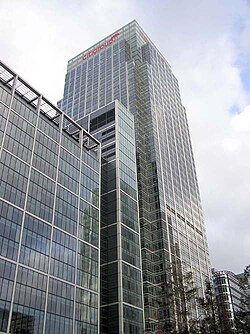
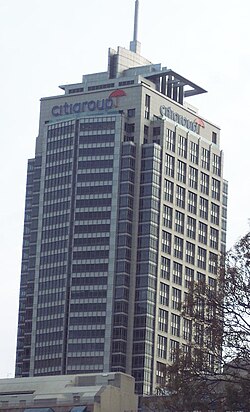
Beyond the United States, the company operates significant regional hubs. The EMEA (Europe, Middle East, and Africa) headquarters is situated at the Citigroup Centre in Canary Wharf, London. Other critical international offices include the Citigroup Centre in Sydney and a major Southern European headquarters in Madrid, where the firm has maintained a presence for over a century.
![View of the Madrid office. Citi has had a presence in Spain for more than a century, and serves as the headquarters of Southern Europe.[232]](/images/b7/ac/b7ac2a8c766d1f409b28e91393a77958711ee2c962ddd07d0c08a9d39a85c0be.jpg)
Financial Overview
The following table summarizes the financial standing and ownership of Citigroup based on recent data.
| Metric | Value / Detail |
|---|---|
| Revenue (2025) | US$85.2 Billion |
| Net Income (2025) | US$14.3 Billion |
| Total Assets (2025) | US$2.6 Trillion |
| Total Equity (2025) | US$220 Billion |
| Top Shareholders | The Vanguard Group (8.71%), BlackRock (8.68%), State Street (4.34%) |
| Tier 1 Capital Ratio (2024) | 15.3% |
Frequently Asked Questions
Who is the current CEO of Citigroup?
Jane Fraser has served as the Chief Executive Officer since March 2021 and became the Chair in October 2025.
What are the predecessor companies of Citigroup?
Citigroup was formed from the merger of Citicorp (which includes the City Bank of New York and First National Bank of New York) and The Travelers Companies.
Where is Citigroup's global headquarters located?
The global headquarters is located at 388 Greenwich Street in Manhattan, New York City.
What happened to Travelers after the merger?
While the merger created Citigroup, the company later spun off Travelers in 2002.
What is the significance of the Tier 1 capital ratio?
The Tier 1 capital ratio is a key measure of a bank's financial strength; for Citigroup, this was 15.3% in 2024, indicating its ability to absorb losses and maintain stability.