Ciro Gomes: A Journey Through Brazil's National Political Landscape
Ciro Gomes has been a prominent and often polarizing figure in Brazilian national politics for decades. From managing critical economic stabilization programs to launching multiple bids for the presidency, his career reflects the shifting alliances and ideological battles of Brazil's democratic era.
Early National Impact and the Ministry of Finance
In 1994, Ciro Gomes entered the national spotlight when he was appointed Minister of Finance under the administration of Itamar Franco. Although his tenure lasted less than four months, it occurred during a pivotal moment in Brazil's economic history: the implementation of the Real Plan. This economic stabilization program was designed to combat hyperinflation, which had plagued the country for years.
His appointment came just 28 days before the 1994 presidential election. Some analysts credit his brief oversight of the Real Plan with helping Fernando Henrique Cardoso secure victory, as Cardoso campaigned on the promise of continuing the plan's implementation. However, this political alignment was temporary, and Ciro eventually broke with the Cardoso government in 1997.
The 1998 Presidential Bid and Party Shifts
Ciro's political trajectory is marked by several party changes. A founding member of the Brazilian Social Democracy Party (PSDB) in 1988, he left the party in 1997, citing its shift toward the right. He subsequently joined the Socialist People's Party (PPS) to oppose the Cardoso administration.
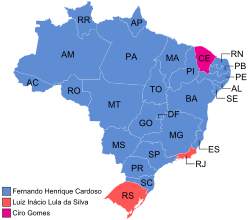
Running for president in 1998 with Roberto Freire as his running mate, Ciro attempted to position himself as a left-wing alternative to Luiz Inácio Lula da Silva of the Workers' Party (PT). Despite interest from the centrist Brazilian Democratic Movement (PMDB), Ciro finished third in the first round with 11% of the vote. His only victory was in his home state of Ceará.
The 2002 Election and Legislative Success
By the 2002 presidential election, Ciro appeared to be a formidable contender, at one point surpassing the center-right candidate José Serra in the polls. However, his momentum collapsed following a series of gaffes, including a controversial joke about his wife, Patrícia Pillar. He ultimately finished fourth in the first round with 12% of the vote.
Following the election, Ciro supported Lula in the second round and was appointed Minister for National Integration. His tenure in the government led to further party friction; when the PPS leadership left the governing coalition in December 2004, Ciro chose to remain in his post. This resulted in his removal from party leadership, leading him to join the Brazilian Socialist Party (PSB) in 2005.
In 2006, Ciro transitioned to the legislative branch, winning a seat in the Chamber of Deputies with 16.19% of the vote—the highest percentage ever achieved by a single candidate in a proportional election in Brazil.
Later Presidential Campaigns: 2018 and 2022
After skipping the 2010 cycle, Ciro returned for a third presidential bid in 2018 as the candidate for the Democratic Labour Party (PDT), selecting former Minister of Agriculture Kátia Abreu as his running mate.

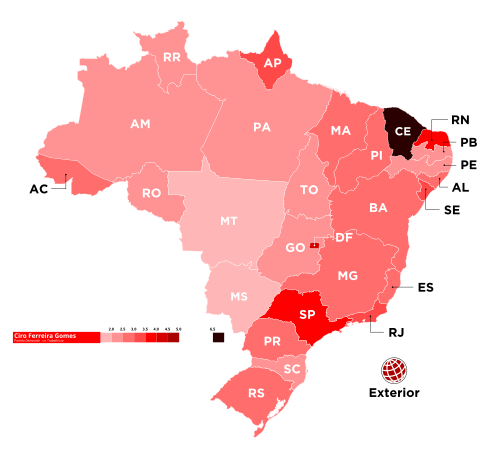
The 2018 election was unique because Lula was legally barred from running under the Ficha Limpa (Clean Slate) law, which prohibits candidates with certain criminal convictions. Analysts speculated that Ciro could unite the left and center-left. However, Lula's endorsement of Fernando Haddad split the vote. Ciro again finished third in the first round, winning only in Ceará.
In the second round, Ciro opposed Jair Bolsonaro, describing him as a "fascist" due to his pro-military statements, though he did not formally endorse Haddad. Following Bolsonaro's victory, some left-wing figures, such as Governor Rui Costa, expressed regret for not supporting Ciro over Haddad.
Ciro ran for president for a fourth time in 2022, where he finished in fourth place.
Key Facts
- Highest Legislative Vote: Achieved 16.19% of the vote for the Chamber of Deputies in 2006.
- Economic Role: Served as Minister of Finance in 1994 during the critical Real Plan stabilization.
- Regional Stronghold: Consistently won his home state of Ceará in presidential bids.
- Party Affiliations: Has been associated with PSDB, PPS, PSB, and PDT.
- Presidential Bids: Ran for president in 1998, 2002, 2018, and 2022.
| Election Year | Party | First Round Result | Key Outcome |
|---|---|---|---|
| 1998 | PPS | 3rd Place (11%) | Won only Ceará |
| 2002 | PPS | 4th Place (12%) | Later became Minister for National Integration |
| 2018 | PDT | 3rd Place | Won only Ceará |
| 2022 | PDT | 4th Place | Fourth presidential bid |
Frequently Asked Questions
What was Ciro Gomes' role in the Real Plan?
Ciro served as the Minister of Finance for less than four months in 1994. He oversaw the Real Plan, an economic stabilization program designed to end hyperinflation in Brazil.
Why did Ciro Gomes change political parties multiple times?
His shifts were often driven by ideological disagreements. For example, he left the PSDB in 1997 because he believed the party had moved too far to the right, and he left the PPS in 2005 after a dispute regarding his decision to remain in Lula's government.
How did Ciro Gomes perform in the 2006 legislative elections?
He was elected to the Chamber of Deputies with 16.19% of the vote, which stands as the highest percentage ever achieved by a single candidate in a Brazilian proportional election.
What is the 'Ficha Limpa' law mentioned in the 2018 election?
The Ficha Limpa (Clean Slate) law is a Brazilian regulation that bars politicians from running for office if they have been convicted of certain crimes, which was the reason Lula could not run in 2018.
Which state has consistently supported Ciro Gomes?
Ciro Gomes has consistently won his home state of Ceará during his presidential campaigns.