CIO History: The Rise and Evolution of the Congress of Industrial Organizations
The Congress of Industrial Organizations (CIO) emerged as a transformative force in American labor, shifting the focus from narrow craft-based unions to broad industrial organizing. By organizing entire industries regardless of skill level, the CIO fundamentally altered the relationship between American workers and major corporations during the mid-20th century.
The Founding of the CIO
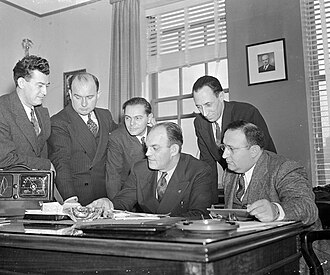
The seeds of the CIO were sown in November 1935, when John L. Lewis convened a group of labor leaders, including Charles Howard, Sidney Hillman, David Dubinsky, Thomas McMahon, John Sheridan, Harvey Fremming, and Max Zaritsky. Their goal was to establish the Committee for Industrial Organization to champion industrial unionism—the practice of organizing all workers in a single industry into one union, rather than splitting them by specific craft.
While initially presented as a group within the American Federation of Labor (AFL), the AFL leadership viewed the CIO as an adversary and demanded its dissolution. This friction only bolstered the CIO's appeal to industrial workers who felt the AFL was ineffective. In 1936, Lee Pressman joined as general counsel, and the United Electrical, Radio and Machine Workers of America (UE) became the first major industrial union chartered by the CIO on November 16, 1936.
The UE's rapid growth was vital for the CIO's early survival, organizing the General Electric plant in Schenectady, New York, and eventually expanding to 358 local unions covering over 600,000 workers across 1,375 plants.
Initial Triumphs and Strategic Victories
The year 1937 marked a period of dramatic success. The United Auto Workers (UAW) secured recognition from General Motors (GM) following a tumultuous 44-day sit-down strike in Flint, Michigan. Simultaneously, the Steel Workers Organizing Committee (SWOC) successfully negotiated a collective bargaining agreement with U.S. Steel.
These victories were achieved through contrasting strategies. The UAW utilized a bottom-up approach, leveraging a membership of 25,000 to shut down GM's production nerve center. In contrast, Lewis led a top-down campaign in the steel industry, employing hundreds of organizers—including radicals and former political opponents—to sign up members. Lewis famously prioritized results over the political beliefs of his staff, asking, "Who gets the bird? The hunter or the dog?"
Beyond the factory floor, the CIO won a landmark legal victory in Hague v. Committee for Industrial Organization (1939). The U.S. Supreme Court ruled that Jersey City Mayor Frank "Boss" Hague's ban on political meetings violated the First Amendment right to freedom of assembly.
Early Setbacks and Internal Conflict
Despite its momentum, the CIO faced significant hurdles. The UAW suffered internal political strife when its first president, Homer Martin, expelled organizers on charges of communism. This led to a split in 1939, with Martin forming the rival UAW-AFL. Meanwhile, the SWOC struggled against "Little Steel" companies like Republic Steel. This conflict culminated in the Memorial Day Massacre on May 30, 1937, where Chicago police killed ten strikers.
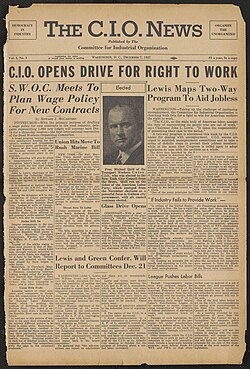
The organization also navigated complex political waters, aligning more closely with the Democratic Party and launching its own newspaper to reach its membership. Internal leadership disputes eventually saw Philip Murray replace John L. Lewis as head of the CIO after the 1940 election.
![718 Jackson Place NW, Washington, D.C., the fourth and final headquarters for the Congress of Industrial Organizations. As of 2008, the building is owned by the federal government and houses small units attached to the Executive Office of the President.[16]](/images/05/ad/05ade4752e3a0f7fcbf2d85ea3518a76b5c433c1963ff08eff9a1661446ac38e.jpg)
Growth During World War II
The onset of World War II brought a shift in priorities. Following the German invasion of the Soviet Union in 1941, many Communists within the unions became fervent supporters of the war effort. The CIO adopted a no-strike pledge to ensure uninterrupted war production, though small-scale strikes over local grievances continued.
During this era, the CIO expanded its reach. The International Longshoremen's and Warehousemen's Union (ILWU), led by Harry Bridges, joined the CIO, as did the Transport Workers Union of America and the National Maritime Union. The government's pressure on employers to recognize unions to avoid 1930s-style turbulence led to increased union security and new benefits, such as vacation pay.
The Postwar Era and the Cold War Purge
The end of the war triggered a wave of strikes in 1945 and 1946 as workers sought wage adjustments. However, the CIO's attempt to organize the American South via "Operation Dixie" failed, largely due to a reluctance to confront Jim Crow segregation laws.
Legislative challenges arrived with the Taft-Hartley Act of 1947, which restricted secondary boycotts and required union officers to sign affidavits swearing they were not members of the Communist Party. This act set the stage for a purge. By 1950, following disputes over the Marshall Plan and the 1948 presidential election, the CIO expelled several unions, including the ILWU and the Food and Tobacco Workers, for their ties to communism.
The Merger with the AFL
By the early 1950s, the distinctions between the AFL and CIO had blurred. The AFL had adopted industrial organizing, and the CIO was facing internal instability. Under the leadership of Walter Reuther (CIO) and George Meany (AFL), the two organizations began merger discussions.
The AFL held the advantage of size, being twice as large as the CIO. The eventual merger created the AFL-CIO, which today comprises 56 national and international labor unions with 12.5 million members.
Key Facts
- Founded: November 9, 1935, as the Committee for Industrial Organization.
- Core Philosophy: Industrial unionism (organizing all workers in an industry regardless of skill).
- Major Early Wins: GM (UAW sit-down strike) and U.S. Steel (SWOC agreement) in 1937.
- Legal Milestone: Hague v. CIO (1939) upheld First Amendment assembly rights.
- Wartime Policy: Adopted a no-strike pledge during WWII to support war production.
- Political Action: Formed the first political action committee (CIO-PAC) in 1943.
- Final Outcome: Merged with the AFL to form the AFL-CIO.
| Union/Event | Key Significance | Date/Period |
|---|---|---|
| UE | First major industrial union chartered by CIO | 1936 |
| UAW | Won recognition at GM via Flint sit-down strike | 1937 |
| SWOC | Secured collective bargaining with U.S. Steel | 1937 |
| Operation Dixie | Failed attempt to organize the American South | Post-WWII |
| Taft-Hartley Act | Restricted union activities and targeted Communists | 1947 |
| AFL-CIO Merger | Unification of craft and industrial unionism | 1955 |
Frequently Asked Questions
What is the difference between craft unionism and industrial unionism?
Craft unionism, practiced by the AFL, organizes workers based on their specific skill or trade. Industrial unionism, championed by the CIO, organizes all workers within a single industry into one union, regardless of their specific job or skill level.
Why did the CIO purge Communist-led unions in 1950?
The purge was driven by the Taft-Hartley Act's affidavit requirements, divisions over the Marshall Plan, and the Communist Party's support for Henry A. Wallace's 1948 presidential campaign, which made coexistence impossible for CIO leadership.
What was the significance of the Flint sit-down strike?
The Flint sit-down strike was a pivotal victory for the UAW, forcing General Motors—the largest carmaker at the time—to recognize the union and proving the effectiveness of the sit-down tactic.
How did the CIO support President Franklin D. Roosevelt?
The CIO generally aligned with the Democratic Party and created the first political action committee (CIO-PAC) in 1943 to help elect Roosevelt, although John L. Lewis personally broke with him over foreign policy in 1940.
What was Operation Dixie?
Operation Dixie was a major CIO organizing drive targeting textile workers in the American South. It is considered a failure because the CIO was reluctant to confront the region's Jim Crow segregation laws.