Cilia: The Essential Cellular Antennas and Motors of Life
In the microscopic world of the cell, cilia are hair-like organelles that project from the cell surface. Far from being simple appendages, they function as sophisticated biological machines, acting as both sensory antennas that receive external signals and powerful motors that move fluids or the cells themselves. These structures are found across a vast array of eukaryotic organisms, playing critical roles in everything from embryonic development to respiratory health.
Cilia are categorized primarily by their ability to move. While some are designed for motility, others serve as the cell's primary sensory interface with its environment. Understanding their structure and function reveals how a tiny organelle can influence the health of entire organ systems.
Key Facts
- Dual Function: Cilia act as either motile pumps to move substances or non-motile sensors (primary cilia) to detect environmental changes.
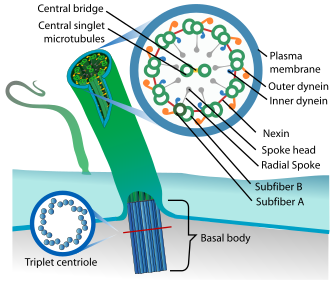
- Structural Core: The central scaffold of a cilium is called the axoneme.
- Foundation: Every cilium originates from a basal body located at the proximal end.
- Clinical Impact: Genetic defects in ciliary structure or function lead to a group of disorders known as ciliopathies.
- Developmental Role: Specialized nodal cilia are essential for establishing left-right asymmetry in the developing embryo.
The Anatomy of a Cilium
The architecture of a cilium is a marvel of biological engineering, consisting of several distinct regions that ensure stability and functionality.
The Basal Body and Rootlet
The foundation of the cilium is the basal body. Extending from this base is the ciliary rootlet, a cytoskeleton-like structure typically 80-100 nm in diameter. This rootlet contains cross striae spaced at regular intervals of 55-70 nm and is composed largely of rootletin, a coiled-coil protein encoded by the CROCC gene.
The Transition Zone and Axoneme
Between the basal body and the projecting shaft lies the transition zone, which acts as a gatekeeper to control the composition of the cilium. The main shaft is the axoneme, a complex arrangement of microtubules that provides the structural integrity and, in motile cilia, the mechanism for movement.
Types of Cilia and Their Functions
Cilia are broadly divided into two categories based on their movement and purpose.
Motile Cilia
Motile cilia are designed for movement. They often appear in large numbers on the surface of tissues to push mucus or other fluids across the cell layer. A prime example is found in the respiratory epithelium, where they sweep debris and mucus out of the airways to protect the lungs.
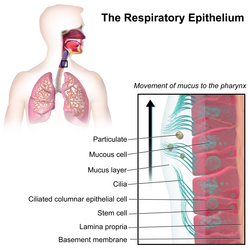
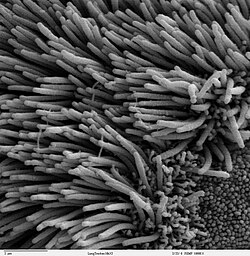
In the trachea, these cilia work alongside much smaller microvilli on non-ciliated cells to maintain a clean respiratory tract.
Non-Motile (Primary) Cilia
Non-motile cilia, often called primary cilia, do not beat. Instead, they function as the cell's antenna, sensing chemical or mechanical signals from the surrounding environment. They are nearly ubiquitous in mammalian cells and are involved in critical signaling pathways, such as the Hedgehog signaling pathway.
Specialized Cilia
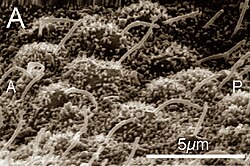
- Nodal Cilia: These are modified motile cilia found in the embryonic node. They create a directional fluid flow that is crucial for determining the left-right asymmetry of internal organs, such as the heart.
- Modified Cilia: Various adaptations exist for specific sensory roles, including those found in the cochlear hair cells of the ear.
Clinical Significance and Ciliopathies
When the genetic instructions for building or operating cilia are flawed, the result is a ciliopathy. Because cilia are found in so many different tissues, these disorders can affect multiple organs simultaneously.
Common manifestations include Primary Ciliary Dyskinesia, which leads to chronic respiratory infections and sometimes situs inversus (where organs are mirrored from their normal positions). Other issues include polycystic kidney disease and defects in pancreatic beta-cell insulin secretion, which can contribute to type 2 diabetes.
| Feature | Motile Cilia | Primary (Non-Motile) Cilia |
|---|---|---|
| Primary Function | Fluid/Mucus transport | Sensory reception |
| Movement | Active beating | Stationary |
| Typical Location | Respiratory tract, oviducts | Most mammalian cell types |
| Key Example | Tracheal epithelium | Pancreatic cells, kidney tubules |
Frequently Asked Questions
What is the difference between cilia and flagella?
While both are microtubule-based projections, cilia are typically shorter and more numerous per cell, whereas flagella are longer and usually limited to one or a few per cell (such as the tail of a sperm cell).
How do nodal cilia affect heart development?
Nodal cilia create a specific flow of fluid in the embryo. This flow provides the mechanical cues necessary for the heart and other organs to develop in their correct left-right positions.
What happens if motile cilia in the lungs stop working?
If motile cilia fail to beat, mucus and trapped particles cannot be cleared from the airways. This leads to chronic sinopulmonary infections and permanent lung damage.
What is the role of the basal body?
The basal body serves as the structural anchor and organizing center from which the axoneme of the cilium grows and extends.
Can primary cilia affect metabolism?
Yes. Research indicates that ciliary dysfunction in pancreatic cells can impair insulin secretion, potentially promoting the development of type 2 diabetes.