Chronospecies and the Evolution of Fossil Lineages
In the study of palaeontology, tracing the history of life requires more than just finding fossils; it requires understanding how species transform over millions of years. One of the most critical concepts in this field is the chronospecies, a term used to describe a species that evolves through a sequential development pattern. Unlike divergent evolution, where one ancestor splits into multiple contemporary species, a chronospecies represents a single, continuous lineage that changes uniformly over time.
This process involves continual alterations in morphology—the physical form and structure of an organism—and genetics. Eventually, these accumulated changes result in a population so distinct from its ancestors that it is classified as a different species, even though there was never a point where two separate species coexisted in the same lineage.
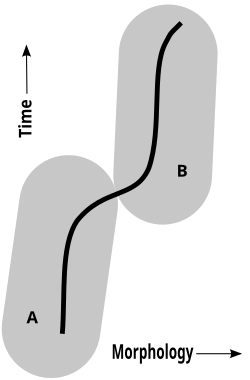
Key Facts
- Chronospecies are defined by a single lineage that changes over time without splitting into multiple contemporary species.
- Paleospecies are extinct species identified solely through fossil material.
- Paleosubspecies are extinct subspecies that evolved into modern forms, often identified via subfossil material from the Late Pleistocene.
- The concept is closely linked to phyletic gradualism, the model of evolution suggesting that species evolve slowly and steadily.
- Identification of these lineages relies heavily on comparative anatomy and stratigraphic data to establish age and relationship.
Defining Fossil Classifications
Paleospecies and Paleosubspecies
While a chronospecies describes the process of change, other terms describe the specimens themselves. A paleospecies is an extinct species identified only by fossil remains. Scientists identify these by looking for distinct similarities between early fossils and proposed descendants. A key requirement for this identification is that the variation found within the early fossil specimens must not exceed the range of variation observed in the later species.
Similarly, a paleosubspecies refers to an extinct subspecies that transitioned into a currently existing form. These are often identified using subfossil material—fossils that have not yet fully mineralized—typically from the Late Pleistocene. Many modern species underwent size changes during the last ice age to adapt to climatic shifts, a phenomenon often associated with Bergmann's Rule.
Identifying Chronospecies in the Record
To classify a specimen as part of a chronospecies, researchers look for strong indicators of a specific relationship with a known species. For example, if specimens from a few million years ago show consistent variations—such as being smaller than a living species but maintaining the exact same proportions—they may represent the final evolutionary step in a chronospecies lineage.
Stratigraphic information, which refers to the layering of rocks and soil, is essential here. By establishing the precise age of the specimens, palaeontologists can map the sequence of change and identify the immediate ancestor of a living taxon.
Evolutionary Models and Examples
The concept of the chronospecies is a cornerstone of the phyletic gradualism model. This model suggests that morphological changes accumulate slowly. Because of this, an extensive fossil record is necessary to find the intermediary forms that connect two organisms that may appear very different today.
Various biological groups provide evidence for these classifications:
- Panthera: Exhibits numerous chrono- and paleospecies, as well as paleosubspecies.
- Bison: Contains several paleospecies and paleosubspecies.
- Coragyps: Identified as a chronospecies.
- Gymnogyps and Marine Sloths: Identified as paleospecies.
- Valdiviathyris: An example of stability, showing no visible change since the Priabonian (approximately 35 million years ago).
| Term | Definition | Primary Evidence |
|---|---|---|
| Chronospecies | A single lineage evolving uniformly over time into a new form. | Sequential morphological changes in fossils. |
| Paleospecies | An extinct species known only from fossils. | Comparative anatomy and fossil similarities. |
| Paleosubspecies | An extinct subspecies that evolved into a modern species. | Subfossil material (e.g., Late Pleistocene). |
Frequently Asked Questions
What is the difference between a chronospecies and divergent evolution?
In divergent evolution, a common ancestor splits into two or more contemporary species that exist at the same time. In a chronospecies, there is only one species in the lineage at any given point in time; it simply evolves into a new form over time.
How do palaeontologists identify a paleospecies?
Identification relies on finding distinct similarities between early fossil specimens and a proposed descendant, ensuring that the variation in the early fossils does not exceed the variation seen in the later species.
What role does stratigraphic information play in identifying chronospecies?
Stratigraphic information allows scientists to determine the age of fossils based on their position in rock layers. This helps establish the chronological order of specimens, which is necessary to prove a sequential evolutionary lineage.
What is phyletic gradualism?
Phyletic gradualism is the evolutionary model suggesting that species evolve through the slow, steady accumulation of small morphological changes over long periods, rather than through sudden bursts of change.
Why are subfossils important for identifying paleosubspecies?
Subfossils, which are more recent than fully mineralized fossils, provide critical data about variations from the Late Pleistocene, helping scientists link extinct subspecies to their modern descendants.