Christmas: History, Traditions, and Global Observances
Christmas, also known as Noël, Nativity, or Xmas, is an international cultural and Christian holiday commemorating the birth of Jesus Christ. While primarily observed by Christians, it has evolved into a global phenomenon celebrated by Alawites and many others regardless of faith. The holiday is characterized by a blend of religious observance, family gatherings, and diverse cultural traditions that vary significantly across the globe.
From the lighting of symbolic candles to the exchange of gifts, Christmas serves as a time for social connection and reflection. Its observance spans different dates and calendars, reflecting the complex history of the church and the diverse ways humanity marks the winter season.
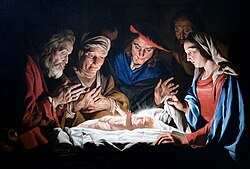
Key Facts
![Martin Luther played a role in the emergence of the Christmas tree and in the tradition of presents on Christmas Eve.[46][47]](/images/58/e6/58e6e1a7f0f06fe484f10d6ae5848b8fe068c7eb4025c4838e89459d72d0405f.jpg)
- Significance: Commemorates the nativity (birth) of Jesus Christ.
- Primary Dates: December 25 (Western Christianity) and January 7 (many Eastern Orthodox churches).
- Core Traditions: Gift-giving, church services, feasting, and symbolic decorations.
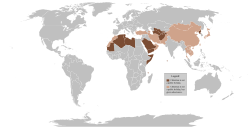
- Global Reach: Observed internationally, though some countries do not recognize it as a public holiday.
- Key Figures: Saint Nicholas (the inspiration for Santa Claus) and the Christkind.
The History and Evolution of Christmas
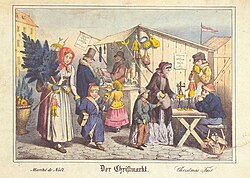
Early and Medieval Eras
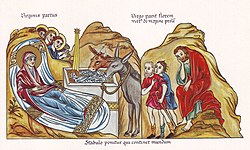
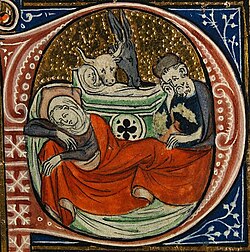
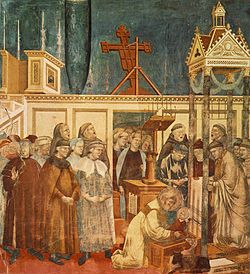
The early development of Christmas was marked by the establishment of a date to celebrate the birth of Christ. In the medieval period, the holiday became deeply embedded in liturgical life, with the use of missals—liturgical books containing the texts and music necessary for the celebration of Mass—to standardize the observance.
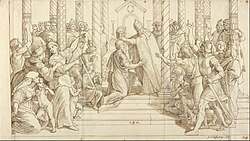
Significant historical events also bolstered the holiday's prestige. For instance, the coronation of Charlemagne on Christmas of 800 AD helped promote the popularity of the date across Europe.
From the 17th to the 21st Century
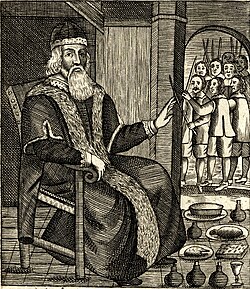
The holiday faced various challenges and transformations over the centuries. In England, Christmas was at one point suppressed by Puritans before being reinstated as a holy day. In the 19th century, the Victorian era redefined the holiday, with figures like Charles Dickens contributing to the modern conception of Christmas as a time of generosity and family warmth.
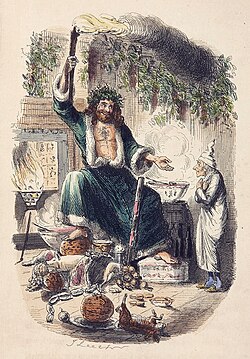
The 20th century saw the holiday navigate political upheavals. In the Soviet Union, the Marxist-Leninist doctrine of state atheism led to the banning of Christmastide, though many traditions were later adapted into New Year's celebrations. Conversely, the holiday continued to expand in the Americas and Asia, becoming a major economic driver through the retail shopping season.
![A 1931 edition of the Soviet magazine Bezbozhnik, published by the League of Militant Atheists, depicting an Orthodox Christian priest being forbidden to take home a tree for the celebration of Christmastide, which was banned under the Marxist–Leninist doctrine of state atheism[244]](/images/99/53/995341af00882dd63c05b13edb9670557fdfd2cc7d450f138a372d818d88967c.jpg)
Observances and Traditions
Religious and Symbolic Decorations
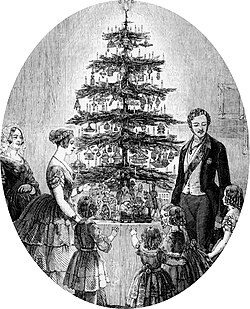
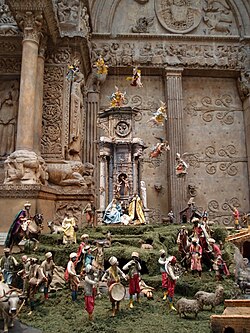
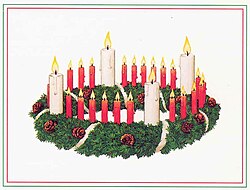
For many, the heart of the holiday is the Nativity scene, a depiction of the birth of Jesus. These range from simple displays to elaborate Neapolitan scenes. Other common decorations include the Christmas tree, a tradition influenced by Martin Luther, and the advent wreath, where a central "Christ Candle" is lit on Christmas Day.
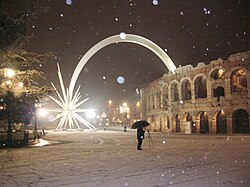
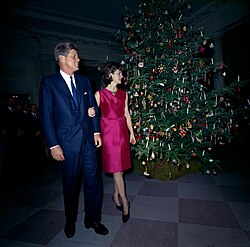
Lighting plays a crucial role in the festivities, from traditional candles to modern electric Christmas lights that adorn cities and homes worldwide.
Music, Gifts, and Figures
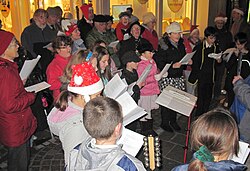
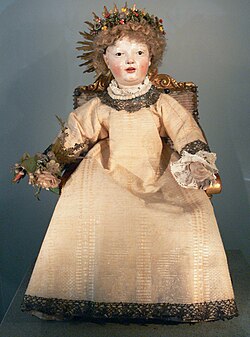
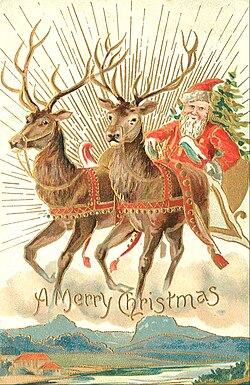
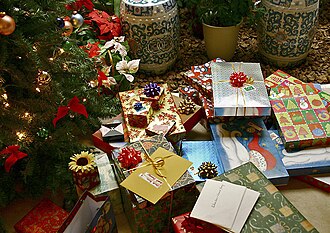
Christmas is synonymous with music, specifically carols performed by choirs and community groups. The tradition of gift-giving is often associated with figures such as Santa Claus, who is rooted in the history of Saint Nicholas (Sinterklaas in the Netherlands), and the Christkind in German-speaking regions.
![Saint Nicholas, known as Sinterklaas in the Netherlands, is considered by many to be the original Santa Claus.[195]](/images/bc/86/bc86de29a97f21bfb259ff2ec68f45f31d6b75351ce672f643ad32b560ac4332.jpg)
Cuisine and Social Gatherings
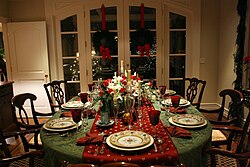
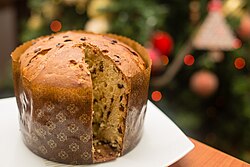
Feasting is a central element of the celebration. Traditional foods vary by region, such as the Italian Panettone, and often culminate in a large family dinner.
The Complexity of Christmas Dates
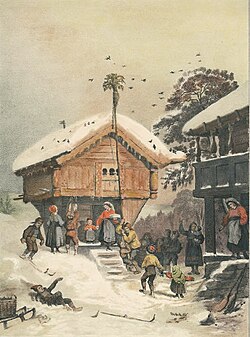
One of the most distinct aspects of Christmas is the variation in dates, which depends on the calendar used by different church denominations.
| Church or Section | Calendar | Calendar Date | Gregorian Date |
|---|---|---|---|
| Western Christianity | Gregorian | December 25 | December 25 |
| Eastern Orthodox (most) | Julian | December 25 | January 7 |
| Armenian Apostolic/Evangelical | Gregorian | January 6 | January 6 |
| Armenian Patriarchate of Jerusalem | Julian | January 6 | January 19 |
| Coptic/Ethiopian Orthodox | Coptic/Ethiopian | Dec 25 (approx) | January 7 |
Frequently Asked Questions
![Mount Ingino Christmas Tree in Gubbio, Italy, the tallest Christmas tree in the world, 2014[106]](/images/94/85/9485b50131c30bf6c434c267c3abb5c3455d791146cddb3f807b9a9cb2a90755.jpg)
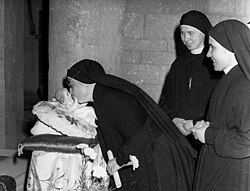
![Many Christians attend church services to celebrate the birth of Jesus Christ[115]](/images/74/6f/746f0802d2c1120f7d7f3f8a8e5c81e8d6511fcec9394559f6aac2375b63f038.jpg)

![A mosaic dated to around 300 AD in the Tomb of the Julii, an apparently Christian tomb in the Vatican Necropolis. Most scholars believe it depicts Jesus as the sun god Sol / Helios.[207][208]](/images/d4/fb/d4fb667ab28f84edc8428ce40e4508ce98fa4afac6f04520b7d0d32018997fa4.jpg)
Why is Christmas celebrated on different dates?
The variation is primarily due to the use of different calendars. While Western churches use the Gregorian calendar, many Eastern Orthodox churches still follow the Julian calendar, which currently differs by 13 days, pushing the celebration of December 25 to January 7.
Who is the original Santa Claus?
Many historians consider Saint Nicholas, known as Sinterklaas in the Netherlands, to be the original inspiration for the modern figure of Santa Claus.
What is the significance of the advent wreath?
The advent wreath is used to count the weeks leading up to Christmas. In many church services, the central Christ Candle is lit on Christmas Day to symbolize the birth of Jesus.
Is Christmas observed in non-Christian countries?
Yes, Christmas is often observed as a cultural or international holiday in many non-Christian countries, though some nations may not recognize it as an official public holiday or may have restrictions on its celebration.