Chotoy Spinetail
The Chotoy Spinetail (Schoeniophylax phryganophilus) is a striking member of the ovenbird family, Furnariidae. Known for its unique throat markings and preference for open landscapes, this bird is a resident of several South American countries. As a member of the Furnariinae subfamily, it represents a fascinating example of avian adaptation in the diverse ecosystems of the Southern Cone.
Key Facts
- Conservation Status: Least Concern (IUCN 3.1).
- Range: Argentina, Bolivia, Brazil, Paraguay, and Uruguay.
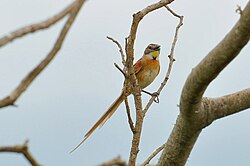
- Distinctive Feature: A bright yellow chin and upper throat with a crisp black square on the lower throat.
- Diet: Primarily arthropods.
- Habitat: Open to semi-open landscapes, including treed savannas and scrub along watercourses.
Taxonomy and Systematics
The taxonomic history of the Chotoy Spinetail has evolved significantly. Originally described under the genus Sylvia and later placed within Synallaxis, it was recognized in its own distinct genus, Schoeniophylax, by the early 2010s. Research indicates that it is a sister species to the white-bellied spinetail (Mazaria propinqua).
There are two recognized subspecies: the nominate S. p. phryganophilus and the smaller S. p. petersi.
Physical Description
The Chotoy Spinetail is a relatively large spinetail, measuring between 20 and 22 cm (7.9 to 8.7 in) in length and weighing between 15 and 22.5 g (0.53 to 0.79 oz). Both males and females share the same plumage.
Adults of the nominate subspecies are characterized by a dark brown forehead, a chestnut crown with faint streaks, and a sandy brown back with prominent dark brown streaks. Their wings are light brown with a chestnut shoulder, and they possess a long, light brown tail with blackish shafts. The most striking feature is the throat: a bright yellow chin and upper throat, contrasted by a crisp black square on the lower throat surrounded by white. The breast transitions from apricot to buffy white, while the belly is whitish.
Juveniles differ from adults by having less sharp streaking on their uppersides, a brown crown, a whitish chin, and a less distinct black throat patch. The subspecies S. p. petersi maintains similar plumage but is smaller in size.
Distribution and Habitat
The species is distributed across several South American nations. The nominate subspecies is widespread, found in eastern Bolivia, the Brazilian states of Mato Grosso do Sul and Rio Grande do Sul, most of Paraguay, northeastern Argentina (extending south to northern Buenos Aires Province), and nearly all of Uruguay. In contrast, S. p. petersi is found in disjunct populations in northeastern Brazil, specifically in the states of Bahia, Minas Gerais, and Piauí.
These birds prefer open to semi-open environments. Their preferred habitats include treed savannas, monte woodlands (dry forests), thickets, and scrub along watercourses, as well as the edges of marshes. They are typically found at elevations ranging from sea level up to 500 m (1,600 ft).
Behavior and Ecology
Movement and Feeding
The Chotoy Spinetail is a year-round resident throughout its range. It feeds on arthropods, typically foraging alone or in pairs. It gleans its prey from foliage and small branches, usually staying within 1 meter (3 ft) of the ground.
Breeding and Nesting
Breeding occurs during the austral spring and summer, from late September to January. Believed to be monogamous, the pair constructs a large nest made of thorny sticks. This nest features a side entrance tube, and both the tube and the inner chamber are lined with soft plant material. Nests are usually placed in bushes or small trees up to 3.5 m (11 ft) high, though some are found higher.
A typical clutch consists of four to five eggs (ranging from three to six). The incubation period lasts 15 to 16 days, and the young fledge approximately 13 to 14 days after hatching.
Vocalization
The song of the Chotoy Spinetail is a series of low-pitched "cho" notes that give the impression of a larger bird. Its call is described as a hurried "sreepsreeptrrit".
Conservation Status
The IUCN classifies the Chotoy Spinetail as Least Concern. The species has a large distribution range and a stable population. Because it is fairly adaptable and can thrive in secondary habitats and scrub, there are currently no immediate threats to its survival.
| Feature | Details |
|---|---|
| Scientific Name | Schoeniophylax phryganophilus |
| Size | 20–22 cm length; 15–22.5 g weight |
| Primary Diet | Arthropods |
| Nesting Material | Thorny sticks with soft plant lining |
| IUCN Status | Least Concern |
Frequently Asked Questions
What makes the Chotoy Spinetail easy to identify?
The most identifying feature is its unique throat pattern, which consists of a bright yellow chin and upper throat with a distinct black square on the lower throat surrounded by white.
Where can the Chotoy Spinetail be found?
It is found in Argentina, Bolivia, Brazil, Paraguay, and Uruguay, primarily in open landscapes like savannas, scrublands, and the edges of marshes.
What do Chotoy Spinetails eat?
They feed on arthropods, which they glean from small branches and foliage close to the ground.
How do the two subspecies differ?
While they share similar plumage, the subspecies S. p. petersi is smaller than the nominate S. p. phryganophilus and is found in disjunct populations in northeastern Brazil.
What is the nesting habit of the Chotoy Spinetail?
They build large, ball-shaped nests made of thorny sticks with a side entrance tube, typically placed in bushes or small trees.