Chaoxianzu: The History and Identity of Korean Chinese
The Chaoxianzu, also known as Joseonjok, represent a unique cultural bridge between China and the Korean Peninsula. As one of the 56 officially recognized ethnic groups in the People's Republic of China, they possess a distinct dual identity: they are Chinese citizens who maintain a deep-rooted Korean cultural heritage.
While the term "Chaoxianzu" is the official designation used within China, the community is a vital part of the global Korean diaspora. Today, they are recognized as the 15th-largest ethnic minority in China, with a population that reflects a complex history of migration, resilience, and transnational movement.
Key Facts
- Official Name: Chaoxianzu (朝鲜族) or Joseonjok (조선족).
- Population: Estimated between 1,702,479 and 1,893,763 (2023 data).
- Primary Regions: Yanbian Korean Autonomous Prefecture and Changbai Korean Autonomous County in Jilin Province.
- Languages: Korean and Mandarin Chinese.
- Major Religions: Mahayana Buddhism and Christianity.
- Global Presence: A significant portion of the population resides in South Korea.
Historical Origins and Migration
The presence of Korean descendants in China is primarily the result of migration waves occurring between the late 19th and mid-20th centuries. Significant periods of movement included the famine in North Hamgyong (1869–1870), the Japanese annexation of Korea in 1910, and the Japanese invasion of Manchuria in 1931.
During these turbulent years, many Koreans settled in Manchuria. Some were refugees fleeing Japanese rule, while others were native descendants of earlier immigrants. This community played a significant role in resistance movements, including joining the Northeast Counter-Japanese United Army to fight against the Japanese Kwantung Army and the puppet state of Manchukuo. Notably, a young Kim Il Sung was among those involved in this guerrilla warfare.
Following the end of the Second World War, many of these migrants chose to remain in the region, eventually acquiring Chinese citizenship and establishing permanent settlements in Northeast China.
Terminology and Official Recognition
The classification of the Korean ethnic group in China has evolved over time. As early as 1928, the Chinese Communist Party began including Koreans in official documents, though they used various terms such as Gaoliren (Goryeo people), Hanren (Han people), and Chaoxianren (Joseon people). While these terms are sometimes used today to refer to Koreans of any nationality, they are distinct from the official ethnic designation.
Following the first national census in 1954, Chaoxianzu became the standardized official name for the Korean ethnicity within China.
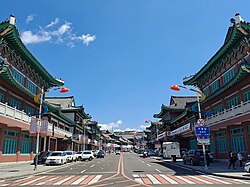
![The Xita neighborhood in Shenyang, often cited as the world's 2nd largest Koreatown after Los Angeles.[9][10]](/images/0d/4c/0d4c0c3d2273b1d209e05a4bb11958e6941d110327117c49ab7f272066cf946c.jpg)
Demographics and Modern Migration Trends
The population of the Chaoxianzu has seen various shifts over the decades. In 1964, the population was reported at over 1.3 million. By 1982, it had grown to 1.7 million, though its overall percentage of the total Chinese population slightly decreased due to rapid national population growth. Recent data shows a trend of dispersion; for instance, the population in Jilin Province has fallen below 1 million as individuals move to other parts of China or abroad.
A defining characteristic of the modern Chaoxianzu community is high levels of emigration to South Korea, driven by economic and financial opportunities. It is estimated that approximately 42% (roughly 708,000 people) of the Korean Chinese population now resides in South Korea while maintaining their Chinese nationality. In South Korea, they are referred to as Jaehan Joseonjok.
Population Summary Table
| Data Source / Year | Estimated Population | Context/Notes |
|---|---|---|
| 1964 Census | Over 1.3 million | 0.19% of China's population |
| 1982 Census | 1.7 million | Ranked 11th largest minority |
| 2010 Census | ~1.83 million | Official Chinese government report |
| 2021 Census | 1,702,479 | Official Chinese government data |
| 2023 (South Korea Agency) | ~1,893,763 | Includes Korean Chinese with Chinese citizenship |
Frequently Asked Questions
What is the difference between Chaoxianzu and South Koreans?
Chaoxianzu refers specifically to ethnic Koreans who hold Chinese citizenship. While they share cultural and ancestral roots with South Koreans, they are distinct in terms of nationality and the specific historical context of their settlement in China.
Where do most Korean Chinese live in China?
The majority reside in the Yanbian Korean Autonomous Prefecture, which is significant as China's first ethnic minority autonomous prefecture. Many also live in the Changbai Korean Autonomous County.
Why is the Chaoxianzu population moving to South Korea?
High levels of emigration to South Korea are primarily driven by the pursuit of better economic and financial opportunities.
What languages do the Chaoxianzu speak?
The community is typically bilingual, speaking both Korean and Mandarin Chinese.
How is the Chaoxianzu identity viewed in South Korea?
In South Korea, they are often referred to as "compatriots with Chinese nationality" (중국국적동포), acknowledging their shared ethnic heritage alongside their Chinese citizenship.