Central News Agency: A History of Taiwan's Official News Service
The Central News Agency (CNA) serves as the official news agency of Taiwan, acting as a primary source of information and a mirror of the region's complex political evolution. From its origins as a party-run propaganda tool in mainland China to its current status as a state-run non-profit organization, the agency has navigated decades of ideological shifts and democratic transitions.
Founding and Early Years in China
The roots of the agency trace back to March 28, 1924, when the Kuomintang (KMT) Central Executive Committee decided to create a news agency under its propaganda department. Founded on April 1 in Guangzhou, the organization initially operated as the Kuomintang Central Executive Committee Propaganda Department Agency. By July 1, 1925, it became the primary vehicle for distributing official party documents and information, increasing its output from one dispatch per day to several.
During the late 1920s, under the leadership of Yin Shuxian, the agency functioned as a monitoring and censorship arm for the party. However, a significant reorganization occurred in 1932 when Chiang Kai-shek appointed Hsiao Tung-tzu as director. Hsiao professionalized the operation by separating it from the Central Executive Committee, renaming it the "Central News Agency," and establishing a professional radio news station.
By 1937, CNA had expanded significantly, boasting 10 bureaus, 21 correspondents, and 159 subscribing Chinese-language newspapers. During the Second Sino-Japanese War, its influence was so pervasive that even the Chinese Communist Party-owned Xinhua Daily relied on CNA for nearly 89% of its content. This dominance, backed by KMT financial support, led to the closure of private competitors like the Kuowen News Agency.
Transition to Taiwan
Following Japan's surrender in 1945, CNA expanded into Taiwan. Correspondent Yeh Ming-hsun flew to Taipei to take over the operations of Dōmei Tsushin, the state news agency of the Empire of Japan. As the Chinese Civil War concluded and the government of the Republic of China retreated to Taiwan, the CNA headquarters were officially relocated to Taipei in 1949.
On October 2, 1950, Tseng Hsu-pai became the first director of CNA in Taiwan. For several decades, the agency remained tightly linked to the KMT. Even after its corporatization in 1973, it continued to receive heavy government subsidies and provided its journalists with preferential access to government press conferences.
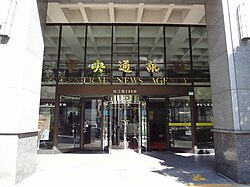
Democratic Reform and Modernization
The 1990s brought a wave of democratic reform to Taiwan, leading to increased scrutiny of CNA. Opposition parties, including the Democratic Progressive Party (DPP) and the New Party, criticized the agency's reliance on state funding—which accounted for 80% of its budget—and its close ties to the KMT. While a 1993 bill to reform CNA into a national news agency failed, internal changes were initiated under Director Tang Pan-pan (appointed in December 1992).
Tang sought to modernize the newsroom by recruiting 65 new journalists and diversifying content beyond text-based wires to include audiovisual and television news. His efforts led to a productivity peak in November 1993, with a record 531 wires published in a single day. Despite these gains, Tang was eventually replaced by Comet Shih due to criticisms regarding overspending and the agency's continued control by the KMT Cultural Work Committee.
Evolution into a Non-Profit Corporation
A pivotal shift occurred on July 1, 1996, when the Legislative Yuan passed a bill transforming CNA into a state-run non-profit organization. While no longer operated directly by the KMT, the agency remained subject to the political leanings of the ruling administration.
- DPP Administration (Chen Shui-bian): Leadership appointments shifted toward those of Taiwanese origin, leading to editorial changes that emphasized a Taiwanese identity (e.g., using "Taiwan-U.S. relations" instead of "Chinese-U.S. relations").
- KMT Administration (Ma Ying-jeou): The agency reverted to using "China" when referring to Taiwan.
Despite these shifts, the agency faced digital challenges between 2005 and 2010, where its web traffic lagged behind other local and mainland Chinese outlets. As of 2022, CNA remains Taiwan's official news agency, receiving funding from the Executive Yuan. Most recently, news anchor Hu Wan-ling was appointed president on October 30, 2023.
Key Facts
- Founded: April 1, 1924, in Guangzhou.
- Official Status: Taiwan's official news agency.
- Major Transition: Became a state-run non-profit organization on July 1, 1996.
- Wartime Influence: Provided 89% of the content for the Xinhua Daily during the Second Sino-Japanese War.
- Current Leadership: Hu Wan-ling (President as of October 30, 2023).
| Year | Event | Significance |
|---|---|---|
| 1924 | Founding in Guangzhou | Established as a KMT propaganda arm. |
| 1932 | Reorganization by Hsiao Tung-tzu | Renamed Central News Agency; professionalized operations. |
| 1949 | Relocation to Taipei | Headquarters moved following the retreat to Taiwan. |
| 1973 | Corporatization | Shifted structure while maintaining government subsidies. |
| 1996 | Non-profit Status | Transitioned to a state-run non-profit organization. |
Frequently Asked Questions
When was the Central News Agency founded?
The agency was founded on April 1, 1924, in Guangzhou, originally serving as the propaganda arm of the Kuomintang Central Executive Committee.
How did CNA transition to Taiwan?
In 1945, CNA took over the bureaus of the Japanese state news agency, Dōmei Tsushin. The headquarters were later moved to Taipei in 1949 during the government's retreat from mainland China.
What happened to CNA during the democratic reforms of the 1990s?
The agency faced criticism for its heavy state funding and KMT ties. This led to internal modernization efforts under Director Tang Pan-pan and eventually its transition to a state-run non-profit in 1996.
How has political leadership affected CNA's terminology?
Under the DPP administration of Chen Shui-bian, the agency used terms like "Taiwan-U.S. relations" to emphasize Taiwanese identity. Under the KMT administration of Ma Ying-jeou, it reverted to using "China" to refer to Taiwan.
Who is the current president of CNA?
News anchor Hu Wan-ling was appointed as the president of the Central News Agency on October 30, 2023.