Central African Federation: The Rise and Fall of a Colonial Union
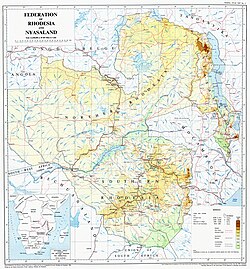
The Central African Federation (CAF) was a complex political experiment that attempted to unite three distinct British territories into a single semi-independent state. Spanning from 1953 to 1963, this union sought to balance economic interests and political stability in a region marked by deep racial divisions and diverging colonial traditions.
The Path to Federation
The seeds of the federation were sown decades before its official inception. In 1929, the Hilton Young Commission noted that the economic and political interests of Nyasaland and Northern Rhodesia were more closely aligned with each other and the self-governing colony of Southern Rhodesia than with Eastern African territories. By 1938, the Bledisloe Commission further suggested that these territories were becoming interdependent, though it stopped short of recommending a full federation, suggesting instead an inter-territorial council.
Due to the disruptions of the Second World War, this coordination body was not established until 1945 as the Central African Council. Presided over by the Governor of Southern Rhodesia, the Council served as a consultative body to promote policy coordination, though it lacked binding authority.
Negotiations and the Role of Sir Andrew Cohen
By November 1950, the British government, via Secretary of State for the Colonies Jim Griffiths, initiated a formal examination of a closer union. The resulting negotiations were arduous, primarily because Southern Rhodesia and the Northern Territories held vastly different approaches to the "Native Question"—the role of black Africans in civil society.
A pivotal figure in breaking these deadlocks was Sir Andrew Cohen, the Assistant Undersecretary for African Affairs. An anti-racialist driven by the horrors of the Holocaust, Cohen compromised his ideals to prevent the region from sliding into a rigid system of white supremacy similar to the National Party's Apartheid in South Africa. Historian Lord Blake famously noted that "Apartheid can be regarded as the father of Federation."
The Federation was formally established via the Rhodesia and Nyasaland Federation Act 1953. While a referendum in Southern Rhodesia saw roughly 25,000 white settlers vote in favor against 15,000 opposed, the union was resolutely rejected by the majority of black Africans and Afrikaners across all three territories.
Constitutional Structure and Governance
The Federation operated under a complex system with five branches of government: one Federal, three Territorial, and one British. This structure often led to jurisdictional rivalry and confusion, earning it a reputation as one of the most elaborately governed countries in the world.
Federal Powers and the Judiciary
The federal government held enumerated powers divided into a "Federal Legislative List" and a "Concurrent Legislative List." Federal law took precedence over territorial law in all shared jurisdictions. The executive branch consisted of a Governor-General (representing the Queen), an Executive Council, and a Cabinet.
The judiciary was anchored by the Supreme Court, inaugurated on July 1, 1955. Its jurisdiction was primarily appellate, though it held original jurisdiction over disputes between federal and territorial governments, election petitions, and specific writs against federal officers.
Racial Policy and the "Partnership"
In 1958, the Prime Minister established the Office of Race Affairs to review policies that hindered the government's official "partnership" policy. However, in practice, Southern Rhodesia remained the dominant force economically, militarily, and electorally.
Demographics and Power Dynamics
The Federation's stability was undermined by a stark demographic imbalance. Southern Rhodesia experienced a massive surge in its European settler population—growing from 60,000 in 1939 to 223,000 by the time of dissolution. In contrast, Nyasaland had the smallest European population and the highest African population growth.
This imbalance shaped the leadership. Sir Godfrey Huggins, who had been Prime Minister of Southern Rhodesia for 23 years, served as the first Federal Prime Minister (1953–1956), followed by Sir Roy Welensky (1956–1963). While Huggins originally favored a unitary state (amalgamation), Britain insisted on a federation to prevent Southern Rhodesia from completely dominating the franchise, which excluded most Africans.
The economic driver for the union was primarily the abundant copper deposits in Northern Rhodesia. Nyasaland, lacking significant minerals, was included more as a symbolic gesture, though it eventually became the epicenter of the nationalist movements that destabilized the Federation.
Administrative Rivalries
The Federation was also a battleground for two British ministries: the Colonial Office (CO), which managed the northern territories and was more sympathetic to African rights, and the Commonwealth Relations Office (CRO), which looked after Southern Rhodesia and favored settler interests. This ideological rift persisted until the creation of the short-lived Central Africa Office in 1962, before responsibility returned to the CO and CRO.
Key Facts
- Established: August 1, 1953, via the Rhodesia and Nyasaland Federation Act.
- Constituent Territories: Southern Rhodesia, Northern Rhodesia, and Nyasaland.
- Primary Economic Motive: Access to Northern Rhodesia's copper deposits.
- Key Leaders: Sir Godfrey Huggins and Sir Roy Welensky.
- Dissolution: December 1963.
- Demographic Shift: Southern Rhodesia's white population grew from 60,000 (1939) to 223,000 (by dissolution).
| Year | Southern Rhodesia (White/Black) | Northern Rhodesia (White/Black) | Nyasaland (White/Black) | Total (White/Black) |
|---|---|---|---|---|
| 1927 | 38,200 / 922,000 | 4,000 / 1,000,000 | 1,700 / 1,350,000 | 43,900 / 3,272,000 |
| 1946 | 80,500 / 1,600,000 | 21,919 / 1,634,980 | 2,300 / 2,340,000 | 104,719 / 5,574,980 |
| 1955 | 125,000 / 2,400,000 | 65,000 / 2,085,000 | 6,300 / 2,550,000 | 196,300 / 7,035,000 |
| 1960 | 223,000 / 2,830,000 | 76,000 / 2,340,000 | 9,300 / 2,810,000 | 308,300 / 7,980,000 |
Frequently Asked Questions
Why was the Central African Federation created?
The Federation was created to coordinate economic and political interests among the three territories, with a strong economic incentive to integrate the copper wealth of Northern Rhodesia with the administrative and settler base of Southern Rhodesia.
Who was Sir Andrew Cohen and why was he important?
Sir Andrew Cohen was the Assistant Undersecretary for African Affairs and a primary architect of the Federation. He pushed for the union as a compromise to prevent the region from adopting a rigid white supremacy system similar to South African Apartheid.
What was the main difference between 'amalgamation' and 'federation' in this context?
Amalgamation, favored by Sir Godfrey Huggins, would have created a single unitary state. Federation, insisted upon by Britain, created a semi-independent union with divided powers to prevent Southern Rhodesia from completely dominating the other territories.
Which territory was the most influential in the Federation?
Southern Rhodesia was the dominant territory economically, militarily, and electorally, largely due to its significantly larger European settler population.
What led to the eventual dissolution of the Federation?
The dissolution was driven by African nationalist aspirations and political opposition, particularly originating in Nyasaland, as well as the inherent instability caused by the demographic imbalance between the European settlers and the African majority.