Caspar René Gregory: Pioneer of New Testament Textual Criticism
Caspar René Gregory was a distinguished scholar whose work fundamentally reshaped how historians and theologians categorize the ancient texts of the New Testament. Born in Philadelphia to Henry Duval Gregory and Mary Jones, Gregory's intellectual journey took him from the United States to Germany, where he became a central figure in the field of textual criticism—the scientific process of comparing manuscript variations to determine the original wording of a text.
Academic Foundations and the Influence of Tischendorf
Gregory's academic path began at the University of Pennsylvania, where he earned his bachelor's degree in 1864. He subsequently pursued theological studies at the Reformed Presbyterian Theological Seminary in Philadelphia (1865–1867) and the Princeton Theological Seminary (1867–1873). Driven by the guidance of his teacher, Ezra Abbot, Gregory traveled to Leipzig University to study under the renowned scholar Constantin von Tischendorf.
The relationship between Gregory and Tischendorf was pivotal. Following Tischendorf's death in 1874, Gregory was entrusted with administering Tischendorf's scientific legacy, ensuring that his groundbreaking work on New Testament manuscripts continued.
Professional Ascent and Academic Achievements
Gregory's commitment to scholarship led him to earn a PhD in 1876 with a dissertation titled Grégoire the priest and the revolutionist, examined by historian Georg Voigt. He remained in Leipzig for post-doctoral work until 1884, eventually rising to the rank of associate professor in 1889 and full honorary professor in 1891.
His academic credentials were extensive. While some biographical accounts suggest he held as many as five doctorates, records confirm a doctorate in theology from Leipzig (1889) and an honorary doctorate of Divinity from the University of Glasgow in 1901. His international standing was further solidified in 1891 when he was elected an International Member of the American Philosophical Society.
Contributions to Biblical Scholarship
Gregory is most remembered for his systematic approach to biblical manuscripts. In 1908, he published Die griechischen Handschriften des Neuen Testaments, which introduced a classification system for Greek New Testament manuscripts that remains the global scholarly standard today.
Beyond classification, Gregory identified a specific medieval practice known as Gregory's Law (or Gregory's Rule). This rule describes the method of collating parchment leaves so that the grain side (the rougher side of the skin) always faces the grain side, and the flesh side (the smoother side) always faces the flesh side.
| Category | Details |
|---|---|
| Primary Field | New Testament Textual Criticism |
| Major Publication | Die griechischen Handschriften des Neuen Testaments (1908) |
| Key Discovery | Gregory's Law (Parchment collation) |
| Academic Affiliation | Leipzig University |
| Notable Mentor | Constantin von Tischendorf |
Later Life and Military Service
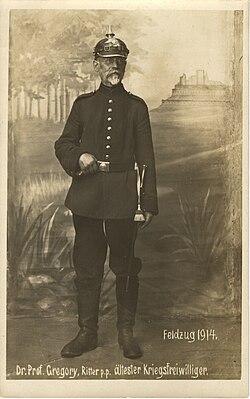
Having become a citizen of Saxony in 1881, Gregory's later years were marked by a surprising turn toward military service. On August 11, 1914, he enlisted in the German Army, becoming the oldest wartime volunteer of the conflict. He achieved the rank of second lieutenant in November 1916.
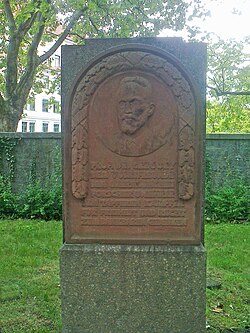
His life came to an end on April 9, 1917, when he passed away in a field hospital located in Neufchâtel-sur-Aisne, France.
Key Facts
- Standardized Classification: Created the manuscript numbering system still used by scholars today.
- Gregory's Law: Identified the medieval practice of pairing grain-to-grain and flesh-to-flesh parchment sides.
- Academic Pedigree: Studied under Constantin von Tischendorf and held multiple doctorates.
- Military Service: Served as the oldest wartime volunteer in the German Army during WWI.
- Global Recognition: Member of the American Philosophical Society and recipient of an honorary degree from the University of Glasgow.
Frequently Asked Questions
What is Gregory's Law?
Gregory's Law refers to the consistent medieval practice of arranging parchment leaves in a manuscript so that the grain side faces the grain side and the flesh side faces the flesh side.
What was Gregory's most significant contribution to biblical studies?
His most significant contribution was the organization of biblical manuscripts into a classification system published in 1908, which continues to be used by scholars worldwide.
Who was Constantin von Tischendorf?
Tischendorf was a renowned scholar of textual criticism and Gregory's mentor at Leipzig University; Gregory eventually administered Tischendorf's scientific legacy.
Where did Caspar René Gregory die?
Gregory died on April 9, 1917, in a field hospital in Neufchâtel-sur-Aisne, France, while serving as a second lieutenant in the German Army.
Which universities did Gregory attend?
Gregory attended the University of Pennsylvania, the Reformed Presbyterian Theological Seminary, Princeton Theological Seminary, and Leipzig University.